Among these garage floor jacks, I’d put the Antlevix 3-Ton Low-Profile Hydraulic Floor Jack first for its blend of low-profile access, useful capacity, and dual-piston pumping. The Jack Boss 4-Ton stands out for buyers who want extra capacity, while the Jack Boss 3-Ton aluminum-and-steel model is the lighter-duty handling choice. The key tradeoffs are capacity versus jack weight, low entry height versus maximum lift, and added convenience versus a simpler steel build. A higher ton rating does not replace checking your vehicle’s lift points or the jack’s usable height range. Read on for the full breakdown and advice on choosing a jack that fits your garage and vehicles.

Get business pricing on garage and car supplies
- Business-only prices and quantity discounts
- Tax-exempt purchasing
- Multiple users, one account, clear invoices
Complete the kit


Key Takeaways
- The Antlevix combines a 3-ton rating, low-profile design, and dual-piston pump, giving it the strongest all-around balance in this lineup.
- The Jack Boss 4-ton and Maxority 5-ton offer more rated capacity, but their higher ratings matter most when the vehicle and lifting setup call for that extra margin.
- Low-profile models address access under cars with limited clearance; buyers should still compare the stated minimum height with their vehicle’s actual lift points.
- The Jack Boss aluminum-and-steel model stands apart for buyers who value easier handling, while all-steel options favor a more traditional, heavier construction.
- The 2-ton options from DNA MOTORING and TONDA suit narrower capacity needs, but their lower ratings make them less flexible for buyers servicing a range of vehicles.
| Antlevix 3-Ton Low-Profile Hydraulic Floor Jack with Dual-Piston Pump |  | Best Overall for Low-Clearance Cars | Capacity: 6,600 lbs (3 tons) | Minimum height: 2.9 inches | Maximum lifting height: 19.8 inches | VIEW LATEST PRICE | See Our Full Breakdown |
| AUTOWN 3-Ton Hydraulic Floor Jack with Cross-Shape Rubber Pad |  | Best for Taller Vehicles and Easy Storage | Capacity: 6,600 lbs (3 tons) | Minimum height: 7.1 inches | Maximum lifting height: 20.9 inches | VIEW LATEST PRICE | See Our Full Breakdown |
| DNA MOTORING 2-Ton Low-Profile Hydraulic Floor Jack, 4,000 lb Capacity |  | Best for Compact Car Maintenance | Capacity: 4,000 lbs (2 tons) | Minimum lifting height: 5.1 inches | Maximum lifting height: 13 inches | VIEW LATEST PRICE | See Our Full Breakdown |
| SATA 3-Ton Heavy-Duty Steel Floor Jack with Dual-Piston Pump |  | Best for Frequent Heavy-Duty Garage Use | Capacity: 6,600 lbs (3 tons) | Overload test capacity: 9,900 lbs (4.5 tons) | Listed lifting range: 3-3/4 to 19-1/8 inches | VIEW LATEST PRICE | See Our Full Breakdown |
| TONDA 2-Ton Hydraulic Floor Jack, 4.9–11.8-Inch Lift, Blue |  | Best Lightweight Pick for Compact Garages | Capacity: 3,800 lbs (listed as 2 tons) | Minimum height: 4.9 inches | Maximum lifting height: 11.8 inches | VIEW LATEST PRICE | See Our Full Breakdown |
| Jack Boss 4-Ton Low-Profile Hydraulic Floor Jack with Dual-Piston Quick-Lift Pump |  | Best for Higher-Capacity Low-Profile Lifting | Capacity: 4 tons (8,800 lbs) | Lifting range: 3.8–20 inches | Pump: Dual-piston quick-lift | VIEW LATEST PRICE | See Our Full Breakdown |
| LARBANKE 3-Ton Hydraulic Floor Jack, Red |  | Best for Maneuverability and a Broad Saddle | Load capacity: 3 tons (6,600 lbs) | Lifting range: 5.31–18.11 inches | Saddle diameter: 4.65 inches | VIEW LATEST PRICE | See Our Full Breakdown |
| Maxority 3-Ton Low-Profile Hydraulic Steel Floor Jack |  | Best for Lowered and Modified Cars | Load capacity: 3 tons (6,600 lbs) | Maximum lifting height: 19.9 inches | Material: High-strength steel | VIEW LATEST PRICE | See Our Full Breakdown |
| VEVOR 2.5-Ton Low-Profile Steel Floor Jack |  | Best Compact Garage Pick | Load capacity: 2.5 tons (5,500 lbs) | Lifting range: 3.35–14.96 inches | Material: Steel | VIEW LATEST PRICE | See Our Full Breakdown |
| Bonnlo 3-Ton Low-Profile Hydraulic Floor Jack |  | Best for Low Clearance and High Lift | Load capacity: 3 tons (6,600 lbs) | Lifting range: 2.95–20.1 inches | Material: Alloy steel | VIEW LATEST PRICE | See Our Full Breakdown |
| Maxority 5-Ton Low-Profile Hydraulic Floor Jack with Dual-Piston Quick-Lift Pump |  | Best for Heavy Vehicles | Load capacity: 11,000 pounds (5 tons) | Maximum lifting height: 22 inches | Weight: 100 pounds | VIEW LATEST PRICE | See Our Full Breakdown |
| AV Steel 3-Ton Steel Hydraulic Floor Jack, 6,000 lb Capacity |  | Best for Standard Vehicles | Load capacity: 6,000 pounds (3 tons) | Lifting range: 5.5 to 18.5 inches | Weight: 63.9 pounds | VIEW LATEST PRICE | See Our Full Breakdown |
| Jack Boss 3-Ton Low-Profile Aluminum and Steel Floor Jack |  | Best for Low-Clearance Cars | Load capacity: 3 tons (6,600 pounds) | Tested capacity: 4.5 tons (9,900 pounds) | Lifting range: 3-15/16 to 18-5/16 inches | VIEW LATEST PRICE | See Our Full Breakdown |
| garage floor jack | Material | Weight | Warranty | Pump |
|---|---|---|---|---|
| Antlevix 3-Ton Low-Profile Hyd | Alloy steel | 62 lbs | 90-day limited | Dual-piston |
| AUTOWN 3-Ton Hydraulic Floor J | — | — | — | — |
| DNA MOTORING 2-Ton Low-Profile | Steel | — | — | — |
| SATA 3-Ton Heavy-Duty Steel Fl | Steel | 70 lbs | — | Dual-piston |
| TONDA 2-Ton Hydraulic Floor Ja | Alloy steel | 14.3 lbs | 1 year | — |
| Jack Boss 4-Ton Low-Profile Hy | Iron | 45.36 kg | 1 year | Dual-piston quick-lift |
| LARBANKE 3-Ton Hydraulic Floor | Carbon steel | 20.5 kg | — | — |
| Maxority 3-Ton Low-Profile Hyd | High-strength steel | — | 90 days | — |
| VEVOR 2.5-Ton Low-Profile Stee | Steel | 13.6 kg | — | — |
| Bonnlo 3-Ton Low-Profile Hydra | Alloy steel | 70.5 lbs | 1 year | Dual-pump design |
| Maxority 5-Ton Low-Profile Hyd | Steel | 100 pounds | 90 days | Dual-piston quick-lift |
| AV Steel 3-Ton Steel Hydraulic | Alloy steel | 63.9 pounds | 12 months | Single-piston hydraulic |
| Jack Boss 3-Ton Low-Profile Al | — | 58.5 pounds | Limited 1-year manufacturer warranty | Dual-piston |
More Details on Our Top Picks
Antlevix 3-Ton Low-Profile Hydraulic Floor Jack with Dual-Piston Pump
The Antlevix combines a 2.9-inch minimum height with a 6,600-pound capacity, making it a versatile garage choice for low cars as well as many SUVs and light trucks. Its dual-piston pump is designed to lift with fewer strokes, while the wide base and steel frame suit regular home maintenance. Compared with the AUTOWN, which starts at 7.1 inches, this jack can reach under substantially lower vehicles; compared with the SATA, it is lighter and has a slightly higher stated maximum lift. The tradeoff is still considerable heft at 62 pounds, and its 19.8-inch maximum lift is not as high as AUTOWN’s 20.9 inches. I’d also factor in its 90-day limited warranty when weighing it against a long-term shop purchase.
Pros:- 2.9-inch minimum height suits many low-clearance vehicles
- 6,600-pound capacity covers cars, many SUVs, and light trucks
- Dual-piston pump is designed to reduce pumping strokes
- Wide base and alloy-steel construction support a stable setup
Cons:- At 62 pounds, it can be cumbersome to reposition or store
- 19.8-inch maximum lift is lower than the AUTOWN’s stated 20.9 inches
- 90-day limited warranty is short for a heavy garage tool
Best for: Home mechanics who work on low-clearance cars and want one 3-ton jack for occasional SUV or light-truck jobs.
Not ideal for: Buyers who need a jack that is easy to carry frequently or want a longer warranty and maximum lift above 19.8 inches.
- Capacity:6,600 lbs (3 tons)
- Minimum height:2.9 inches
- Maximum lifting height:19.8 inches
- Pump:Dual-piston
- Material:Alloy steel
- Weight:62 lbs
- Dimensions:26.77 x 13.39 x 6.69 inches
- Warranty:90-day limited
Our verdict“Choose the Antlevix if low entry height and broad vehicle coverage matter more than easy portability or an extended warranty.”
AUTOWN 3-Ton Hydraulic Floor Jack with Cross-Shape Rubber Pad
The AUTOWN’s strongest case is its 7.1-to-20.9-inch lifting range: it reaches higher than the Antlevix and SATA, which can help when servicing taller SUVs, trucks, crossovers, or vans. Its cross-shaped rubber pad is designed to grip both round and flat lifting points, while rolling casters and a detachable handle make positioning and flat storage more practical. That convenience comes with a major fit limitation: a 7.1-inch minimum height can rule it out for many sedans and lowered cars. The Antlevix, with a 2.9-inch entry height, is the better match for those vehicles. I’d choose the AUTOWN for a garage centered on taller vehicles, not as a universal jack for a mixed fleet. Check the vehicle’s lift-point clearance before buying.
Pros:- 20.9-inch maximum lift exceeds the Antlevix and SATA specifications
- 6,600-pound capacity suits many larger passenger vehicles
- Cross-shaped rubber pad is designed to grip different lifting-point shapes
- Casters and detachable handle aid positioning and flat storage
Cons:- 7.1-inch minimum height may prevent use on sedans and lowered vehicles
- Vehicle clearance must be checked before purchase
- No product weight is provided, making portability harder to judge
Best for: Owners of SUVs, trucks, crossovers, or vans who need extra lifting height and appreciate a handle that detaches for storage.
Not ideal for: Drivers of low-slung sedans or lowered cars, since its 7.1-inch minimum height is much higher than the Antlevix or SATA.
- Capacity:6,600 lbs (3 tons)
- Minimum height:7.1 inches
- Maximum lifting height:20.9 inches
- Materials:Alloy steel and aluminum
- Compatible vehicle types:SUV, truck, crossover, van
- Saddle pad:Cross-shaped rubber pad
- Storage feature:Detachable handle
- Dimensions:23.4 x 7.4 x 7.5 inches
Our verdict“Pick the AUTOWN for taller vehicles and higher lift, but choose the Antlevix or SATA if low entry clearance is a priority.”
DNA MOTORING 2-Ton Low-Profile Hydraulic Floor Jack, 4,000 lb Capacity
For car owners who do not need a 3-ton jack, the DNA MOTORING offers a simpler, lower-capacity option with a 4,000-pound rating, swivel casters, and an overload release valve. Its large saddle supports stable contact at the lift point, while the steel construction is a more substantial approach than choosing a jack solely for light weight. Compared with the Antlevix and SATA, its capacity is lower and its 13-inch maximum lift leaves less working height, so it is aimed at routine car jobs rather than broad vehicle coverage. Its 5.1-inch minimum height is also not as low as either 3-ton low-profile model. This jack is for lifting only: use properly rated jack stands, and skip it for pickups, trucks, or oversized SUVs.
Pros:- 4,000-pound capacity is suited to many passenger-car lifting tasks
- Swivel casters help with positioning under a vehicle
- Overload release valve and large saddle support controlled lifting
- Steel construction provides a rigid frame
Cons:- Not recommended for pickups, trucks, or oversized SUVs
- 13-inch maximum lift offers less working height than the Antlevix or SATA
- Jack stands are required to support a raised vehicle
Best for: Car owners who want a steel hydraulic jack for routine maintenance and do not need the capacity or lift height of a 3-ton model.
Not ideal for: Pickup, truck, and oversized-SUV owners, or anyone who needs more than 13 inches of lift or plans to work beneath a vehicle without jack stands.
- Capacity:4,000 lbs (2 tons)
- Minimum lifting height:5.1 inches
- Maximum lifting height:13 inches
- Material:Steel
- Casters:Swivel
- Item weight:9.75 kg
- Model:TOOLS-00234
- Safety note:Use jack stands to support the vehicle
Our verdict“Choose this model for car-focused maintenance if its 4,000-pound capacity and 13-inch lift meet your needs.”
SATA 3-Ton Heavy-Duty Steel Floor Jack with Dual-Piston Pump
The SATA is the most heavy-duty-feeling specification set in this group: it pairs a 6,600-pound capacity with steel construction, a dual-piston pump, overload protection, and a slow-release system. Its listed minimum height of 2.13 inches is especially low, though the product description gives a different low-profile figure of 2-11/16 inches, so I would verify clearance needs rather than assume the lower number. Against the Antlevix, the SATA is heavier at 70 pounds and has a slightly lower stated maximum lift at 19-1/8 inches; its emphasis is a robust frame and controlled lowering rather than easier handling. The 4.5-ton overload test capacity is not a working capacity. This is a substantial garage jack, but its weight makes frequent repositioning less convenient.
Pros:- 6,600-pound rated capacity for cars, many SUVs, and light trucks
- Dual-piston pump is designed to reduce handle effort and lifting time
- Overload protection and slow-release system support controlled operation
- Very low listed minimum height may suit vehicles with limited clearance
Cons:- 70-pound weight makes moving and repositioning difficult
- Listed 2.13-inch minimum height conflicts with the description’s 2-11/16-inch figure
- 19-1/8-inch maximum lift is slightly below the Antlevix’s 19.8 inches
Best for: Home mechanics or small-shop users who want a steel 3-ton jack with dual-piston lifting and controlled lowering for repeated vehicle work.
Not ideal for: Buyers who need a portable jack or rely on a precise minimum-clearance figure without confirming the discrepancy in the listed height data.
- Capacity:6,600 lbs (3 tons)
- Overload test capacity:9,900 lbs (4.5 tons)
- Listed lifting range:3-3/4 to 19-1/8 inches
- Listed minimum height:2.13 inches; description also states 2-11/16 inches
- Pump:Dual-piston
- Safety features:Overload protection valve and slow-release system
- Material:Steel
- Weight:70 lbs
Our verdict“The SATA suits frequent garage lifting where a heavy steel build and controlled lowering matter more than portability.”
TONDA 2-Ton Hydraulic Floor Jack, 4.9–11.8-Inch Lift, Blue
At 14.3 pounds, the TONDA is far easier to carry and position than the 62-pound Antlevix or 70-pound SATA. That makes it a practical fit for a compact garage, occasional car maintenance, or anyone who wants a jack that is less awkward to move between storage and the vehicle. Its 4.9-inch minimum height is close to the DNA MOTORING’s 5.1 inches, but its stated 3,800-pound capacity and 11.8-inch maximum lift are more limited than the DNA’s 4,000-pound rating and 13-inch reach. A safety bypass valve and four casters add useful features, though this remains a car-oriented jack, not a substitute for a higher-capacity model. Use properly rated jack stands whenever working under a raised vehicle.
Pros:- 14.3-pound weight makes it much easier to carry than the Antlevix or SATA
- Four casters and an integrated handle aid positioning and transport
- Safety bypass valve helps protect against overloading within rated capacity
- 1-year warranty
Cons:- 3,800-pound capacity limits the vehicles it can serve
- 11.8-inch maximum lift is lower than the DNA MOTORING’s 13 inches
- Jack stands are required to support a raised vehicle
Best for: Car owners with limited garage storage who need a lightweight jack for occasional maintenance and whose vehicle fits within its stated capacity.
Not ideal for: Owners of heavier vehicles or anyone needing more than 11.8 inches of lift; the DNA MOTORING provides slightly more capacity and height.
- Capacity:3,800 lbs (listed as 2 tons)
- Minimum height:4.9 inches
- Maximum lifting height:11.8 inches
- Material:Alloy steel
- Weight:14.3 lbs
- Dimensions:16.5 x 4 x 4.3 inches
- Casters:Two steel casters and two swivel casters
- Warranty:1 year
Our verdict“Choose the TONDA for lightweight, occasional car work when portability matters more than capacity or maximum lift.”
Jack Boss 4-Ton Low-Profile Hydraulic Floor Jack with Dual-Piston Quick-Lift Pump
The 4-ton capacity sets this Jack Boss apart from the 3-ton Bonnlo and Maxority models, giving buyers more rated capacity for suitable cars, light trucks, and SUVs. Its 3.8-inch minimum height is also a useful advantage for low-clearance vehicles, while the dual-piston pump is designed to reduce the strokes needed to raise a load. A wide stance adds support during lifting, making this a strong fit for a garage that prioritizes capacity over easy handling. The tradeoff is substantial: at 45.36 kg, it is much heavier than the 13.6 kg VEVOR, and its 20-inch maximum height is not unusually tall compared with the Bonnlo’s 20.1 inches. I’d choose it for capacity, not portability.
Pros:- 4-ton rated capacity exceeds the 3-ton Bonnlo, LARBANKE, and Maxority models.
- 3.8-inch minimum height suits many low-clearance vehicles.
- Dual-piston quick-lift pump is designed to raise loads with fewer strokes.
- Wide stance supports stability under load.
Cons:- At 45.36 kg, it is cumbersome to move around a garage.
- 20-inch maximum height may not provide enough clearance for every repair setup.
- A 1-year warranty is limited compared with buyers seeking longer coverage.
Best for: Home mechanics lifting heavier vehicles who want a low-profile jack with more rated capacity than the 3-ton options.
Not ideal for: Buyers who need to carry or frequently reposition a jack, or who want maximum lift height beyond 20 inches.
- Capacity:4 tons (8,800 lbs)
- Lifting range:3.8–20 inches
- Pump:Dual-piston quick-lift
- Material:Iron
- Weight:45.36 kg
- Dimensions:13 × 6 × 28 inches
- Vehicle compatibility:Cars, light trucks, and SUVs
- Warranty:1 year
Our verdict“Choose this Jack Boss if higher rated capacity and low-profile access matter more than a lightweight, easy-to-store jack.”
LARBANKE 3-Ton Hydraulic Floor Jack, Red
The LARBANKE is a straightforward 3-ton steel jack for garages where a generous saddle and easier positioning matter more than getting under a very low car. Its 4.65-inch saddle is larger than the saddle details provided for the other picks, and the 360-degree swivel casters help guide it into position. Compared with the low-profile VEVOR, though, its 5.31-inch minimum height rules it out for many lowered vehicles; the VEVOR starts at 3.35 inches. The LARBANKE’s 18.11-inch maximum lift also falls short of the Bonnlo’s 20.1 inches. Carbon steel construction and a 20.5 kg weight suit regular garage use, but this is not the pick for low-slung cars or buyers seeking the lightest option.
Pros:- 3-ton capacity suits many passenger-car maintenance jobs.
- 4.65-inch saddle provides a broad contact area.
- 360-degree swivel casters support positioning in a garage.
- Carbon steel construction is suited to workshop use.
Cons:- 5.31-inch minimum height is higher than the low-profile VEVOR and Bonnlo.
- 18.11-inch maximum height is lower than the Bonnlo’s 20.1 inches.
- At 20.5 kg, it is not a lightweight option for frequent carrying.
Best for: DIY mechanics with standard-clearance cars who want a broad saddle and swivel-caster positioning for routine garage work.
Not ideal for: Owners of lowered or low-clearance vehicles, or buyers who need more than 18.11 inches of lift.
- Load capacity:3 tons (6,600 lbs)
- Lifting range:5.31–18.11 inches
- Saddle diameter:4.65 inches
- Material:Carbon steel
- Casters:2 steel casters and 2 360-degree swivel casters
- Weight:20.5 kg
- Dimensions:21.97 × 12.52 × 6.77 inches
- Vehicle type:Car
Our verdict“Pick the LARBANKE for standard-clearance cars if saddle size and caster maneuverability matter more than low-profile access.”
Maxority 3-Ton Low-Profile Hydraulic Steel Floor Jack
The Maxority is aimed at owners who need low-profile access with extended reach, particularly when a lowered or modified car makes jack placement difficult. Its dual-piston hydraulic system is designed to lift with fewer strokes, and the built-in saddle safety valve adds a safety feature to the lifting setup. Compared with the LARBANKE, whose 5.31-inch minimum height can block access under low cars, this Maxority is explicitly built around low clearance. The supplied specifications list a 19.9-inch maximum lift but do not state its minimum height, so buyers should verify that measurement against their vehicle before choosing it. Its 90-day warranty is also shorter than the one-year coverage listed for the Jack Boss and Bonnlo, and the color is selected at random.
Pros:- Low-profile design is intended for vehicles with limited ground clearance.
- Extended reach helps access jack points on lowered or modified vehicles.
- Dual-piston rapid-pump system is designed to reduce pumping strokes.
- Steel construction and a saddle safety valve suit home or workshop maintenance.
Cons:- Minimum lifting height is not provided in the listed specifications.
- 90-day warranty is shorter than the one-year coverage on the Jack Boss and Bonnlo.
- Color is selected at random.
Best for: Owners of lowered or modified cars who need a steel jack designed for low-profile access and extended reach.
Not ideal for: Buyers who require a specified minimum height before purchase, want a longer warranty, or need to choose the jack’s color.
- Load capacity:3 tons (6,600 lbs)
- Maximum lifting height:19.9 inches
- Material:High-strength steel
- Lifting system:Hydraulic, dual pistons
- Vehicle fit:Car; universal fit
- Color:Random
- Included component:Pumping handle
- Warranty:90 days
Our verdict“Choose the Maxority for low-profile and extended-reach needs, but confirm its minimum height and accept the short warranty before buying.”
VEVOR 2.5-Ton Low-Profile Steel Floor Jack
At 13.6 kg, the VEVOR is the easiest jack in this group to store or reposition, while its 3.35-inch minimum height gives it credible access under low-clearance cars. The two-piece handle comes apart for storage, and the rotating rubber saddle is designed to help protect the vehicle’s contact point. Those practical details make it a more space-conscious choice than the much heavier Jack Boss 4-ton. The compromise is capacity: at 2.5 tons, it is rated below the 3-ton Bonnlo, LARBANKE, and Maxority, so buyers need to match its rating to their vehicle and lifting plan. Its 14.96-inch maximum height is also notably lower than those models’ roughly 18-to-20-inch ranges.
Pros:- 13.6 kg weight makes it easier to move than the Jack Boss 4-ton.
- 3.35-inch minimum height accommodates many low-clearance cars.
- Two-piece handle disassembles for compact storage.
- 360-degree rotatable rubber saddle is designed to protect the vehicle contact point.
Cons:- 2.5-ton capacity is lower than the 3-ton and 4-ton choices in this batch.
- 14.96-inch maximum lift is substantially lower than the Bonnlo’s 20.1 inches.
- Handle must be assembled from two pieces before use.
Best for: DIY car owners with limited garage storage who want a light, low-profile steel jack for vehicles within its 2.5-ton capacity.
Not ideal for: Owners needing a 3-ton or higher rating, or more than 14.96 inches of maximum lift.
- Load capacity:2.5 tons (5,500 lbs)
- Lifting range:3.35–14.96 inches
- Material:Steel
- Pump type:Single-piston hydraulic
- Handle length:31.5 inches
- Saddle:Detachable, 360-degree rotatable rubber
- Weight:13.6 kg
- Certifications:CE, UKCA, ASME PALD-2014
Our verdict“Choose the VEVOR for compact storage and easy repositioning if its 2.5-ton capacity and 14.96-inch lift meet your needs.”
Bonnlo 3-Ton Low-Profile Hydraulic Floor Jack
The Bonnlo pairs a 2.95-inch minimum height with a 20.1-inch maximum lift, giving it the broadest stated lifting span in this group. That range makes it more flexible than the VEVOR, which reaches only 14.96 inches, and its 3-ton capacity exceeds the VEVOR’s 2.5-ton rating. A dual-pump design is intended to speed lifting, while swivel front casters help position the jack under a vehicle. The clear drawback is handling: at 70.5 lbs, it is heavier than the VEVOR and the LARBANKE, so frequent hauling or storage on a shelf will be less convenient. It is a strong garage-based option, but buyers seeking a portable jack may prefer the much lighter VEVOR despite its lower capacity and lift height.
Pros:- 2.95-inch minimum height suits vehicles with limited ground clearance.
- 20.1-inch maximum lift exceeds the VEVOR and LARBANKE specifications.
- 3-ton capacity is higher than the VEVOR’s 2.5-ton rating.
- Dual-pump design and swivel front casters aid lifting and positioning.
Cons:- 70.5-pound weight makes it cumbersome to carry or reposition.
- The listed package dimensions omit a second measurement, limiting storage planning.
Best for: Garage mechanics working on low-clearance sedans, SUVs, vans, or trailers who want 3-ton capacity and a high maximum lift.
Not ideal for: Buyers who need a lightweight jack for frequent carrying or compact storage.
- Load capacity:3 tons (6,600 lbs)
- Lifting range:2.95–20.1 inches
- Material:Alloy steel
- Pump:Dual-pump design
- Compatible vehicles:Sedans, SUVs, vans, MPVs, and trailers
- Weight:70.5 lbs
- Warranty:1 year
Our verdict“Choose the Bonnlo if you want low-profile access and a 20.1-inch lift in a 3-ton jack, and can accommodate its weight.”
Maxority 5-Ton Low-Profile Hydraulic Floor Jack with Dual-Piston Quick-Lift Pump
The Maxority stands apart from the 3-ton options here with an 11,000-pound capacity, making it the stronger fit for heavier cars, trucks, and SUVs. Its dual-piston quick-lift pump can reduce the number of strokes needed, while the long handle gives the operator leverage and control. The 22-inch maximum lift also reaches higher than the AV Steel’s 18.5-inch limit, which can help when more working clearance is needed. That extra capacity comes with a real portability cost: at 100 pounds, this is the heaviest and least convenient jack in this group to move around a garage. Its 22-inch ceiling may also be short for some jobs that call for more lift. I’d choose it for capacity over maneuverability, not as an easy-to-store everyday option.
Pros:- 11,000-pound capacity exceeds the 3-ton capacity of the AV Steel and Jack Boss models.
- Dual-piston pump reduces the number of strokes needed to raise a vehicle.
- Long handle supports leverage and controlled operation.
- Anti-slip saddle and rubber padding help protect vehicle contact points.
Cons:- At 100 pounds, it is difficult to reposition and store compared with the 58.5-pound Jack Boss.
- The 22-inch maximum lift may not provide enough clearance for every repair.
- The listed warranty is only 90 days.
Best for: Home mechanics lifting heavier cars, trucks, or SUVs who prioritize high capacity and a higher maximum lift over easy repositioning.
Not ideal for: Owners of low-clearance sports cars or anyone who needs to carry, frequently move, or store a floor jack in a compact space; it weighs 100 pounds and its maximum lift is 22 inches.
- Load capacity:11,000 pounds (5 tons)
- Maximum lifting height:22 inches
- Weight:100 pounds
- Material:Steel
- Style:Low profile
- Pump:Dual-piston quick-lift
- Safety features:Overload safety valve, anti-slip saddle, and rubber padding
- Warranty:90 days
Our verdict“Choose the Maxority if your garage work calls for 5-ton capacity and a higher lift, and skip it if you need a lighter jack for frequent repositioning.”
AV Steel 3-Ton Steel Hydraulic Floor Jack, 6,000 lb Capacity
The AV Steel is the straightforward choice for routine lifting of standard cars, SUVs, minivans, and pickups. Its 6,000-pound capacity is well below the Maxority’s 11,000 pounds, but that larger rating is unnecessary for many everyday garage jobs. A 5.5-inch minimum height gives it a defined fit range, while the rotating saddle and rear wheels help with positioning under a vehicle. The tradeoff is its single-piston pump, which takes more strokes than the dual-piston Jack Boss. At nearly 64 pounds, it is no featherweight either. I would not choose it for lifted vehicles, heavy-duty trucks, or RVs; the product is explicitly not intended for those uses. Its 12-month warranty and stated ANSI/ASME PASE standard add practical context for buyers comparing basic steel jacks.
Pros:- 6,000-pound capacity suits many standard cars and light trucks.
- Rotating saddle and rear rotating wheels help with positioning.
- Built-in overload protection valve provides a specified safety feature.
- Listed as meeting the ANSI/ASME PASE safety standard.
Cons:- Not suitable for lifted vehicles, heavy-duty trucks, or RVs.
- At 63.9 pounds, it can be awkward to move or store.
- Single-piston operation takes more strokes than the dual-piston Jack Boss.
Best for: DIY owners of standard cars, family SUVs, minivans, and light pickups who want a steel jack with a rotating saddle and defined safety protection.
Not ideal for: Owners of lifted vehicles, heavy-duty trucks, or RVs, and buyers who want faster dual-piston lifting or a lighter jack to move around.
- Load capacity:6,000 pounds (3 tons)
- Lifting range:5.5 to 18.5 inches
- Weight:63.9 pounds
- Dimensions:26.4 × 14.2 × 8.3 inches
- Material:Alloy steel
- Pump:Single-piston hydraulic
- Safety standard:ANSI/ASME PASE
- Warranty:12 months
Our verdict“Pick the AV Steel for routine work on standard vehicles, but choose a higher-capacity jack for heavy-duty applications or a dual-piston model for quicker lifting.”
Jack Boss 3-Ton Low-Profile Aluminum and Steel Floor Jack
For cars that sit close to the ground, the Jack Boss offers the most useful starting clearance among these three: its minimum height is 3-15/16 inches, compared with 5.5 inches for the AV Steel. That lower entry point can make the difference when a standard jack will not fit beneath a vehicle. The dual-piston pump also needs fewer strokes than the AV Steel’s single-piston design, and the aluminum body helps keep its weight to 58.5 pounds—far less than the 100-pound Maxority. A welded steel frame and rubber saddle balance lighter construction with support and vehicle-contact protection. The compromise is capacity: at 3 tons, it is not the pick for heavier vehicles the Maxority can handle. It also requires assembly of its two-piece handle before use.
Pros:- 3-15/16-inch minimum height suits many low-clearance vehicles.
- Dual-piston pump reduces the number of strokes needed.
- At 58.5 pounds, it is lighter than both the AV Steel and Maxority.
- Rubber saddle and welded steel frame combine contact protection with structural support.
Cons:- 3-ton capacity is substantially lower than the 5-ton Maxority.
- The two-piece handle requires assembly for operation.
- Its 18-5/16-inch maximum height is lower than the AV Steel’s 18.5-inch limit.
Best for: Owners of low-clearance cars who want a lower-entry jack with a dual-piston pump and easier repositioning than the 100-pound Maxority.
Not ideal for: Owners lifting vehicles that exceed a 3-ton capacity, or buyers who prefer a one-piece handle and no setup before operation.
- Load capacity:3 tons (6,600 pounds)
- Tested capacity:4.5 tons (9,900 pounds)
- Lifting range:3-15/16 to 18-5/16 inches
- Weight:58.5 pounds
- Materials:Aluminum body and welded steel frame
- Pump:Dual-piston
- Dimensions:28.3 × 13.7 × 7.8 inches
- Warranty:Limited 1-year manufacturer warranty
Our verdict“Choose the Jack Boss for low-clearance cars and easier movement, but opt for the Maxority if your vehicle requires more than 3 tons of capacity.”
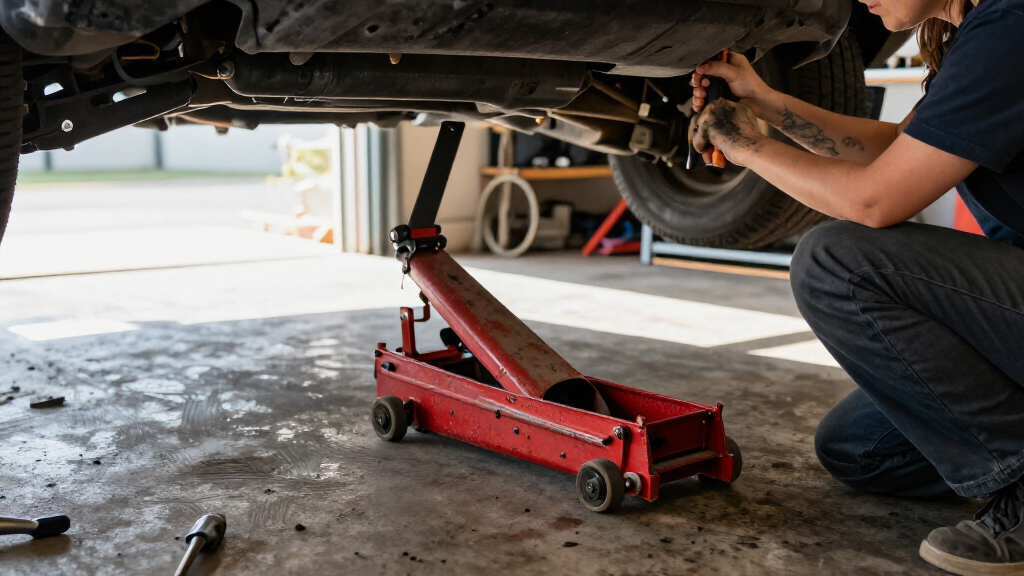
How We Picked
I compared the 13 jacks on the factors that change everyday garage use: rated capacity, minimum and maximum lift height, construction, pump design, and stated pad features. A jack needs enough capacity for the intended vehicle, but its minimum height must also clear the car’s lift point and its maximum height must support the planned work. I treated low-profile access, dual-piston pumping, and protective pad designs as useful advantages only when they addressed a clear buyer need.
The order favors balanced capability and broad usefulness over the largest capacity number alone. Models with specialized strengths, such as higher capacity, lighter mixed-material construction, or a stated lift range, rank well for those needs but do not automatically outrank more versatile picks. I also weighed tradeoffs: heavier steel construction may be less convenient to move, lower-capacity jacks fit fewer use cases, and product details that are not specified should not be assumed. Buyers should confirm each jack’s dimensions and rated capacity against their vehicle and workspace before purchase.
| garage floor jack | Pump | Material |
|---|---|---|
| Antlevix 3-Ton Low-Profile Hyd | Dual-piston | Alloy steel |
| AUTOWN 3-Ton Hydraulic Floor J | — | — |
| DNA MOTORING 2-Ton Low-Profile | — | Steel |
| SATA 3-Ton Heavy-Duty Steel Fl | Dual-piston | Steel |
| TONDA 2-Ton Hydraulic Floor Ja | — | Alloy steel |
| Jack Boss 4-Ton Low-Profile Hy | Dual-piston quick-lift | Iron |
| LARBANKE 3-Ton Hydraulic Floor | — | Carbon steel |
| Maxority 3-Ton Low-Profile Hyd | — | High-strength steel |
| VEVOR 2.5-Ton Low-Profile Stee | — | Steel |
| Bonnlo 3-Ton Low-Profile Hydra | Dual-pump design | Alloy steel |
| Maxority 5-Ton Low-Profile Hyd | Dual-piston quick-lift | Steel |
| AV Steel 3-Ton Steel Hydraulic | Single-piston hydraulic | Alloy steel |
| Jack Boss 3-Ton Low-Profile Al | Dual-piston | — |
Factors to Consider When Choosing Garage Floor Jacks
Choosing among floor jacks starts with the vehicle and the jobs you plan to do, not the biggest capacity printed on the listing. These checks help narrow the field before you compare pump styles or construction.
Match Capacity to the Vehicle and the Lift
A jack’s rated capacity is a limit, not a target for every lift. Check the vehicle’s weight and use the manufacturer’s guidance to identify the correct lifting points and equipment rating. A 2-ton model may suit a narrower set of jobs, while a 3-ton jack offers broader coverage for many home-garage vehicles. The 4-ton Jack Boss and 5-ton Maxority appeal when the work calls for greater rated capacity, but a larger rating does not make an unsuitable lift point safe. Avoid choosing from curb weight alone or assuming you can lift any part of a vehicle with one corner’s share of its total weight. Follow the vehicle and jack instructions, and support a raised vehicle with appropriately rated stands rather than relying on the hydraulic jack.
Check Both Ends of the Lift Range
Minimum height determines whether the saddle can reach under the vehicle, while maximum height determines how far it can raise the lift point. Buyers often focus on low-profile access and forget that a jack also needs enough travel for the intended repair. Compare the jack’s stated range with the clearance at the approved lift point, not just the vehicle’s advertised ground clearance. The TONDA lists a 4.9–11.8-inch range, which makes its working limits especially easy to identify from the supplied specifications. If the car is too low to admit a jack, a different approach may be needed; do not force the saddle beneath the vehicle. If the vehicle needs more lift than the jack provides, select suitable equipment rather than extending the setup with unstable objects.
Balance Capacity Against Weight and Mobility
Steel jacks can make sense for a stationary garage where durability and a familiar construction matter more than carrying weight. A heavier jack may be harder to move around a tight workspace or load into a vehicle, so think about how often you will reposition it. The Jack Boss aluminum-and-steel model offers a different construction approach for buyers who prioritize easier handling, though its 3-ton rating may not suit every vehicle. Do not assume that a lighter jack is automatically the better choice; check capacity, lift range, and the manufacturer’s use guidance together. Buyers who rarely move a jack may prefer a conventional steel model, while frequent repositioning makes handling more relevant. Keep the jack on a firm, level surface during use regardless of its material.
Treat Pump Design as a Convenience Feature
Dual-piston and quick-lift designs are intended to reduce the pumping needed to bring the saddle up, which can save effort during repeated lifts. They do not change the jack’s rated capacity or replace a careful setup. If you lift vehicles often, a faster approach to lifting may matter more than it does for occasional maintenance. Buyers should compare the handle and pump arrangement and check the product instructions for proper operation. A simpler model can still be the more sensible fit if it meets the vehicle’s capacity and height needs. Do not pick a jack solely because a pump feature sounds faster; safe positioning and a stable lift remain the priority.
Match the Saddle to the Vehicle’s Lift Points
The saddle is the contact point between the jack and vehicle, so its shape and any protective pad can affect how well it fits the approved lifting area. The AUTOWN’s cross-shape rubber pad is a specific feature to compare if you want a defined pad design, but it does not make every vehicle’s lift point compatible. Check the owner’s manual for the correct lift locations and examine whether the saddle can sit securely at those points. A pad can help protect a surface, yet it cannot compensate for poor alignment or an unstable contact area. If the vehicle requires a special adapter, confirm that it is compatible with the jack and permitted by the vehicle maker. Never lift from an unapproved body panel or suspension component just because the saddle seems to fit.
Plan for Storage, Maintenance, and Safe Use
A floor jack needs a storage spot where it can remain clean, dry, and easy to inspect. Before buying, check the jack’s footprint and handle arrangement against your available space, especially if a low-profile model has a long chassis. Hydraulic equipment also needs care: follow the maker’s instructions for fluid checks, bleeding, and inspection rather than improvising maintenance. Look for leaks, damaged wheels, or a saddle that does not hold position before each use. A jack is for lifting, not for holding a vehicle while someone works beneath it, so pair it with properly placed jack stands on a stable surface. This planning can matter more than a convenience feature when the jack will be used only occasionally.
Frequently Asked Questions
Is a 3-ton floor jack enough for a home garage?
A 3-ton rating covers many common home-garage needs, but it is not a universal fit. Check the vehicle maker’s lifting guidance and the jack’s rated capacity before choosing. Also confirm that the jack reaches the approved lift points and provides enough height for the job. A 3-ton model may be more versatile than a 2-ton option if you service different vehicles, while a heavier vehicle or specific lifting task may call for a different rating. Use rated jack stands to support the vehicle after lifting.
Should I choose a low-profile jack if my car is not lowered?
Not necessarily, but low-profile access can help with vehicles that have limited clearance at their approved lift points. If your current jack fits under the vehicle with room to position the saddle correctly, a low minimum height may not add much value. Compare the minimum height with the clearance at the actual lifting location rather than relying only on the car’s general ground-clearance figure. Also check maximum height so the jack can still serve your repair needs. A low-profile design is useful only when its full range and capacity suit the work.
Does a higher ton rating mean a floor jack is safer?
A higher rating gives a jack a higher stated capacity, but that alone does not make a lift safe. The jack must be used on a suitable surface, placed at an approved lift point, and matched to the vehicle and job. A jack with more capacity can still be a poor choice if it cannot fit under the vehicle or lacks the needed lift height. Follow both the vehicle maker’s instructions and the jack’s operating guidance. Once the vehicle is raised, support it with correctly rated stands instead of working beneath a hydraulic jack alone.
Is an aluminum-and-steel jack worth choosing over an all-steel model?
Mixed-material construction may appeal if you expect to move the jack often and want easier handling than a heavier steel model can offer. An all-steel jack may suit a garage where the jack stays in one place and portability matters less. Compare the listed capacity, height range, dimensions, and handling details rather than treating material as a stand-in for performance. The Jack Boss 3-ton aluminum-and-steel model is the lineup’s distinct choice for this preference, while several steel models prioritize conventional construction. Your vehicle requirements should decide whether that handling tradeoff is worthwhile.
Can I use a floor jack without jack stands for a quick repair?
No: a hydraulic floor jack should lift the vehicle, not serve as the sole support while you work. Hydraulic systems can lose pressure or shift, and a vehicle falling from a jack can cause severe injury. Use stands rated for the vehicle and place them at the manufacturer-approved support points on a firm, level surface. Follow the stand and vehicle instructions, then check stability before working near or beneath the vehicle. If the task does not require the vehicle to be raised, avoid lifting it at all.
Conclusion
For the broadest mix of low-profile access, 3-ton capacity, and dual-piston pumping, I’d choose the Antlevix as best overall. The best value depends on your needs: the DNA MOTORING or TONDA 2-ton models are worth comparing if their lower capacity and height range fit your vehicle, while the AUTOWN adds a defined cross-shape rubber pad. For a best premium-capacity pick, the Jack Boss 4-ton is the more measured step up; the Maxority 5-ton suits buyers whose work calls for still more rated capacity. Beginners should favor a model whose capacity and lift range clearly match their vehicle, with the Antlevix serving as a balanced starting point. For easier handling, choose the Jack Boss aluminum-and-steel 3-ton; for a specifically listed height range, consider the TONDA. Confirm fit and lifting points before buying, then use rated stands whenever a vehicle is raised.