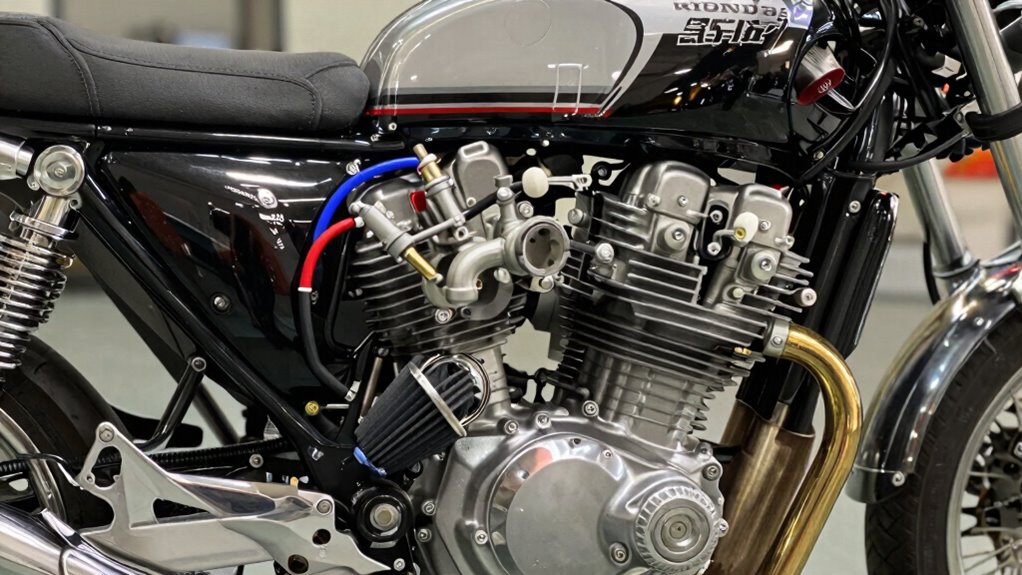

To boost your Honda CB750’s performance, start by optimizing your carburetor jetting—increase main jets after exhaust or filter upgrades and fine-tune mixture screws for a smooth air-fuel ratio. Synchronize your carburetors with a vacuum gauge for even response, and adjust the ignition timing for better throttle response. Regular maintenance, like cleaning jets and checking for air leaks, will keep your bike running reliably. Keep exploring these tips to reveal even more power.

Get business pricing on garage and car supplies
- Business-only prices and quantity discounts
- Tax-exempt purchasing
- Multiple users, one account, clear invoices
Key Takeaways
- Upgrade main jets by about 10 sizes after exhaust or filter modifications for improved high RPM fuel flow.
- Use a vacuum gauge to synchronize carburetors for smoother idle and better throttle response.
- Adjust mixture screws gradually, enriching the air-fuel ratio for optimal performance after modifications.
- Verify and set ignition timing accurately with a timing light, especially after carb or exhaust changes.
- Regularly clean jets, check for intake leaks, and perform routine maintenance to ensure consistent engine performance.
Optimizing Carburetor Jetting for Enhanced Performance
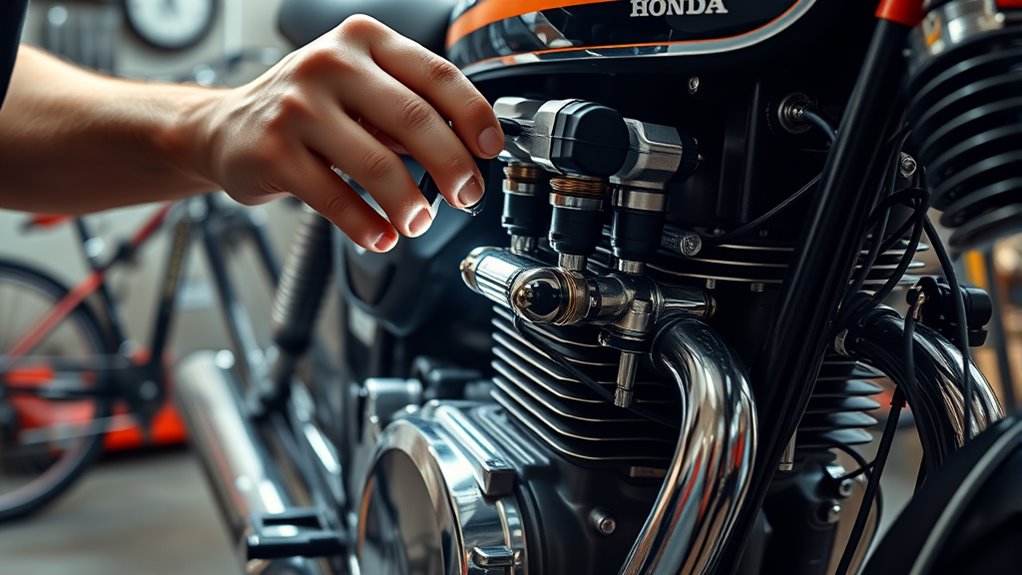
To enhance carburetor jetting for better performance, you need to carefully evaluate and adjust your jet sizes based on your engine modifications and riding conditions. Start by increasing your main jets by about 10 sizes if you’ve upgraded to a high-flow exhaust or pod filters, ensuring proper fuel flow at higher RPMs. Next, set your mixture screws gradually, typically around 1/2 to 3/4 turn out from fully closed, to fine-tune the air-fuel ratio. Regularly inspect and clean your jets to prevent clogging, which can cause rough idling or weak acceleration. Remember, jetting isn’t static; factors like altitude, fuel quality, and engine wear influence your tuning. Make small adjustments, test ride, and repeat until you achieve smooth throttle response and ideal power. Proper carburetor maintenance is essential to sustain optimal performance over time and to prevent issues such as clogged jets, which can significantly affect your bike’s running condition. Additionally, understanding the role of jet sizing can help you make more precise adjustments tailored to your specific riding conditions. Incorporating diagnostic tools can further assist in fine-tuning your carburetor for peak performance. Using fuel mixture analyzers can provide valuable feedback to optimize your settings more accurately.
Achieving Perfect Balance: Synchronizing Your Carburetors
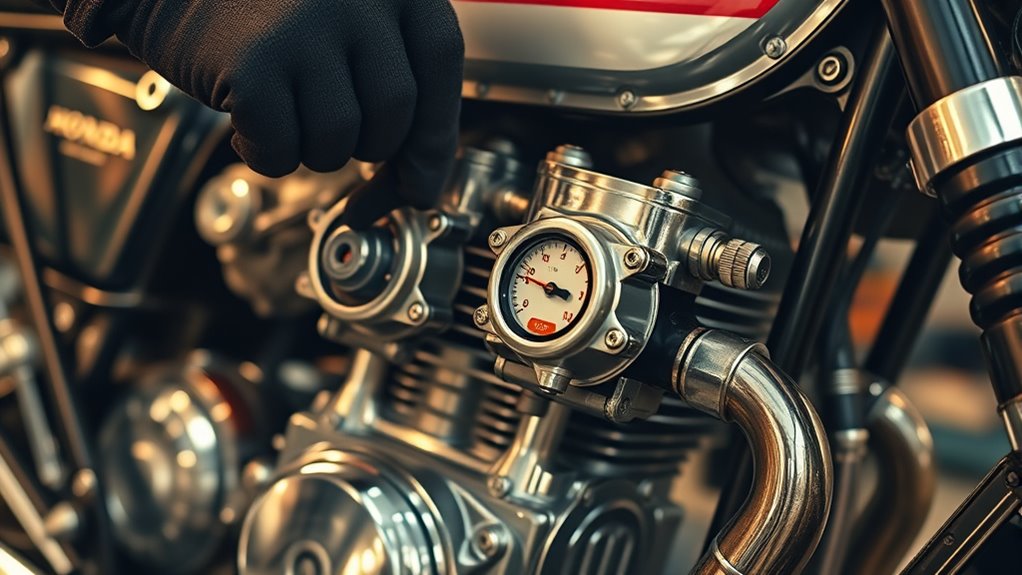
Achieving perfect balance among your Honda CB750’s carburetors is essential for smooth engine operation and ideal performance. To do this, use a manometer or vacuum gauge to measure vacuum levels on each carburetor. Loosen the locknuts on the throttle screws, then turn the screws equally until the vacuum readings match, ensuring each cylinder receives the same airflow. Start the engine and observe the gauge, making small adjustments for consistency. Listen for smoother idling and notice reduced vibrations across cylinders. After balancing, tighten the locknuts securely. Always verify your adjustments by revving the engine and checking for even throttle response. Proper synchronization results in a stable idle, improved throttle response, and overall smoother engine performance.
Fine-Tuning Air-Fuel Mixture for Different Modifications

Once you’ve synchronized your carburetors, the next step is fine-tuning the air-fuel mixture to match your specific modifications. If you’ve upgraded your exhaust or installed high-flow air filters, you’ll need to enrich the mixture to prevent running lean. Start by turning the mixture screws out gradually, typically between 1/2 to 3/4 turn, and listen for smoother idle and improved throttle response. For turbocharged setups, consider increasing main jet sizes by about 10 numbers to support higher fuel flow. Keep an eye on engine behavior—if it sputters, stalls, or overheats, adjust the mixture accordingly. Regularly test and adjust based on riding conditions, altitude, and modifications to guarantee optimal performance and fuel economy. Fine-tuning is an ongoing process that maximizes your bike’s power and reliability, especially when considering engine mapping to optimize fueling strategies. Additionally, monitoring air-fuel ratio with a wideband O2 sensor can help achieve precise adjustments for peak efficiency.
Improving Power With Ignition Timing Adjustments

Adjusting your ignition timing can substantially boost your Honda CB750’s power and responsiveness. With a timing light, you can precisely set the ignition to guarantee the spark occurs at the ideal point in the compression cycle. Focus on cylinders #3 or #4, depending on your points setup, to get the most accurate reading. Proper timing reduces engine knock, improves mid-range power, and smooths engine operation. When you advance the timing slightly, you’ll notice better throttle response and increased power. However, avoid over-advancing, which can cause knocking or overheating. Check your timing regularly as part of routine maintenance, especially after tuning your carburetors or modifying your exhaust. Correct ignition timing pairs with carb tuning to maximize performance and engine efficiency. Understanding your ignition system components helps ensure accurate adjustments and optimal engine performance. Regularly inspecting the timing light ensures precise readings and consistent results. Additionally, staying informed about automotive repair basics can help you troubleshoot any issues that arise during tuning. Incorporating Glycolic Acid benefits into your skincare routine can also improve your skin’s overall appearance and health.
Maintenance and Troubleshooting for Reliable Power

Maintaining your Honda CB750’s carburetors and ignition system is key to guaranteeing consistent, reliable power. Regular checks prevent common issues like poor idling, misfires, or weak acceleration. To troubleshoot effectively:
- Clean carburetors and jets regularly to avoid clogging and ensure proper fuel flow.
- Inspect and replace intake boots and seals to prevent unmetered air leaks that cause lean conditions.
- Synchronize carburetors using a manometer or vacuum gauge for smooth idling and balanced performance.
- Use a timing light to verify ignition timing, guaranteeing optimal combustion and power delivery.
- Incorporate essential oils such as peppermint or eucalyptus during maintenance to promote a clean and fresh engine environment. This can also help reduce ear wax odor and other unwanted smells from the engine or components.
- Proper storage and handling can prevent spoilage and odor, ensuring your motorcycle remains in top condition.
- Regularly check fuel quality and supply to prevent fuel-related issues that can impact engine reliability.
Consistent maintenance and prompt troubleshooting keep your engine running smoothly, maximize power, and extend the lifespan of your CB750. Stay vigilant with routine checks and adjustments to maintain peak performance.
Frequently Asked Questions
How Do I Identify When My Carburetors Need Re-Jetting?
You’ll want to re-jet your carburetors when you notice poor acceleration, rough idling, or if the engine runs lean or rich despite previous adjustments. Symptoms like sputtering under load, excessive smoke, or engine overheating are signs. If you’ve changed exhaust or air filters, or if altitude varies, re-jetting becomes necessary. Regularly check your spark plugs—if they’re black or fouled, it’s time to adjust your jets.
What Are Signs of Uneven Carburetor Synchronization?
You notice a shaky, uneven idle that flickers as if the engine’s fighting itself. When you accelerate, the bike stumbles or hesitates, and the smoothness you once felt disappears. If your revs fluctuate unpredictably or vibrations increase, your carburetors are likely out of sync. These signs point to uneven airflow, which can rob your bike of power and smoothness—so trust your senses and get those carbs balanced for peak performance.
How Does Altitude Affect Carburetor Tuning?
Altitude affects your carburetor tuning because higher elevations have less oxygen, making your engine run leaner. To compensate, you should increase your main jet size by about 10 numbers and adjust your mixture screws accordingly. Keep an eye on engine performance during altitude changes and make small adjustments as needed. Regularly check your jets and mixture to ensure smooth throttle response, power, and idling across different elevations.
Can Changing Exhaust Systems Impact Ignition Timing Settings?
Yes, changing exhaust systems can impact ignition timing settings. When you install a free-flow exhaust, it alters backpressure and scavenging, which affects how your engine burns fuel. You might need to adjust the timing to optimize power and smoothness. Use a timing light to check and fine-tune your ignition timing after exhaust modifications, ensuring your engine runs efficiently and prevents knocking or performance issues.
What’s the Best Way to Troubleshoot Persistent Idle Issues?
To troubleshoot persistent idle issues, start by checking and cleaning your carburetors thoroughly to remove any clogs or buildup. Then, verify the synchronization using a manometer to ensure even airflow across all cylinders. Adjust the mixture screws gradually for the best air-fuel ratio, and inspect for vacuum leaks or damaged seals. Don’t forget to confirm your spark plugs are clean and correctly gapped, which can also affect idle stability.
Conclusion
Think of tuning your Honda CB750 as tuning a symphony—when each note is just right, the engine sings smoothly and powerfully. By fine-tuning your carburetors, balancing airflow, and adjusting ignition timing, you’re crafting a harmonious ride that roars with confidence. Keep up with maintenance and troubleshooting, and your bike will run like a well-oiled orchestra, ready to hit every note of performance with clarity and strength.
Fall Picks
fall essentials
As an affiliate, we earn on qualifying purchases.