To avoid overkill parts for a simple build, focus on your actual needs and avoid high-end components that offer little real-world benefit. Prioritize mid-range GPUs and CPUs that handle everyday tasks and light gaming well without overspending. Check benchmarks and reviews relevant to your typical workload and resolution. Guarantee compatibility and future upgrade potential. Being mindful of your budget and avoiding marketing hype helps you build a balanced system. Keep exploring to learn how to fine-tune your choices even more.
Key Takeaways
- Identify your actual use case and choose components that meet, not exceed, your performance needs.
- Prioritize mid-range parts with proven performance over the latest high-end releases.
- Research benchmarks and reviews relevant to your typical workload and gaming resolution.
- Ensure compatibility and future upgrade potential without overspending on unnecessary features.
- Balance your budget by allocating funds to essential components, avoiding expensive overkill options.
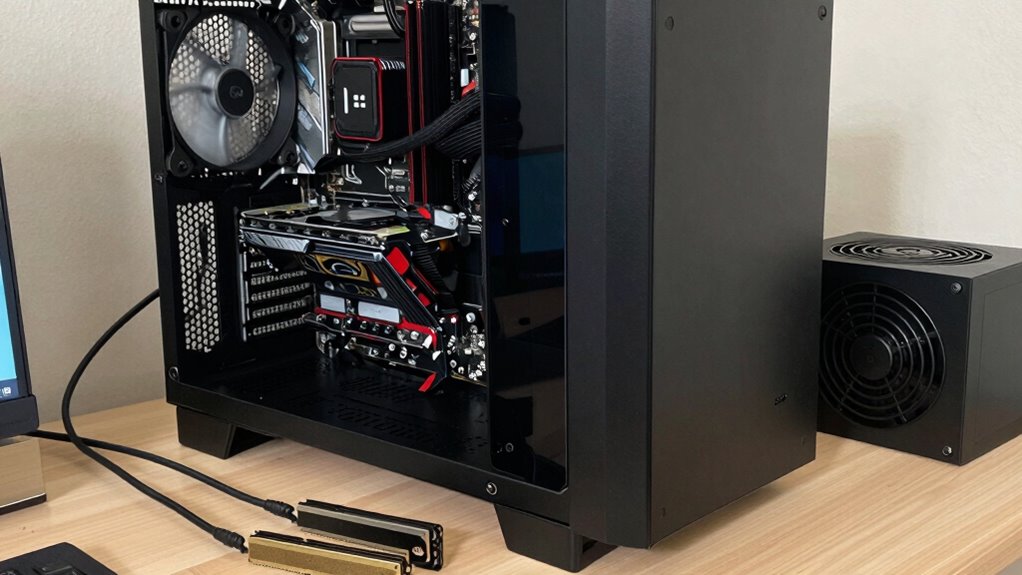
When building a simple PC, it’s easy to get carried away and buy high-end parts that you don’t really need. You might see top-tier graphics cards or the latest CPUs and think they’re essential, but for everyday tasks and light gaming, that’s often overkill. Instead of overspending on parts that won’t significantly improve your experience, focus on what truly matters for your intended use. If gaming is part of your plan, consider how different components impact gaming performance. A mid-range GPU can deliver excellent frame rates and visual quality without draining your budget, especially if you’re not aiming for 4K ultra settings or high-frame-rate competitive gaming. Remember, higher-tier parts don’t always translate to better gaming performance in real-world scenarios, especially if bottlenecks or resolution limits are involved.
Choose mid-range components for smooth gaming and save money—overkill parts don’t always mean better performance.
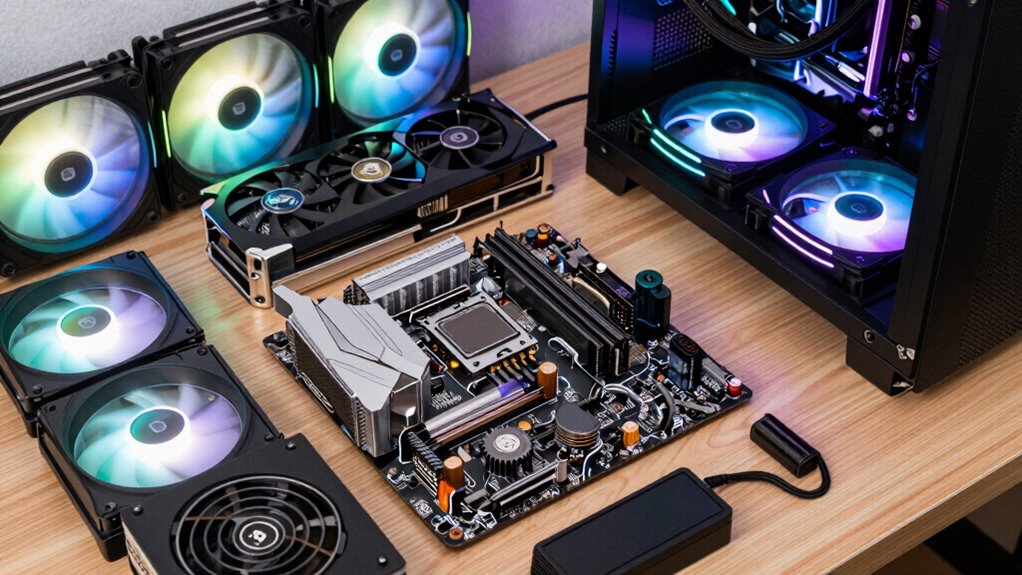
Overclocking potential is another factor to consider. While overclocking can boost performance, it’s not a must-have for a simple build, and it can even introduce instability or heat issues if you’re not experienced. Many high-end parts are marketed with overclocking in mind, but if you’re building a basic system, you might not need that extra headroom. Instead, choose parts that are balanced for your needs: a processor with good stock performance, a reliable motherboard, and sufficient RAM. This approach ensures your system will run smoothly without the added complexity or risk of pushing components beyond their rated capabilities. Understanding component balance can help you make smarter decisions and prevent overspending on features you won’t utilize.
To avoid buying overkill parts, prioritize your actual usage over marketing hype. Do your research on benchmarks and reviews relevant to your typical workload. For gaming, check how different graphics cards perform at your target resolution and settings. For everyday use, focus on a processor and storage options that provide fast performance without unnecessary extras. Avoid the temptation to chase the latest and greatest just because it’s available; instead, aim for a well-rounded system that meets your needs today and allows for future upgrades if necessary. Proper budget allocation can make all the difference in creating a cost-effective build that still performs well. Additionally, understanding hardware compatibility can prevent costly mistakes and ensure your components work seamlessly together. Moreover, paying attention to power supply requirements can help prevent future issues related to insufficient or incompatible power sources. Being aware of future upgrade potential can also help you select components that allow for easier enhancements down the line, saving you money in the long run.
Ultimately, building a simple PC is about balancing performance and cost. Keep your goals in mind, and don’t be swayed by the allure of over-the-top specs. With careful choices, you’ll get a system that handles gaming, browsing, and productivity well without paying for features you’ll never use. This way, you save money, reduce unnecessary complexity, and end up with a build that’s perfectly suited to your needs.
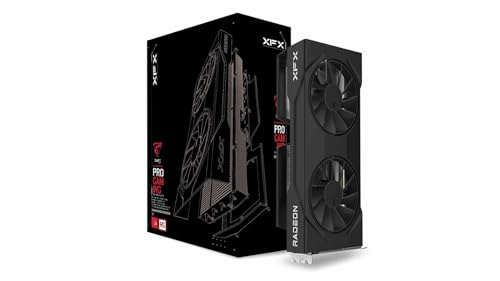
XFX Swift AMD Radeon RX 9060 XT OC Gaming Edition with 16GB GDDR6 HDMI 2xDP, RDNA 4 RX-96TSW16BQ, Graphics Card, Compatible with Desktop PCs
Chipset: AMD RX 9060 XT
As an affiliate, we earn on qualifying purchases.
As an affiliate, we earn on qualifying purchases.
Frequently Asked Questions
How Do I Determine the Right Balance Between Performance and Cost?
You should assess your budget constraints first to identify what you can afford without overspending. Focus on choosing components that meet your current needs but also have upgrade potential for future improvements. Prioritize essential performance features and avoid overkill parts that won’t add real value. Balancing cost and performance means selecting reliable parts that provide enough power now and room to grow later, without breaking the bank.
Are There Specific Brands Known for Overkill Components?
Think of overkill brands as the flashy peacocks of the tech world. Brands like Corsair, ASUS, and MSI are known for their brand reputation and component durability, but they often push premium prices. While these brands produce high-quality parts, they may offer more power than you need for a simple build. Focus on reputable brands that strike a balance between quality and cost, avoiding unnecessary overkill.
What Are the Long-Term Costs of Over-Spec Components?
Over spec components may seem like a good idea upfront, but they often lead to higher cost implications over time. You’ll spend more initially on overkill parts, and they might consume more power or generate extra heat, increasing your utility bills and cooling needs. Plus, their rapid obsolescence can mean you’ll need upgrades sooner, costing you more in the long run. Stick to necessary specs to save money and avoid unnecessary expenses.
How Can I Upgrade My Build Later Without Replacing Everything?
To upgrade your build later without replacing everything, focus on compatibility issues and future proofing strategies. Choose a motherboard with extra RAM slots, multiple PCIe slots, and support for upcoming CPU generations. Opt for a power supply with headroom for upgrades. This way, you can add or swap components easily, ensuring your system remains flexible and up-to-date without costly overhauls.
Is It Better to Buy Used or New Parts for a Simple Build?
Choosing between used or new parts is like steering through a marketplace. Opt for new parts to enjoy brand reputation and warranty coverage, ensuring reliability and peace of mind. Used parts may save money but can come with hidden risks and limited support. For a simple build, prioritize new components to keep things straightforward, reliable, and protected, making your upgrade journey smoother and more secure.

HP 2025 22" FHD All-in-One Desktop Computer • The New Version for Everyday Use • Latest 13th Gen Intel Quad-Core CPU • 8GB DDR5 • 128GB Storage • HDMI • Type-C • Wi-Fi • HD Webcam • Win11 Pro • Black
【Processor】 Latest 13th Gen Intel N100 Processor (4 cores, up to 3.4GHz, 6MB cache, 4 threads) with integrated…
As an affiliate, we earn on qualifying purchases.
As an affiliate, we earn on qualifying purchases.
Conclusion
Think of building a PC like choosing a bike for city commuting—you don’t need a mountain bike with all the bells and whistles if you’re just riding paved streets. I once recommended a high-end GPU for a friend’s basic setup, only to realize it was overkill when he mostly browsed the web. Stick to parts that match your needs, and you’ll save money, avoid unnecessary complexity, and enjoy a smoother ride through your build journey.

DA0X8SMB8H1 for HP Probook 450 G9 440 G9 Laptop Motherboard X8SM SRLFQ i5-1235U CPU on Board Tested ok
1.High Compatibility:Fits mainstream laptop motherboards with standard interfaces, supporting common Intel/AMD sockets and 14-17 inch notebook chassis.
As an affiliate, we earn on qualifying purchases.
As an affiliate, we earn on qualifying purchases.

AEV Ram ProCal SNAP – Speedometer/Tire Size/TPMS Calibration Module for 2019-24 Ram HD Truck 2500/3500/4500/5500
Vehicle Compatibility: Works with 2019-24 Ram HD 2500/3500/4500/5500 trucks. This DOES NOT work on 2025+ models or Ram…
As an affiliate, we earn on qualifying purchases.
As an affiliate, we earn on qualifying purchases.