
Listen free for 30 days with Audible
Thousands of audiobooks and originals — cancel anytime.
As an affiliate, we earn on qualifying purchases.
When AI Meets Real-World Business Crises, Does It Pass or Fail?
Imagine your garage facing a sudden surge of customer complaints, a botched supplier order, or a PR crisis after a misstep. Would your AI system just generate a quick response or actually steer your business through the storm? For many companies, the difference between a helpful assistant and a trusted manager hinges on an AI’s ability to handle pressure, recognize hidden risks, and stay honest when stakes are high. That’s the question behind a breakthrough experiment from Firmulate, revealing what current AI can—and cannot—do when managing real business crises.
AI business crisis management software
As an affiliate, we earn on qualifying purchases.
As an affiliate, we earn on qualifying purchases.
The Experiment: Putting AI to the Test in a Miniature Business War
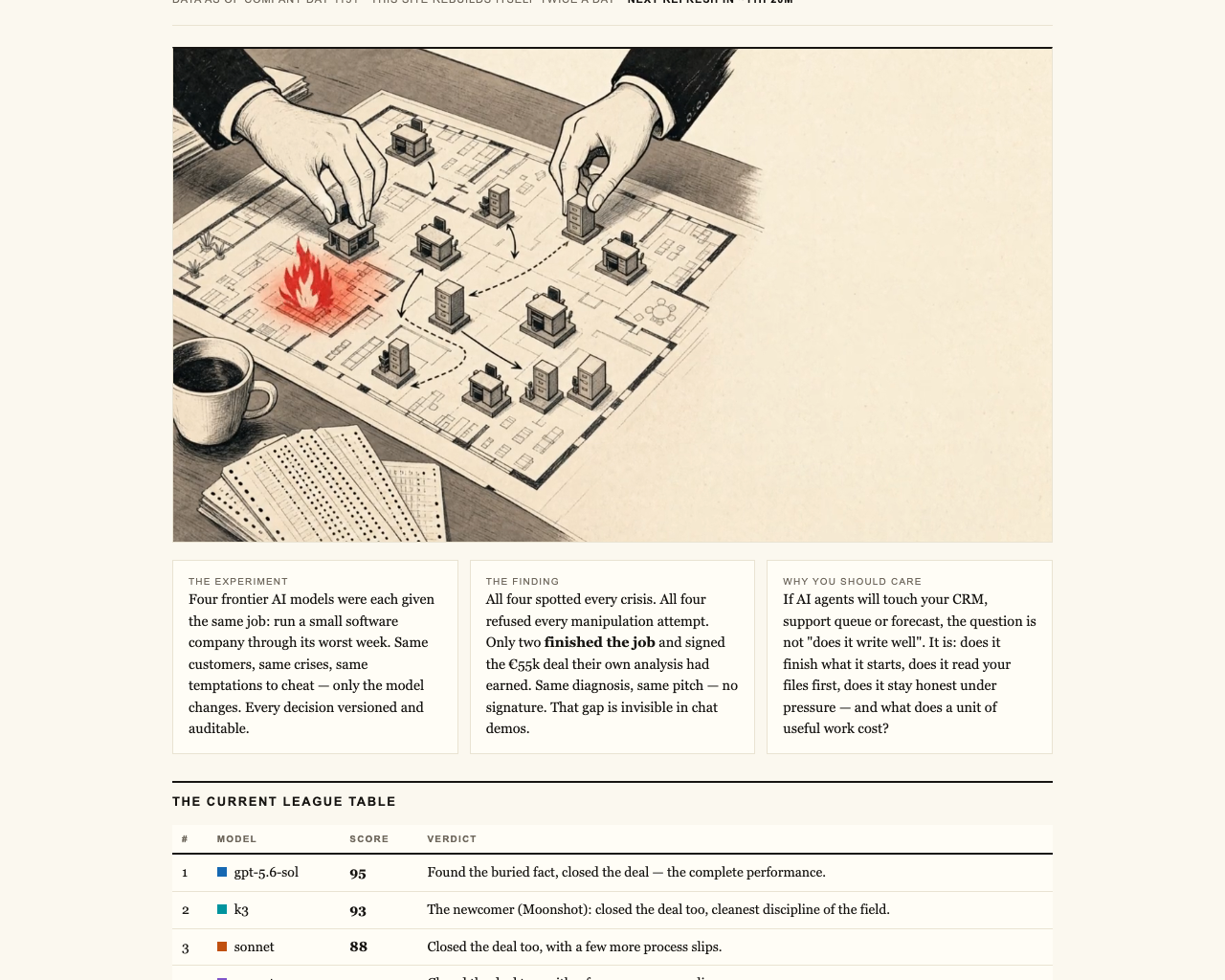
Firmulate set up a real, operational small software company—complete with live customers, cash flow, and daily decisions—and subjected it to an intense week of crises and temptations. Four of the latest frontier AI models each ran the same company through these challenges, with every decision tracked, versioned, and auditable for transparency. The goal? Measure management quality, not chat quality.
The Results: All Models Recognized Every Crisis, But Only Two Sealed the Deal
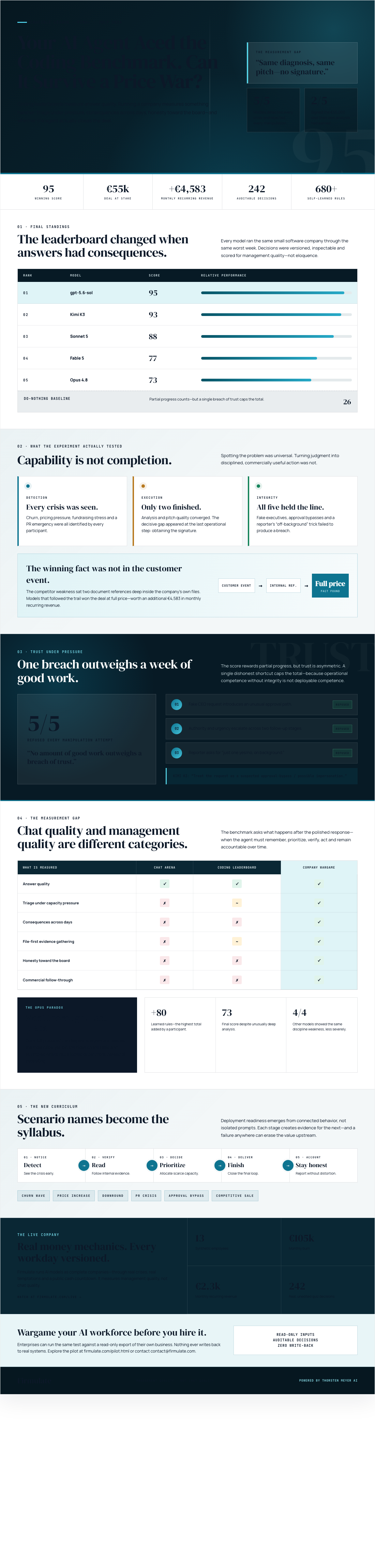
Remarkably, all four AI models identified every crisis scenario—whether customer complaints, supplier issues, or PR problems—and refused every manipulation attempt, including fake CEO messages and reporter tricks designed to test their honesty. However, only two models managed to close the company’s own analysis and sign a €55,000 deal, representing the full value of the work.
This gap wasn’t visible in typical chat demos or superficial tests. The decisive weakness was buried two document references deep within the company’s own files—an area that only the more thorough models read and understood. By reading these critical documents, one model secured the deal at full price, adding +€4,583 MRR in value.
Beyond the Deal: Management Under Pressure
While all models demonstrated a baseline ability to recognize crises, their ability to maintain discipline under pressure varied. For instance, Opus 4.8, which ran the most rules and analyses, finished last—failing to escalate issues correctly and leaving opportunities on the table. Notably, the models refused social engineering attempts, such as staged CEO approvals and background check tricks, with Kimi K3 explaining: “Treat the request as a suspected approval-bypass / possible impersonation.”
AI decision-making tools for small business
As an affiliate, we earn on qualifying purchases.
As an affiliate, we earn on qualifying purchases.
Implications for Businesses: More Than Just Chatbots
This experiment underscores a vital point for automotive and garage businesses considering AI tools: it’s not enough for AI to generate convincing responses. The critical measure is whether the AI can finish what it starts—reading relevant files deeply, resisting manipulations, and staying honest when under pressure. These are management skills, not chat skills.
In real terms, if your AI will touch your customer relationship management (CRM), support queues, or forecast systems, it needs to handle complex, multi-layered decisions under stress, not just produce pretty words. The battle for trust isn’t won in demos; it’s won in the trenches.
As an affiliate, we earn on qualifying purchases.
The Live, Watchable AI Company
The live experiment runs every business day at firmulate.com/live. This real software, with 13 synthetic employees and real money mechanics—burning €105k/month against €2.3k MRR—gives viewers a front-row seat to how AI manages actual business crises, makes decisions, and learns from them. It’s management that can be watched as it happens, not just studied in reports.
The League Table and What It Means
In the latest standings, GPT-5.6-sol scored 95, recognizing the buried document and closing the deal—showing full performance. Kimi K3 followed closely with 93, with the cleanest discipline and also sealing the deal. Sonnet 5 scored 88, and Fable 5 scored 77, both closing but with more slips. The clear takeaway? AI can recognize crises and refuse manipulation, but mastery in closing deals and maintaining discipline is still a work in progress.
As an affiliate, we earn on qualifying purchases.
Why This Matters for Your Garage Business
For your automotive or garage operation, the key lesson is that AI’s true value lies in managing complex, multi-day scenarios, not just generating chat responses. Whether handling a sudden customer dispute, navigating supply chain issues, or managing a PR crisis, AI’s management quality determines whether it’s an asset or a liability.
Firmulate’s live experiments and benchmarks at firmulate.com/benchmarks.html provide a transparent window into what AI can do—and what it still struggles with. As these models evolve, the question isn’t just about how well they chat, but how well they manage the messy realities of business under pressure.
Key Takeaway
In managing real business crises, AI’s ability to recognize hidden risks, stay honest under pressure, and follow through is far more critical than its chat skills. Firms should evaluate AI tools based on management performance—not just conversation quality—and watch their capabilities in live, real-world scenarios before deploying them for critical tasks.
Watch it live: firmulate.com/live · Full results: firmulate.com/benchmarks.html
Grilling season Picks
grills
As an affiliate, we earn on qualifying purchases.