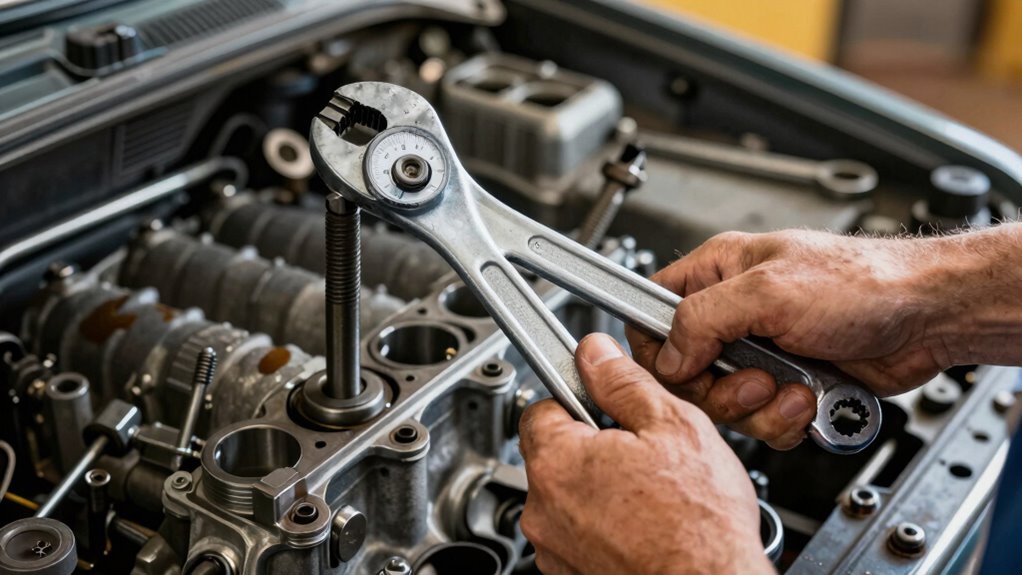
Every restoration garage needs a torque wrench strategy to guarantee you tighten bolts correctly and prevent future issues. Proper torque prevents damage, maintains safety, and keeps critical components like wheels and engines functioning smoothly. Using a strategic approach ensures consistent results and reduces mistakes that could lead to costly repairs. Regular calibration and following best practices protect your work and boost your reputation. Keep going to discover how a disciplined torque wrench strategy can elevate your restoration process.
Key Takeaways
- Ensures bolts are tightened accurately to prevent future mechanical failures.
- Maintains proper sealing and performance of engine and critical components.
- Promotes even pressure distribution during assembly, reducing damage risk.
- Enhances safety, durability, and reliability of restored vehicles.
- Supports consistent, professional-quality repairs aligned with manufacturer specifications.
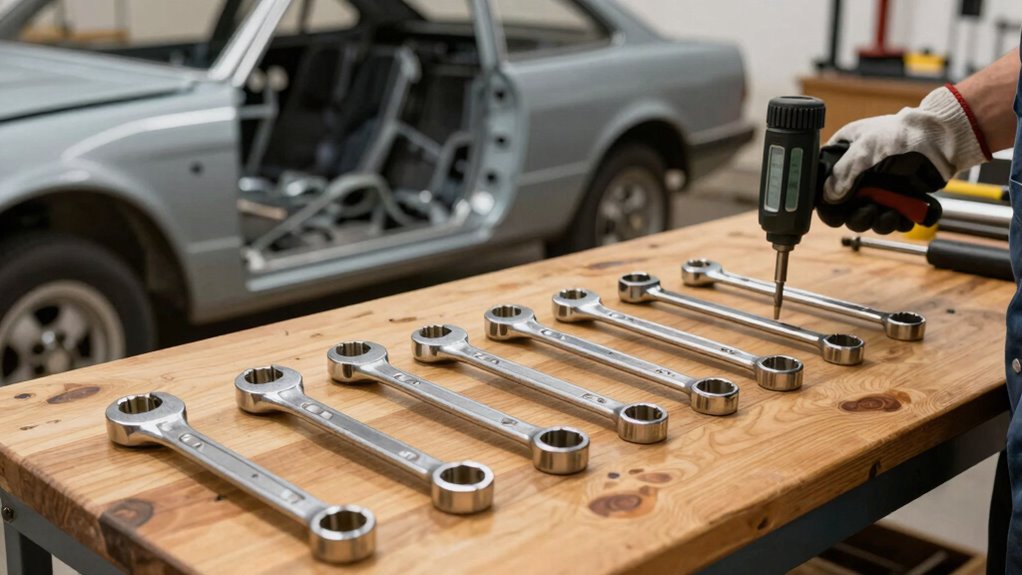
When restoring classic vehicles, having a solid torque wrench strategy is vital to guarantee every bolt is properly tightened without risking damage. A well-planned approach ensures that essential components like the engine, suspension, and wheels are secured correctly, preventing future issues and maintaining the vehicle’s integrity. Using a torque wrench for tasks such as wheel alignment ensures that each wheel is adjusted precisely, which is key for safe handling and tire longevity. If bolts are too loose, your vehicle can become unstable; if they’re too tight, you risk damaging threads or warping parts. This precision is especially important during the restoration process when every detail counts.
A precise torque wrench strategy ensures safe, reliable restorations by protecting components and maintaining vehicle integrity.
A good torque wrench strategy also plays a significant role in engine diagnostics. When working on an engine, proper bolt torque ensures that components like cylinder heads, manifolds, or timing covers are sealed correctly. Incorrect torque can cause leaks, misfires, or even engine failure down the line. By following a systematic approach, you reduce the chance of over-tightening or under-tightening, which can compromise engine performance and longevity. Additionally, an effective torque strategy helps you maintain consistency across all repairs, making your restoration more reliable and professional.
Implementing a torque wrench strategy involves understanding the specific torque specifications for each part. You should always consult the manufacturer’s manual or a trusted repair guide to determine the correct settings. Using a torque wrench with adjustable settings allows you to dial in the precise value needed, rather than relying on guesswork. When tightening bolts, work in a crisscross or sequence pattern to ensure even distribution of pressure. This practice minimizes the risk of warping parts or creating uneven stress, which can lead to mechanical issues later on. Regular calibration of your tools is also essential, as it ensures consistent and accurate torque application over time. Proper torque application techniques are crucial for maintaining the integrity of your restoration work. Moreover, understanding torque specifications is key to applying the correct amount of force for each bolt, avoiding damage caused by incorrect tightening. Ensuring that your tools are properly maintained and calibrated can also prevent errors caused by tool inaccuracies, further enhancing your restoration quality.
Furthermore, your strategy should include regular calibration of your torque wrench to keep it accurate. Over time, tools can lose their calibration, leading to inconsistent torque application. Regular checks ensure that your tightening remains precise, which is vital when performing delicate tasks like aligning wheels or sealing engine components. proper torque specifications help prevent common mistakes and protect the integrity of the vehicle’s critical parts. Incorporating calibration practices into your routine can extend the lifespan of your tools and improve your overall restoration quality. By integrating a disciplined torque wrench approach into your restoration workflow, you enhance both the safety and durability of the finished vehicle, making sure every bolt is exactly where it needs to be for peak performance and longevity.

SUERCUP 1/2" Drive Digital Torque Wrench, 3.8-250.8Ft.Lb/5.1-340Nm, ±1% Accuracy, Electronic Torque Wrench with Vibration/Buzzer/LED, 9 Presets & 5 Units, for Lug Nuts, Suspension, Brakes & Moto
【High Accuracy & Colorful Large Digital Display】: SUERCUP digital torque wrench is 3.8-250.8Ft.Lb/5.1-340Nm, with an accuracy of up…
As an affiliate, we earn on qualifying purchases.
As an affiliate, we earn on qualifying purchases.
Frequently Asked Questions
How Often Should Torque Wrenches Be Calibrated?
You should calibrate your torque wrench at least once a year or after every 5,000 uses, whichever comes first. Regular calibration helps maintain accuracy, extending your torque wrench’s lifespan and ensuring reliable results. Keep an eye on calibration frequency recommendations from the manufacturer, and if you notice any accuracy issues, calibrate immediately. Proper maintenance and timely calibration are essential for precise work in your restoration garage.
What Types of Torque Wrenches Are Best for Restoration Work?
Ever wondered which torque wrench suits restoration work best? You should opt for a click-type torque wrench because it’s precise and reliable, especially when considering calibration frequency. These wrenches are less affected by temperature effects, maintaining accuracy across varied environments. Their ease of use makes them ideal for delicate restoration tasks, ensuring you apply the exact torque needed without over-tightening or damaging components.
Can I Use a Torque Wrench for All Vehicle Components?
You can’t use a torque wrench for all vehicle components, as some parts require different tools. Focus on proper tool maintenance and calibration procedures to guarantee accuracy when you do use a torque wrench. Regularly check and calibrate your wrench to keep it precise. Remember, using the right tool and maintaining it properly prevents over-tightening or under-tightening, which could cause damage or safety issues during restoration work.
How Do Temperature Variations Affect Torque Wrench Accuracy?
Temperature effects are like a thief in the night, quietly stealing your torque wrench’s precision. When temperatures fluctuate, especially in extreme conditions, your wrench’s calibration can drift, leading to inaccurate torque readings. To counter this, you should regularly check and recalibrate your torque wrench, especially after significant temperature changes. Maintaining proper calibration frequency guarantees consistent accuracy, no matter the weather, keeping your restoration work precise and reliable.
What’s the Proper Storage Method for Torque Wrenches?
You should store your torque wrenches in a clean, dry place to prevent rust and damage. Proper cleaning involves wiping off dirt and grease after each use, ensuring accuracy. Use storage techniques like a designated toolbox or wall mount to keep them protected and organized. Avoid storing them with set torque, as it can affect calibration. Regularly check and recalibrate to maintain precision in your restoration projects.

LPABY Adjustable Torque Wrench 19 to 110 Nm 43mm Open End Torque Wrench Spanner for HVAC, Car Repair, Bicycle Maintenance (Style 2)
Adjustable Torque Wrench: Torque range 19-110 NM, clear scale, Meaning it’s hugely versatile and suitable for a wide…
As an affiliate, we earn on qualifying purchases.
As an affiliate, we earn on qualifying purchases.
Conclusion
In the end, having a torque wrench strategy is your best bet to guarantee safety and precision in your restoration garage. It’s like the old adage says, “Measure twice, cut once.” By consistently applying the right torque, you prevent future headaches and keep your projects running smoothly. Don’t overlook this essential tool—it’s the small detail that makes a big difference in delivering quality work every time.

LEXIVON Bike Torque Wrench 1/4-Inch Dr. 15-Piece Kit | 72-Tooth Gear, Dual-Direction Click Type 2~26 Nm / 17.7~230.1 in-lb (LX-191)
THE ULTIMATE BIKE TOOL – This 15-Piece bicycle torque wrench features precise scales of 2~26 Newton Meter (17.7~230.1…
As an affiliate, we earn on qualifying purchases.
As an affiliate, we earn on qualifying purchases.

LEXIVON Torque Wrench 1/2-Inch Drive Click 10~150 Ft-Lb/13.6~203.5 Nm (LX-183)
PRECISE & HIGH QUALITY – Manufactured in Taiwan, our torque wrench is engineered for superior precision. It ships…
As an affiliate, we earn on qualifying purchases.
As an affiliate, we earn on qualifying purchases.