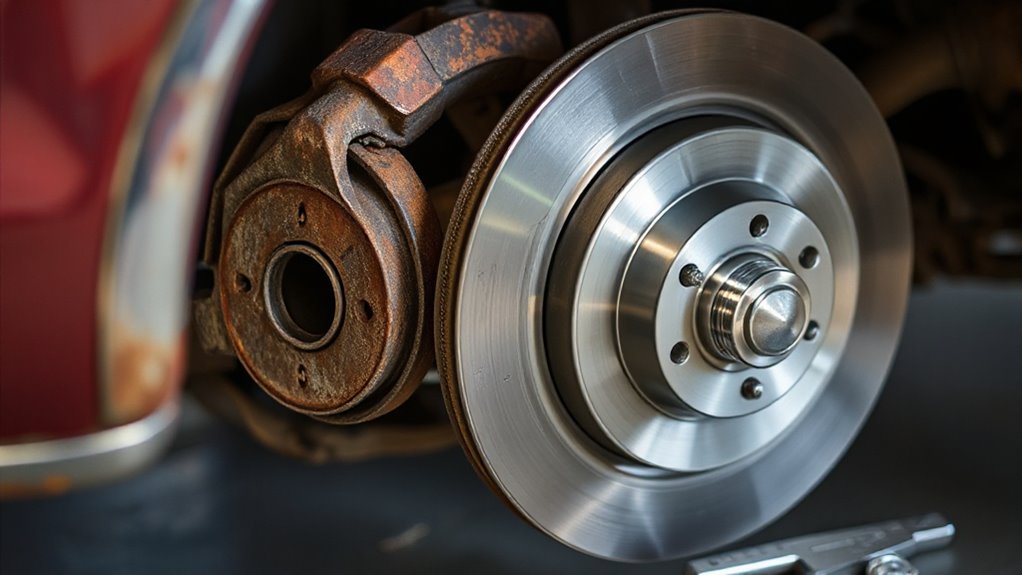

When converting from drum to disc brakes, you should consider rotor size, compatibility with your hub and wheels, and choosing the right brake pads for your driving style. Larger rotors improve heat dissipation and stopping power, but may require modifications. Matching pad materials to rotor type guarantees ideal performance and longevity. Proper installation and maintenance are key to safety and effectiveness. Keep exploring these options to make the best upgrade decision for your vehicle.

Get business pricing on garage and car supplies
- Business-only prices and quantity discounts
- Tax-exempt purchasing
- Multiple users, one account, clear invoices
Key Takeaways
- Ensure rotor size and thickness match vehicle specifications for proper fit and performance.
- Choose compatible hub and wheel assembly components to accommodate disc brake installation.
- Select appropriate brake pads based on driving conditions, balancing noise, dust, and stopping power.
- Larger rotors improve heat dissipation but may require suspension or wheel modifications.
- Regular maintenance and correct component pairing are essential for safety and optimal braking performance.

Upgrading your brakes can considerably improve your vehicle’s stopping power and safety, but it’s essential to understand the key considerations before making any changes. Converting from drum brakes to disc brakes is a popular upgrade, offering better heat dissipation, improved stopping performance, and easier maintenance. However, before jumping into the conversion, you need to carefully evaluate factors like brake pad selection and rotor sizing to guarantee compatibility and peak performance.
When selecting brake pads for your new disc brake system, you should consider the driving conditions and your vehicle’s intended use. High-performance pads can provide better braking response and fade resistance, especially during aggressive driving or towing. On the other hand, standard brake pads may suffice for everyday driving, offering quieter operation and longer life. The key is to choose pads that match your driving style and the rotor material, as this will influence braking efficiency and pad wear. Keep in mind that brake pad selection also impacts noise levels and dust production, so weigh those factors based on your preferences.
Rotor sizing is equally critical in a disc brake conversion. You need to ensure that the new rotors fit your vehicle’s hub and wheel assembly. Larger rotors generally offer increased surface area, which helps dissipate heat more effectively and improves braking performance under heavy use. However, they also add weight and may require modifications to your suspension or wheel clearance. Smaller rotors are easier to install and may be compatible without extensive modifications but could compromise braking performance during demanding situations. It’s essential to select rotor sizes that not only fit physically but also match your vehicle’s braking requirements. Consult your vehicle’s specifications or a professional to determine the peak rotor diameter and thickness for your upgrade. Additionally, paying attention to proper brake system maintenance ensures sustained performance and safety over time.
Frequently Asked Questions
Will Converting to Disc Brakes Improve My Vehicle’s Stopping Distance?
Yes, converting to disc brakes can improve your vehicle’s stopping distance. Disc brakes handle heat better, reducing brake fade during repeated or hard braking, which maintains consistent performance. They also offer a firmer pedal feel, giving you better control and confidence. Overall, this upgrade enhances safety and braking efficiency, especially in demanding driving conditions, making your stopping distance shorter and more reliable.
How Much Does a Complete Drum-To-Disc Conversion Typically Cost?
A complete drum-to-disc conversion typically costs between $500 and $1,500, depending on your vehicle and parts chosen. You should do a cost analysis to compare new or refurbished parts, considering parts availability in your area. Labor costs can add another $200 to $500 if you’re not doing the work yourself. Keep in mind, higher-quality components may cost more but can improve performance and longevity.
Can I Upgrade My Brakes Without Replacing the Entire Suspension?
Upgrading your brake system without replacing your entire suspension is absolutely possible and doesn’t require a suspension overhaul. Most modern brake upgrades, like swapping drums for discs, are designed to be compatible with your existing suspension setup. You can enhance braking performance by simply upgrading components, ensuring suspension compatibility remains intact. So, you don’t need to overhaul your suspension—just focus on your brake system for better stopping power.
Are There Any Compatibility Issues With Different Vehicle Makes and Models?
Yes, vehicle compatibility can be an issue when upgrading brakes, as aftermarket options vary across makes and models. You need to check if the parts are designed for your specific vehicle to guarantee proper fit and performance. Some upgrades might require adapters or modifications. Always verify compatibility before purchasing and consult with experts to avoid issues, so your brake upgrade is safe and effective.
How Does Converting to Disc Brakes Affect My Vehicle’s Overall Handling?
Converting to disc brakes improves your vehicle’s handling by providing better brake pedal feel and more consistent braking performance. You’ll notice increased steering responsiveness because disc brakes resist fade under heavy use, allowing for more precise control. This upgrade enhances your overall driving experience, especially during intense braking or cornering, giving you confidence and smoother responses. Plus, better modulation helps you brake more effectively, making your vehicle feel more responsive on the road.
Conclusion
Upgrading from drums to discs substantially improves your vehicle’s braking performance and safety. Did you know that disc brakes reduce stopping distances by up to 20% compared to drum brakes? This upgrade isn’t just about better stopping power; it also enhances heat dissipation and reduces brake fade during intense use. If you’re considering the switch, keep in mind the compatibility and cost factors. Making this upgrade could be the best move for your vehicle’s safety and your peace of mind.
Evergreen bestsellers Picks
bestsellers
As an affiliate, we earn on qualifying purchases.