For most home garages, I’d start with the CRAFTSMAN 26-Gallon Vertical Oil-Free Air Compressor: its larger tank suits longer jobs while its oil-free design keeps routine upkeep simpler. The Klutch 29-Gallon stands out for buyers who need stronger airflow for air tools, while the compact DEWALT 2.5-Gallon makes more sense when quiet operation and easy storage matter more than extended run time. Choosing among garage air compressors means balancing tank capacity and delivered airflow against noise, footprint, and portability. Smaller compressors handle tires and brief tasks well, but can struggle with tools that need sustained air. Read on for the full breakdown and help matching a compressor to your garage work.

Get business pricing on garage and car supplies
- Business-only prices and quantity discounts
- Tax-exempt purchasing
- Multiple users, one account, clear invoices
Complete the kit


Key Takeaways
- The CRAFTSMAN 26-Gallon is the clearest all-around fit for a home garage that needs more capacity than a pancake or mini-tank compressor without moving to a larger 29-gallon unit.
- The Klutch 29-Gallon is the airflow-focused choice, with a stated 5.1 CFM at 90 PSI that better suits sustained air-tool work than the smaller portable options.
- Tank size alone does not predict tool performance: check CFM at the pressure your tool requires, since a high PSI figure cannot make up for insufficient airflow.
- Compact picks solve different problems: the DEWALT 2.5-gallon favors quieter, portable operation, while the CRAFTSMAN wall-mount model prioritizes a fixed setup and a retractable hose.
- Oil-free models and accessory bundles favor convenience, but buyers should still compare noise, duty cycle, and included fittings against the jobs they plan to do.


| garage air compressor | Tank capacity | Maximum pressure | Noise level | Airflow |
|---|---|---|---|---|
| CRAFTSMAN 26-Gallon Vertical O | 26 gallons | 150 PSI | 75 dB | 5.0 CFM at 90 PSI |
| RyanTek 15-Gallon Oil-Free Air | 15 gallons | 125 PSI | 66 dB at 4 m | 4.5 CFM at 90 PSI |
| DEWALT DWFP55130 2.5-Gallon Po | 2.5 gallons | 200 PSI | 71.5 dBA | 3.0 SCFM at 90 PSI |
| Klutch 20-Gallon Air Compresso | 20 gallons | 175 PSI | 80 dB | 4.2 SCFM at 90 PSI |
| Klutch 29-Gallon Air Compresso | 29 gallons | 175 PSI | 81 dB | 5.1 CFM at 90 PSI |
| DEWALT 27-Gallon Vertical Oil- | 27 gallons | 200 bar | 78 dBA | 5.1 CFM at 90 PSI; 6.8 CFM at 40 PSI |
| Craftsman 6-Gallon Pancake Air | 6 gallons | 150 PSI | 82 dB | 2.6 SCFM at 90 PSI |
| CRAFTSMAN Air Compressor | 2 gallons | 125 PSI | 78 dB | — |
| CRAFTSMAN Wall Mount Air Compr | 0.5 gallon | 125 PSI | 65 dB | 1.8 CFM |
| ECOMAX 6-Gallon 150 PSI Oil-Fr | 6 gallons | 150 PSI | 75 dB | Listed as 3 cubic inches per minute at 90 PSI |
More Details on Our Top Picks
CRAFTSMAN 26-Gallon Vertical Oil-Free Air Compressor, 1.8 HP, 120V
I’d put the CRAFTSMAN 26-gallon near the top for a garage that needs more reserve than a small portable tank but still runs on household 120V power. Its 5.0 CFM at 90 PSI suits tire inflation, blow-off cleaning, and intermittent use of compatible pneumatic tools; the 150 PSI ceiling adds flexibility, though it does not mean the compressor can sustain every high-demand tool. Compared with the Klutch 29-Gallon, it has a smaller tank and lower stated airflow, but its 75 dB noise rating is lower than that model’s 81 dB. The oil-free pump avoids routine oil changes, while the tall 125.9-pound build is a commitment to a mostly fixed spot. I’d skip it if frequent carrying or continuous air-tool work is part of the plan.
Pros:- 26-gallon tank provides useful air reserve for intermittent garage tasks.
- Delivers 5.0 CFM at 90 PSI for compatible tools and cleaning.
- Oil-free pump avoids routine pump oil changes.
- Runs on 120V household power and is rated at 75 dB.
Cons:- At 125.9 pounds, it is difficult to move frequently.
- Its airflow may not keep up with continuous high-demand pneumatic work.
- Vertical footprint requires a suitable storage location.
Best for: Garage owners who want a 120V compressor for inflation, cleaning, and intermittent pneumatic-tool use, with more stored air than a compact portable unit.
Not ideal for: Buyers who need a compressor they can lift and move often, or who plan sustained work with high-air-demand tools.
- Tank capacity:26 gallons
- Airflow:5.0 CFM at 90 PSI
- Maximum pressure:150 PSI
- Motor power:1.8 hp
- Voltage:120 V
- Pump:Oil-free
- Noise level:75 dB
- Weight:125.9 lb
Our verdict“Choose this CRAFTSMAN for a mostly stationary garage setup that needs a sizable tank and useful intermittent-tool airflow on 120V.”
RyanTek 15-Gallon Oil-Free Air Compressor, 2 HP, 125 PSI
The RyanTek 15-gallon is the lineup’s quieter, more mobile tank-style choice: its stated noise level is 66 dB at 4 m, and its 68.3-pound weight with wheels and a handle is far easier to reposition than the 125.9-pound CRAFTSMAN 26-gallon. It supplies 4.5 CFM at 90 PSI, a useful level for intermittent workshop tasks, while the smaller tank means less stored air between recovery cycles than the Klutch 29-Gallon. Twin cylinders, dual outlets, and an upward-facing gauge make it convenient when switching between compatible hoses or checking pressure. Its oil-free pump also suits indoor work where routine oil service is unwelcome. I would not choose it for long runs with air-hungry tools, and its 110V corded design still ties it to a power outlet.
Pros:- Rated at 66 dB at 4 m, quieter than the larger Klutch and CRAFTSMAN tank models listed here.
- Wheels and handle make it easier to reposition than the heavier 26- and 29-gallon compressors.
- Provides 4.5 CFM at 90 PSI with an oil-free twin-cylinder pump.
- Dual outlets and an upward-facing gauge support convenient workshop use.
Cons:- The 15-gallon tank stores less air than the larger CRAFTSMAN and Klutch options.
- At 68.3 pounds, it is still a substantial lift over steps or into a vehicle.
- Requires a 110V corded power source.
Best for: Home mechanics and hobbyists who want a quieter, wheeled compressor for intermittent tool use and indoor workshop tasks.
Not ideal for: Users running high-demand tools for extended periods, or anyone needing a cordless compressor or a large air reserve.
- Tank capacity:15 gallons
- Airflow:4.5 CFM at 90 PSI
- Maximum pressure:125 PSI
- Motor power:2 hp
- Voltage:110 V
- Pump:Oil-free, twin-cylinder
- Noise level:66 dB at 4 m
- Weight:68.3 lb
Our verdict“Pick the RyanTek if quieter operation and easier repositioning matter more than the larger air reserve of the 26- and 29-gallon models.”
DEWALT DWFP55130 2.5-Gallon Portable Quiet Air Compressor, 200 PSI
Unlike the tank-heavy CRAFTSMAN 26-gallon, the DEWALT DWFP55130 is built around portability and nailer work rather than a large reserve for general garage tools. Its 2.5-gallon tank and 3.0 SCFM at 90 PSI are suited to compatible pneumatic nailers, and dual quick couplers let two tools connect without swapping the outlet. The 200 PSI maximum is high for this group, but buyers should not mistake peak pressure for sustained airflow: the small tank limits runtime with air-hungry equipment. At 36 pounds, it is much easier to carry than the RyanTek or either large Klutch compressor, and it can be stored vertically or horizontally. Its 71.5 dBA rating is quieter than the larger Klutch models, though it still needs a corded 120V outlet.
Pros:- At 36 pounds, it is substantially easier to carry than the tank-style garage compressors in this lineup.
- Dual quick couplers support connecting two nailers.
- Vertical or horizontal storage helps fit it into limited garage space.
- Oil-free pump and 71.5 dBA noise rating support lower-maintenance, quieter operation.
Cons:- The 2.5-gallon tank limits runtime with tools that draw air continuously.
- Its 3.0 SCFM at 90 PSI is lower than the larger tank models’ stated airflow.
- Requires a corded 120V power source.
Best for: DIYers and finish carpenters who need a carryable compressor for one or two compatible nailers and want flexible storage in a crowded garage.
Not ideal for: Garage owners who need long runtimes for spraying, continuous blow-off, or other high-air-demand tools.
- Tank capacity:2.5 gallons
- Airflow:3.0 SCFM at 90 PSI
- Maximum pressure:200 PSI
- Voltage:120 V
- Motor current:12 A
- Pump:Oil-free
- Noise level:71.5 dBA
- Weight:36 lb
- Couplers:Dual quick couplers
Our verdict“Choose the DEWALT for portable nailer work and compact storage, not for sustained garage tasks that need a large air reserve.”
Klutch 20-Gallon Air Compressor, 2 HP, 120V
The Klutch 20-gallon sits between the portable DEWALT and the larger tank compressors: it offers a useful workshop-sized reservoir without the 29-gallon model’s bulk. Its 4.2 SCFM at 90 PSI and 175 PSI maximum support tasks such as nailing and compatible spraying, while thermal overload protection adds a safeguard if the motor gets too hot. Rubber wheels, a handle, and vibration-reducing foot stabilizers make it more manageable around a garage than a stationary tank, though 90 pounds is still not a casual carry. Compared with the CRAFTSMAN 26-gallon, it has less tank capacity and slightly less stated airflow, but it includes a two-year warranty and overload protection. The tradeoff is noise: its 80 dB rating is louder than the CRAFTSMAN and RyanTek.
Pros:- 20-gallon tank balances stored air with a smaller footprint than the 29-gallon Klutch.
- Thermal overload protection helps protect the motor from overheating.
- Wheels, an ergonomic handle, and stabilizing feet support workshop maneuvering and reduced vibration.
- Oil-free pump and two-year warranty are practical ownership features.
Cons:- Its 80 dB noise rating is louder than the RyanTek and CRAFTSMAN 26-gallon models.
- At 90 pounds, it is cumbersome to lift or carry.
- Its 4.2 SCFM at 90 PSI is below the airflow listed for the 26- and 29-gallon alternatives.
Best for: Garage users who want a mid-size wheeled compressor for intermittent nailing or spraying and value thermal protection and vibration control.
Not ideal for: People working in noise-sensitive spaces, or buyers who need the larger air reserve and higher stated airflow of the 26- or 29-gallon models.
- Tank capacity:20 gallons
- Airflow:4.2 SCFM at 90 PSI
- Maximum pressure:175 PSI
- Motor power:2 hp
- Voltage:120 V
- Maximum current:14 A
- Noise level:80 dB
- Weight:90 lb
- Warranty:2 years
Our verdict“Choose this Klutch if you want a protected, wheeled mid-size shop compressor and can accept its louder operation and 90-pound weight.”
Klutch 29-Gallon Air Compressor, 2.5 HP, 120V, 175 PSI, 5.1 CFM at 90 PSI
Among these five, the Klutch 29-gallon offers the strongest stated airflow at 90 PSI: 5.1 CFM, just above the CRAFTSMAN 26-gallon’s 5.0 CFM. That makes it the more compelling choice here for garage owners who want a larger reserve and plan more frequent pneumatic-tool use, though the listing’s “continuous” wording should not replace checking a tool’s actual air requirement. Its 2.5 HP motor, 175 PSI maximum, and oil-free pump suit a range of nailing, painting, and blow-gun tasks. Against the Klutch 20-gallon, it brings more tank capacity and airflow, but also weighs 127 pounds and is rated at 81 dB. Large flat-free tires help with rolling, not lifting, so I’d reserve it for a garage with space to keep it parked near an outlet.
Pros:- Highest stated airflow in this group at 5.1 CFM at 90 PSI.
- 29-gallon tank provides more stored air than the other four compressors reviewed here.
- Oil-free pump avoids routine oil changes.
- Large flat-free tires support rolling the compressor around a garage.
Cons:- At 127 pounds, it is difficult to lift and reposition despite the tires.
- The 81 dB rating makes it one of the louder choices in this group.
- Its 120V power and stated airflow do not guarantee suitability for every continuous-duty tool.
Best for: Garage owners who need the largest tank and highest stated 90 PSI airflow in this group for regular, compatible pneumatic-tool tasks.
Not ideal for: Buyers who need a quiet compressor, carry equipment between locations, or expect a 120V unit to sustain tools beyond its rated airflow.
- Tank capacity:29 gallons
- Airflow:5.1 CFM at 90 PSI
- Maximum pressure:175 PSI
- Motor power:2.5 hp
- Voltage:120 V
- Maximum current:14.5 A
- Pump:Oil-free
- Noise level:81 dB
- Weight:127 lb
Our verdict“Pick the Klutch 29-gallon if maximum tank capacity and the group’s highest stated 90 PSI airflow matter more than low noise or easy lifting.”
DEWALT 27-Gallon Vertical Oil-Free Portable Air Compressor
The 27-gallon vertical tank gives this DEWALT more reserve than the 6-gallon Craftsman and ECOMAX pancake models, so it is better suited to longer stretches of nailing, spraying, or other intermittent garage work. Its 5.1 CFM at 90 PSI is useful context when comparing it with smaller compressors, though it does not make this a match for every air-hungry tool. The upright footprint helps preserve floor space, and wheels and a handle make repositioning possible. The tradeoff is weight: at 136 pounds, it is portable in the garage, not easy to carry or roll over rough ground. Oil-free operation cuts routine pump maintenance, while the 78 dBA rating is quieter than some shop compressors but still audible indoors. It also needs a 120-volt outlet capable of supplying up to 15 amps.
Pros:- 27-gallon tank provides more stored air than the 6-gallon pancake models in this roundup.
- Vertical layout, wheels, and handle help conserve floor area and reposition it within a garage.
- Oil-free pump avoids routine oil changes.
- Low-voltage start is designed to help the motor start under challenging power conditions.
Cons:- At 136 pounds, moving it over steps or uneven surfaces can be difficult.
- Requires a 120-volt supply and draws up to 15 amps.
- Its 78 dBA operating noise may still be intrusive in a small or attached garage.
Best for: Garage owners who want a larger air reserve for nailing, air brushing, or occasional spraying without giving up as much floor space as a horizontal tank requires.
Not ideal for: Buyers who need a compressor they can lift into a vehicle, run far from a suitable 120-volt outlet, or use for tools requiring more airflow than its stated 5.1 CFM at 90 PSI.
- Tank capacity:27 gallons
- Motor power:1.7 hp
- Airflow:5.1 CFM at 90 PSI; 6.8 CFM at 40 PSI
- Maximum pressure:200 bar
- Power:120 volts; 15 A
- Noise level:78 dBA
- Pump and configuration:Oil-free; single-stage, direct-drive, vertical
- Weight:136 pounds
- Dimensions:26.8 × 23.5 × 54.5 inches
Our verdict“Choose this DEWALT for a space-saving, larger-tank garage compressor, but skip it if you need lightweight portability or higher stated airflow.”
Craftsman 6-Gallon Pancake Air Compressor 4-Tool Combo Kit
This Craftsman makes the most sense when the tools matter as much as the compressor: the kit includes three pneumatic nailers and a 25-foot hose, giving a home woodworker a ready starting point for trim and small projects. Its 6-gallon tank and 2.6 SCFM at 90 PSI suit finish-nailing and inflation better than long, demanding runs. Compared with the larger DEWALT 27-gallon compressor, it stores much less air, but its 30.8-pound carryable form is easier to move between a garage bench and a work area. The oil-free pump keeps upkeep simple. The compromises are the 82 dB noise level and a corded 120-volt power requirement; this is a practical stationary-outlet tool, not a quiet or cordless solution. Tool coverage is also shorter than compressor coverage.
Pros:- Includes 16-gauge finish, 18-gauge brad, and 23-gauge pin nailers.
- 25-foot hose and dual quick couplers make it easier to connect tools around a small work area.
- 30.8-pound weight and carry handle make it more portable than the DEWALT 27-gallon model.
- Oil-free pump reduces routine maintenance.
Cons:- The 6-gallon tank and 2.6 SCFM at 90 PSI are limiting for extended use or air-hungry tools.
- Operating noise is listed at 82 dB.
- Compressor warranty is one year, while tools and accessories have six-month coverage.
Best for: DIY woodworkers and homeowners setting up a garage for trim, cabinetry touch-ups, and other finish-nailing jobs who want the nailers and hose included.
Not ideal for: Buyers who already own pneumatic nailers, need sustained airflow for demanding tools, or want a quieter compressor for an attached garage.
- Tank capacity:6 gallons
- Maximum pressure:150 PSI
- Airflow:2.6 SCFM at 90 PSI
- Motor:1 hp
- Power:Corded electric; 120 volts; maximum 10 A
- Noise level:82 dB
- Weight:30.8 pounds
- Included tools and hose:16-gauge finish nailer, 18-gauge brad nailer, 23-gauge pin nailer, and 25-foot hose
- Pump and warranty:Oil-free; one year for compressor and six months for tools and accessories
Our verdict“Pick this Craftsman if your garage projects center on finish nailing and you want a compressor-and-tool set rather than a larger air reserve.”
CRAFTSMAN Air Compressor, 2 Gallon Portable Air Compressor 1/3HP Max 125 PSI Oil-Free Light Weight with 10 PCS Accessory Kit
With a 2-gallon tank and a reported weight of about 19 pounds, this CRAFTSMAN is aimed at garage owners who value easy storage and quick setup over a long air supply. The included hose, tire chuck, gauge, blow gun, and other fittings cover common inflation and cleanup tasks without requiring a separate accessory haul. Compared with the Craftsman 6-gallon combo kit, it is much smaller and lighter, but it does not include pneumatic nailers or a stated airflow rating to help judge sustained tool use. The 125 PSI maximum is suitable for many inflation jobs; it does not tell you how quickly the tank can replenish during continuous work. Oil-free construction and two quick couplings keep setup straightforward. I would treat the broad painting and fastening claims cautiously without a published CFM figure.
Pros:- Compact 2-gallon tank and approximately 19-pound listed weight suit portable, occasional use.
- Accessory kit includes a hose, tire gauge, chuck, blow gun, and several fittings.
- 125 PSI maximum supports common tire-inflation and general air tasks.
- Oil-free pump avoids routine lubrication maintenance.
Cons:- Small tank limits stored air for longer tool runs.
- No CFM or SCFM rating is supplied, making sustained tool compatibility difficult to judge.
- The listed 1/3 hp motor offers less stated power than the 1 hp Craftsman 6-gallon kit.
Best for: Garage owners who mainly inflate tires, use a blow gun for brief cleanup, and need a compact compressor that is easy to store or carry.
Not ideal for: Woodworkers planning regular pneumatic nailing or anyone choosing a compressor for sustained spraying, since no airflow figure is provided and the tank is small.
- Tank capacity:2 gallons
- Maximum pressure:125 PSI
- Motor power:0.33 hp
- Power:Corded electric; 120 volts
- Noise level:78 dB
- Weight:About 19 pounds (11.11 kg listed)
- Pump:Oil-free
- Included accessories:Air hose, tire gauge, ball-foot chuck, plugs, coupler, nozzle, blow gun, thread seal tape, and sleeve
Our verdict“Choose this compact CRAFTSMAN for occasional inflation and short air tasks, not as the main compressor for regular pneumatic-tool work.”
CRAFTSMAN Wall Mount Air Compressor With 8 PCS Accessory Kit, Tire Inflator Portable & Quiet Air Compressor with Retractable 30ft Air Hose, Mini Tank 125 PSI MAX Pressure & 1.5 HP for Garage and Home
This CRAFTSMAN stands apart from the tank-first compressors in the roundup: its 0.5-gallon tank, wall-mount format, and retractable 30-foot hose prioritize quick access and reduced floor clutter. That layout makes it more convenient for topping up tires around a garage than the 6-gallon ECOMAX pancake model, which stores far more air for longer tasks. The stated 1.8 CFM and 125 PSI point toward light-duty use, but the tiny tank means frequent recovery can matter when demand continues; the advertised 20-second recovery figure does not replace a full duty-cycle specification. At a listed 65 dB, it is the quietest-rated option in this batch. It is oil-free and includes inflation and blow-gun accessories, but buyers should check the mounting location and treat broad claims about powering pneumatic tools cautiously.
Pros:- Wall-mount design can keep the compressor off the floor and save garage space.
- Retractable 30-foot hose reaches farther around a vehicle than the ECOMAX’s 25-foot hose.
- Listed 65 dB noise level is lower than the other compressors in this batch.
- Oil-free pump and included inflation accessories simplify routine use.
Cons:- The 0.5-gallon tank offers little stored air for continuous tool demand.
- Listed airflow is only 1.8 CFM, limiting its usefulness for air-hungry tools.
- Wall mounting reduces flexibility compared with portable pancake compressors.
Best for: Home garage owners who want a fixed, tidy station for tire inflation and brief air tasks, with a long hose that reaches around a vehicle.
Not ideal for: DIYers who need stored air for repeated nailing or extended spraying, or renters and garage owners without a suitable wall-mount location.
- Tank capacity:0.5 gallon
- Maximum pressure:125 PSI
- Airflow:1.8 CFM
- Motor power:1.5 hp
- Hose:Retractable, 30 feet
- Noise level:65 dB
- Weight:20.9 pounds (11.14 kg listed)
- Pump and power:Oil-free; corded electric
- Included accessories:Blow gun, quick plugs, inflation needle, tire chuck, nozzles, and pressure regulator
Our verdict“Choose this CRAFTSMAN for a quiet, space-saving tire-inflation station, not for sustained garage tool work.”
ECOMAX 6-Gallon 150 PSI Oil-Free Pancake Air Compressor with 10-Piece Accessory Kit
The ECOMAX offers a familiar 6-gallon pancake format with a 25-foot hose, dual gauges, dual quick couplers, and a broad accessory kit for inflation and brief shop tasks. Its 150 PSI maximum matches the Craftsman 6-gallon combo, while its stated 75 dB noise level is lower than that model’s 82 dB rating. The Craftsman has a clearer advantage for finish work because it includes three nailers and lists 2.6 SCFM at 90 PSI. ECOMAX lists airflow as only “3 cubic inches per minute at 90 PSI,” an unusual unit that does not allow a dependable comparison with standard SCFM figures. I would not choose it for a tool based on airflow until that specification is confirmed. At 34.17 pounds, it remains movable, but it is heavier than the smaller Craftsman 2-gallon unit.
Pros:- Six-gallon tank provides more stored air than the 2-gallon and 0.5-gallon options in this batch.
- Includes a 25-foot hose, dual gauges, dual quick couplers, and useful air accessories.
- Oil-free pump reduces routine maintenance.
- Listed 75 dB noise level is below the Craftsman 6-gallon combo’s 82 dB rating.
Cons:- Airflow is listed in an unusual cubic-inches-per-minute unit, making tool compatibility hard to assess.
- At 34.17 pounds, it is less convenient to carry than the 2-gallon CRAFTSMAN.
- Unlike the Craftsman 6-gallon combo, it does not include pneumatic nailers.
Best for: Garage owners seeking a 6-gallon portable compressor with a long hose and included inflation and blow-gun accessories for intermittent tasks.
Not ideal for: Buyers who need a verified airflow rating for pneumatic tools, want nailers included, or need a lighter compressor for frequent carrying.
- Tank capacity:6 gallons
- Maximum pressure:150 PSI
- Motor power:1.5 hp
- Airflow:Listed as 3 cubic inches per minute at 90 PSI
- Power:Corded electric; 120 volts
- Noise level:75 dB
- Weight and dimensions:34.17 pounds; 16.54 × 15.94 × 19.49 inches
- Hose:25 feet; 0.25-inch diameter
- Pump and accessories:Oil-free; hose, tire chuck, gauge, plugs, coupler, nozzle, blow gun, thread seal tape, and sleeve
Our verdict“Pick the ECOMAX for a portable 6-gallon tank and accessory bundle, but verify its airflow before relying on it for pneumatic tools.”
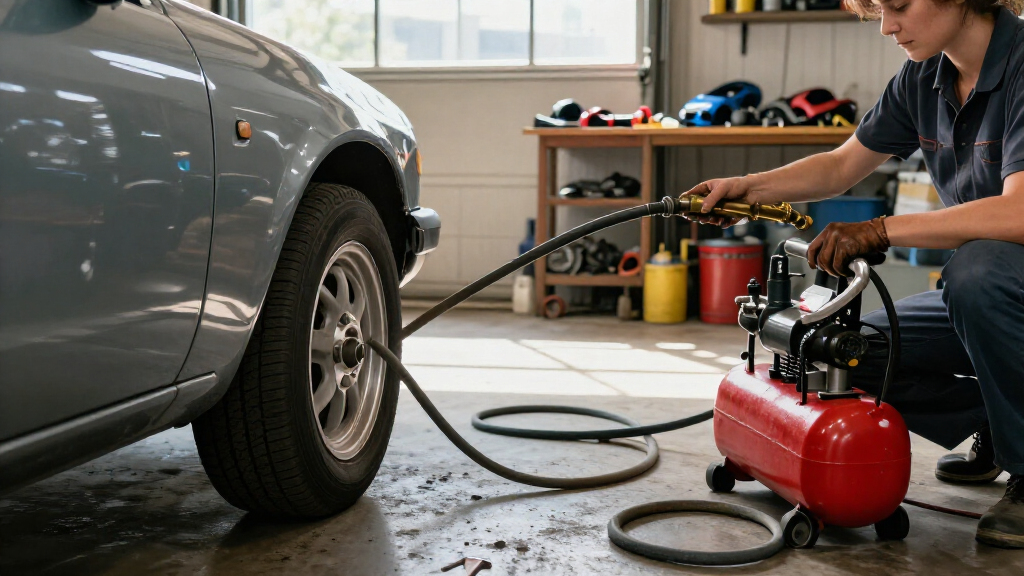
How We Picked
I ranked these garage air compressors by how well their stated capacity, pressure, and airflow match common garage jobs, from tire inflation and light DIY work to running air tools. I also weighed practical ownership factors: portability, storage footprint, oil-free maintenance, and whether the included accessories reduce setup work or simply add items a buyer may not need.
The order favors versatile compressors that can cover a wider range of home-garage tasks, then distinguishes specialized picks for airflow, quiet operation, beginner-friendly kits, and limited-space storage. Where product details do not state a comparable airflow figure, I avoid treating tank capacity or maximum PSI as proof that a model can run demanding tools. Buyers should confirm the compressor’s CFM at the tool’s required PSI before choosing it for sustained use.
| garage air compressor | Pump |
|---|---|
| CRAFTSMAN 26-Gallon Vertical O | Oil-free |
| RyanTek 15-Gallon Oil-Free Air | Oil-free, twin-cylinder |
| DEWALT DWFP55130 2.5-Gallon Po | Oil-free |
| Klutch 20-Gallon Air Compresso | — |
| Klutch 29-Gallon Air Compresso | Oil-free |
| DEWALT 27-Gallon Vertical Oil- | — |
| Craftsman 6-Gallon Pancake Air | — |
| CRAFTSMAN Air Compressor | Oil-free |
| CRAFTSMAN Wall Mount Air Compr | — |
| ECOMAX 6-Gallon 150 PSI Oil-Fr | — |
Factors to Consider When Choosing Garage Air Compressors
I’d choose a garage compressor by starting with the job that sets the highest demand, not by picking the biggest tank or pressure number. These factors help separate compressors suited to occasional inflation from models intended to keep air tools working.
Match Airflow to the Tool, Not Just the PSI
CFM at a stated PSI is the key comparison for tools that run continuously, such as some sanders, grinders, and spray equipment. Maximum PSI tells you the upper pressure the compressor can reach; it does not say how quickly it can replace air while a tool is running. Find the tool’s airflow requirement and compare it with the compressor’s delivered airflow at a similar pressure. If a tool needs more air than the compressor can supply, a larger tank may delay the slowdown but will not solve the mismatch. For tools with intermittent bursts, a modest compressor may still work because it can recover between uses. Check the duty cycle and intended use before planning long sessions. When airflow figures are missing, treat the compressor as a better fit for lighter tasks until the manufacturer provides a clear rating.
Choose Tank Capacity for Work Rhythm
A tank stores compressed air, giving a tool a reserve and reducing how often the motor needs to restart. Small tanks suit short bursts such as topping up tires or using a brad nailer, while larger tanks can support longer bursts before pressure drops. But tank capacity is not the same as continuous output: the pump still has to replenish air at a rate that keeps up with the tool. A common mistake is buying a large tank to compensate for low airflow, then finding that the compressor still cycles frequently during sustained work. Think about how long you use a tool at once and how much recovery time you can tolerate. A larger unit may also take up more floor space and be harder to move, so capacity has a real storage cost.
Plan for Noise, Location, and Power
Noise can shape where and when you work, especially in an attached garage or a home with nearby rooms. Look for a published sound rating if quiet operation is a priority; labels such as “quiet” are useful clues but do not replace a comparable measurement. A vertical compressor can use floor space efficiently, while a wall-mounted unit keeps the tank and hose arrangement off the floor but needs a suitable mounting surface and permanent location. Check the electrical requirements and circuit capacity before bringing home a larger motor, since a compressor that trips a shared circuit can disrupt other garage equipment. Also consider hose reach, ventilation, and access to the drain and controls. The best placement is one that leaves enough room for safe operation and routine maintenance.
Treat Portability as a Real Requirement
Portable does not always mean effortless to move: a full-size tank can be awkward even with wheels, while a small compressor is easier to carry but may need more frequent recovery. Decide whether the unit will stay beside a workbench, move between the garage and driveway, or travel to other locations. For a fixed tire-inflation station, a wall mount and long retractable hose can reduce floor clutter. For varied tasks around a home, a compact tank may be more useful than a higher-capacity model that rarely leaves its corner. Pay attention to the complete setup, including hose storage, handle placement, and accessory compatibility. Avoid choosing a small unit solely for portability if your main tools require sustained airflow.
Weigh Maintenance and Accessory Bundles
Oil-free pumps reduce routine lubrication work, which can suit occasional users who want a simpler ownership routine. They still need care: drain moisture from the tank as directed, keep intake areas clear, and follow the manual’s inspection schedule. Bundled kits may include a hose, inflation attachments, or basic tools, making setup easier for someone starting from scratch. Yet a bundle is only useful when its fittings match the tasks you actually do; an accessory set cannot replace a compressor with adequate airflow. Compare the compressor itself before giving much weight to the number of included pieces. Also check whether common fittings and replacement parts are easy to source for your intended setup.
Leave Headroom for Future Projects
Buy for your most demanding likely task, but avoid paying in space and complexity for work you do not expect to do. A buyer who only inflates tires and runs occasional nailers may prefer a compact, simple compressor over a large shop-style tank. Someone planning to add an air-hungry tool should check that tool’s airflow needs before choosing a model, rather than assuming any garage compressor will support it. Consider whether you will use one tool at a time or want multiple users to work at once; the latter can raise airflow demand quickly. A larger compressor can provide more reserve, but it may also bring more noise, weight, and electrical demands. Choosing with a specific upgrade path in mind is more useful than buying on vague hopes of “future-proofing.”
Frequently Asked Questions
Can a small-tank compressor run an impact wrench?
It depends on the wrench’s airflow demand, how often you use it, and the compressor’s delivered CFM at the working pressure. A small tank may handle short bursts, but repeated use can drain the reserve faster than the pump restores it. Check the tool manual for its air consumption and compare that figure with the compressor rating at the same or a similar PSI. If the compressor’s airflow is below the tool’s demand, expect pauses or reduced performance rather than assuming a higher maximum PSI will fix it. For frequent wheel work, favor an adequately rated compressor over one selected only for compact size.
Is a 26- or 29-gallon compressor worth the space in a home garage?
A larger tank makes sense when your work involves longer bursts, frequent tool use, or less tolerance for recovery pauses. It is less compelling if your main jobs are tire inflation, brief blow-offs, or occasional nail-gun use. Compare airflow as well as capacity: a bigger tank can store more air, but it cannot make an underpowered pump deliver air faster. Measure the intended parking or work area and leave room to reach the drain, controls, and hose connections. If floor space is tight, a vertical design or compact unit may fit better even if it offers less reserve.
Should I choose an oil-free compressor for a garage?
Oil-free designs are a practical choice for buyers who want to avoid checking and changing pump oil as part of regular care. That convenience does not mean the compressor is maintenance-free; tank moisture still needs draining, and the manual may call for other inspections. Some buyers may prefer an oil-lubricated model for a different duty profile, but the pump design alone does not tell you whether a compressor can run a particular tool. Compare airflow, duty cycle, noise, and upkeep instructions together. For occasional home-garage jobs, the simpler routine of an oil-free model can be a useful advantage.
What should I check before buying a compressor for spray painting?
Start with the spray gun’s required CFM and operating pressure, then compare them with the compressor’s delivered airflow at that pressure. Painting can demand steady, clean air for longer stretches than tire inflation, so tank size by itself is a poor guide. Check whether the compressor can support the gun without frequent pressure swings, and plan for suitable filtration and moisture control in the air line. Also consider noise and where the unit can run while you work. If the airflow rating is not clear, contact the manufacturer or choose a compressor with documented output that meets the gun’s stated needs.
Do accessory kits make a compressor a better buy for a first-time owner?
A kit can make setup easier when it includes useful basics such as an air hose and tire-inflation fittings, particularly if you own no compatible equipment yet. Still, the included pieces do not tell you whether the compressor has enough airflow for your planned tools. Check the fittings, hose length, and tool compatibility before treating the bundle as a deciding factor. A beginner focused on tires and light tasks may value a ready-to-use set, while a buyer planning air-tool work should prioritize compressor output first. You can also add better-matched accessories later, so avoid letting a long accessory list outweigh the machine’s capabilities.
Conclusion
For the broadest home-garage mix, I’d choose the CRAFTSMAN 26-Gallon as the best overall pick, while buyers who need a stated airflow figure for more demanding tool work should look closely at the Klutch 29-Gallon as the premium, airflow-focused option. The RyanTek 15-Gallon is the best value-style middle ground for shoppers who want more reserve than a small portable unit without stepping up to the largest tanks. For beginners handling tire inflation and occasional light tasks, the Craftsman 6-Gallon Pancake Combo Kit offers a straightforward starting point with included tools. Choose the DEWALT 2.5-Gallon when portability and quieter operation matter most, or the CRAFTSMAN wall-mount model when a fixed garage station and retractable hose better fit your space. Before deciding, match the compressor’s CFM at your tool’s working pressure to the work you plan to do.
Black Friday Picks

Vitamix 5200 Blender with 64 oz. Container, Black
As an affiliate, we earn on qualifying purchases.