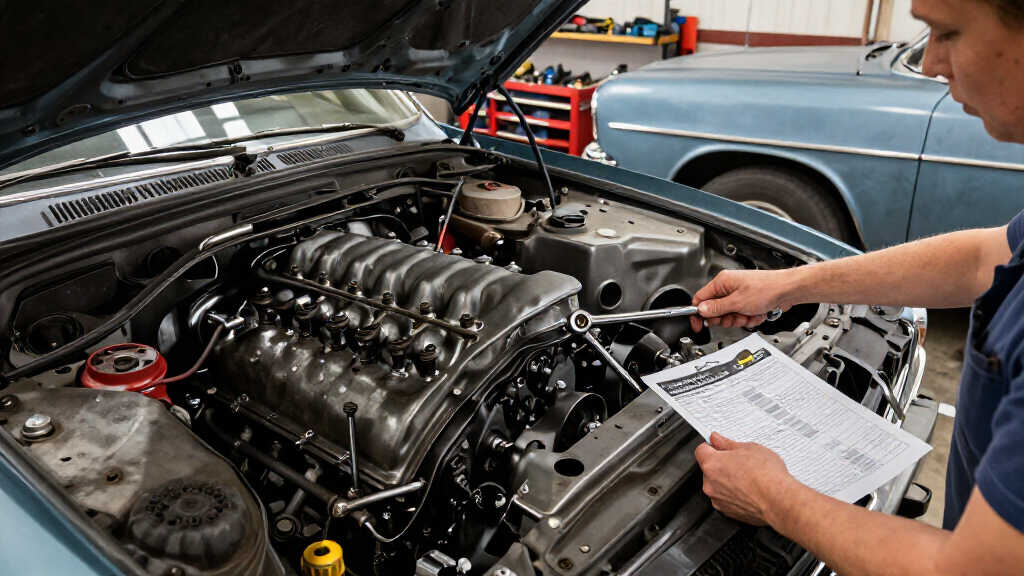
This checklist is for classic-car owners planning an engine rebuild, whether you are tackling the work yourself or organizing tools before a shop visit. A rebuild involves more than replacement parts: safe handling, clean preparation, and careful assembly all shape how smoothly the work proceeds.

Get business pricing on garage and car supplies
- Business-only prices and quantity discounts
- Tax-exempt purchasing
- Multiple users, one account, clear invoices
The sections follow the work from lifting and supporting the engine through cylinder preparation and assembly. Some entries are tool guidance without a product pick; others include a named pick that you should verify against your engine and intended use.
Use each section to check fit, capacity, and compatibility before buying. Confirm the engine’s service information, work area, and tool requirements first, then treat the list as a planning aid rather than a substitute for the manufacturer’s procedures.
Engine hoist
A hoist is the tool that moves an engine between the vehicle and your work area, so choosing one starts with safe handling rather than convenience. Check the engine’s weight and lifting points against the hoist’s documented capacity, and account for any attached components that will remain on the engine. Use suitable chains or lifting hardware, inspect them before use, and follow the hoist instructions throughout the lift.A common mistake is assuming that a hoist that fits through a doorway or under a hood is automatically suitable for the job. Reach affects capacity on many hoists, so check the rating at the boom position you actually need. Also consider the floor surface, available turning room, and how the legs will clear the vehicle. Keep the load controlled, avoid working under a suspended engine, and arrange a stable route to the engine stand before lifting.
What to look for:
- Documented capacity appropriate to the engine and attachments
- Capacity rating at the intended boom extension
- Leg and boom clearance for the vehicle and work area
- Compatible lifting chains, brackets, or load leveler
- Stable floor and clear path to the engine stand
Engine stand
An engine stand supports the engine during inspection and assembly, and a rotating head can make it easier to reach different sides. The listed pick is named “Rotating Amber Glass Fruit and Snack Serving Stand with Gold Metal Fra.” Its name describes a serving stand, not an engine stand, so it does not establish that it can support an engine or attach to an engine block.Do not use a serving stand as engine support. Before choosing an actual engine stand, confirm its rated capacity, mounting plate and fastener compatibility, rotation-locking method, and footprint. Check that the stand’s mounting pattern works with the block and that the engine can be secured with the specified hardware. A frequent buying mistake is treating “rotating” as enough evidence of suitability; rotation alone says nothing about load rating or secure mounting. Select a stand made for engine support and follow its assembly and use instructions.
What to look for:
- A stand explicitly designed for engine support
- Documented capacity suitable for the complete engine
- Mounting plate and hardware compatible with the block
- Secure rotation lock and stable base
- Clear assembly and safe-use instructions
Rotating Amber Glass Fruit and Snack Serving Stand with Gold Metal Frame

This decorative serving stand has one fixed center bowl and four rotatable side bowls made of embossed amber glass. Its weighted gold-tone metal base is designed for stability, and the detachable bowls are hand-wash only.
Pros:
- Rotatable side bowls make snacks easy to access
- Detachable glass bowls are easy to wipe clean
- Decorative amber glass and gold-tone frame suit entertaining and home display
Cons:
- Hand-wash only
- Large footprint may require substantial table space
Best for: Rebuilders selecting a purpose-built engine stand
Not ideal for: Anyone considering the listed serving stand for engine loads
Bottom line: The named serving stand is not identified as engine support; choose a rated engine stand with compatible mounting hardware.
Cylinder honing tool
Cylinder honing prepares cylinder walls as part of an engine rebuild, and the correct approach depends on the engine’s specifications and the condition of the bores. Before selecting a tool or abrasive, consult the service information for the required finish and procedure. Confirm the bore diameter and tool range, and make sure the method is appropriate for the block and the work being performed.A common mistake is honing by feel or choosing an abrasive without knowing the required finish. Too much or uneven material removal can affect fit, so do not treat honing as a general cleanup step. Check the tool’s adjustment range and use instructions, keep the tool aligned, and follow the specified lubrication and cleaning process. If the bores need measurement or machining beyond your equipment or experience, get an engine machine shop involved before assembly. Compatibility here means matching the tool and process to the engine—not merely finding a tool that enters the cylinder.
What to look for:
- Tool range that matches the measured cylinder bore
- Abrasive and process suited to the service specification
- Clear instructions for setup, lubrication, and use
- A way to maintain alignment and consistent movement
- Machine-shop guidance when bore condition exceeds the planned work
Piston ring compressor
A ring compressor helps guide piston rings into the cylinder during installation. The listed pick is “Piston Ring Compressor Tool Kit with Pliers & Wrench, Adjustable Size,” but its name alone does not establish the tool’s size range or compatibility with a particular piston and bore. Check the listed specifications against measured dimensions and the engine’s assembly instructions before relying on it.Look for a range that covers the piston and cylinder dimensions, along with a design that tightens evenly and releases cleanly. A common mistake is assuming an adjustable tool fits every engine or forcing a piston when a ring catches. Keep the compressor square to the bore, confirm the rings are oriented and gapped as specified, and use the method described in the service information. If the tool’s range, fit, or operating instructions are unclear, resolve that before assembly. Careful alignment and a suitable fit help avoid turning a routine installation step into a damaged ring or cylinder.
What to look for:
- Documented size range matching piston and bore measurements
- Even compression around the ring pack
- Secure tightening and controlled release
- Instructions compatible with the intended installation method
- Clear access for keeping the compressor square to the bore
Piston Ring Compressor Tool Kit with Pliers & Wrench, Adjustable Size from 2.08"

This professional piston ring compressor kit includes a tension band, pliers, and a four corner wrench, designed for engine repair and assembly. The adjustable tension bands fit piston sizes from 2.08" to 5.90", ensuring a secure compression of piston rings during installation.
Pros:
- Adjustable size for a wide range of piston diameters
- Durable manganese steel construction
- Includes essential tools for engine repair
Cons:
- Requires some mechanical skill to operate
- Limited to piston sizes within specified range
Best for: Rebuilders whose measured piston and bore fit the tool’s documented range
Not ideal for: Engines with dimensions outside the stated range or unclear fit
Bottom line: Confirm the tool’s actual size range and follow the engine’s ring installation procedure.
Torque wrench
A torque wrench helps apply specified fastener torque during engine assembly, where the correct value depends on the fastener and engine procedure. The listed pick is “Tekton 1/4, 3/8, 1/2 Inch Drive Micrometer Torque Wrench Set.” The name identifies three drive sizes and a micrometer style, but you should check the published ranges and accuracy information against the torque specifications you need to apply.A frequent mistake is using a wrench outside its specified range or assuming drive size alone determines suitability. Compare each required torque value with the wrench’s range, confirm the needed sockets or adapters, and follow the engine manual’s sequence and any instructions for threads or lubrication. Use the wrench as directed, avoid using it as a breaker bar, and store it according to its instructions. For fasteners with a specified tightening sequence or staged procedure, follow those steps precisely. A set is useful only when its coverage matches the actual assembly tasks.
What to look for:
- Range coverage for the engine’s required torque values
- Accuracy information and calibration guidance
- Drive sizes compatible with the required sockets
- Instructions for setting, using, and storing each wrench
- A suitable procedure for fasteners requiring staged tightening
Tekton 1/4, 3/8, 1/2 Inch Drive Micrometer Torque Wrench Set

This set includes three calibrated micrometer torque wrenches with 1/4, 3/8, and 1/2 inch drives, each with a certified accuracy within ±3%. Designed for precision and control, the wrenches feature easy-to-read scales, secure locking collars, and durable cases for safe transport.
Pros:
- Calibrated to ISO standards with certified accuracy within ±3%
- Includes multiple drive sizes for versatile use
- Durable cases for safe transport and storage
- Easy-to-read laser-marked scales
Cons:
- No thumb knob for locking adjustment
- Requires careful handling to maintain calibration
- Limited to specific torque ranges
Best for: Rebuilders whose required torque values fall within the set’s documented ranges
Not ideal for: Jobs requiring values or access the set does not cover
Bottom line: Verify the range of each wrench against the engine manual before tightening fasteners.
Engine assembly lubricant
Assembly lubricant is used during engine assembly where the service procedure calls for it. The right product and application depend on the engine components and instructions, so start with the rebuild documentation rather than choosing by a broad label. Confirm which surfaces or parts require assembly lubricant and whether the procedure specifies a particular type or application method.A common mistake is applying lubricant everywhere or substituting it for a different fluid specified by the procedure. Follow the component maker’s instructions, use only the amount and locations directed, and keep parts clean as you assemble them. Check compatibility with the materials and the next steps in the build, including any instructions about priming or initial startup. If the documentation does not make the product or application clear, ask the engine builder or machine shop before assembly. Careful, documented application helps keep lubrication decisions consistent across the rebuild.
What to look for:
- Product type specified by the engine or component instructions
- Compatibility with the parts and materials being assembled
- Clear application guidance for the required surfaces
- Instructions for storage and use during assembly
- Guidance that fits the planned priming and startup procedure
Set priorities around safe handling and engine-specific fit first: confirm the hoist and a purpose-built stand, then identify the cylinder preparation method and tools required for assembly. Check the compressor dimensions and torque ranges against the engine documentation before purchase, and choose lubricant based on the stated procedure. This buying order helps catch compatibility gaps before the rebuild is underway.
Take the work one step at a time, measure carefully, and keep the service information close as you prepare each part. When a tool’s rating, fit, or procedure is uncertain, pause and confirm it with a qualified machine shop or engine builder. A well-planned rebuild starts with clear specifications and tools suited to the job.
Evergreen bestsellers Picks

Breville Barista Pro Espresso Machine with Built-In Grinder, Brushed Stainless Steel

Bose QuietComfort Wireless Bluetooth Noise-Cancelling Headphones, Ice Blue

Ninja Double Oven Pro XL Countertop Oven and Air Fryer, 12-in-1, Onyx, DCT801BK
As an affiliate, we earn on qualifying purchases.