
TL;DR

Get business pricing on garage and car supplies
- Business-only prices and quantity discounts
- Tax-exempt purchasing
- Multiple users, one account, clear invoices
Online interest is surging around a report that Mercedes-Benz plans to assemble a battery-electric GLC in Thailand. The claim has not been confirmed by the company, and key details such as timing, plant location and investment size remain unverified.
Attention is spiking around a single-line automotive item circulating under the headline “Mercedes-Benz to assemble electric GLC in Thailand”. The item, picked up via an auto news feed, suggests the German luxury automaker is preparing to build a battery-electric version of its GLC SUV at its Thai operations. As of now, no company statement, press release or named executive comment has been verified, and the specifics of the reported plan remain unconfirmed.
What is established beyond dispute is the broader setting. Mercedes-Benz has operated in Thailand for decades and maintains an assembly operation in Rayong, in the country’s Eastern Seaboard industrial zone, which has produced Mercedes passenger cars for the Thai and regional market. Thailand has long been Southeast Asia’s second-largest vehicle manufacturing hub after Indonesia, and its government has for years pursued policies meant to attract electric vehicle production, including tax incentives and subsidy schemes tied to local manufacturing commitments.
The reported development is that the electric GLC — a battery-electric variant of Mercedes’ best-selling midsize luxury SUV, which the company has confirmed globally as part of its electrified lineup rollout — would be added to local Thai assembly. Interest in the story appears to be driven by that combination: Mercedes’ most commercially important SUV body style, electrified, and built in Thailand rather than imported. For Thai buyers, local assembly has historically meant lower import duties and, in several government incentive schemes, eligibility for EV subsidies that imported models do not receive.
However, the only verified information at this stage is the existence of the headline and the coverage interest around it. It is not yet clear whether the report refers to full assembly of a finished vehicle, semi-knocked-down or completely-knocked-down kit assembly, or another form of local manufacturing arrangement. No timeline, investment figure, production volume target or plant has been confirmed in the material available.
Why Local EV Assembly Matters in Thailand
If confirmed, locally assembling an electric GLC in Thailand would carry weight on several fronts. First, Thailand is the largest luxury car market in Southeast Asia, and Mercedes-Benz competes closely there with BMW; locally built models enjoy a meaningful cost advantage over imported rivals. Second, Thailand’s EV incentive framework has rewarded automakers that commit to domestic production, and several manufacturers — particularly Chinese brands — have already announced or begun Thai EV assembly plants. A Mercedes EV assembly commitment would signal that established premium incumbents are responding to that competitive shift rather than conceding the local EV segment to newer entrants.
Third, the GLC is consistently among Mercedes’ highest-volume models globally, and an electric GLC built in Thailand would mark one of the clearest cases of a premium European EV being localized for the Southeast Asian market rather than exported from Europe. That has implications for pricing, delivery times and the pace of EV adoption among Thai buyers who have so far seen limited premium EV options assembled locally.
Mercedes-Benz and Thailand’s EV Push
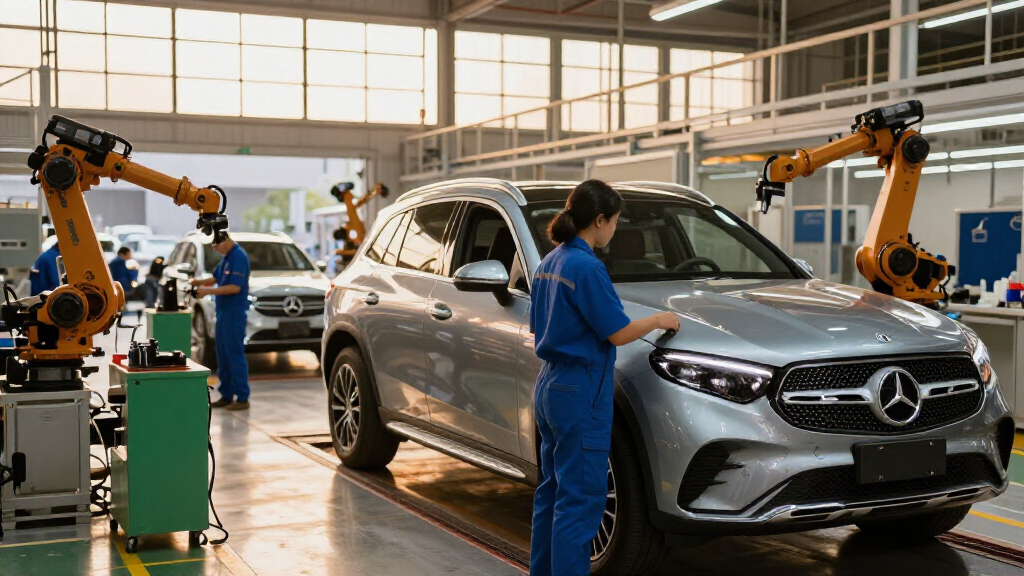
Mercedes-Benz has assembled vehicles in Thailand since the 1970s, with its Rayong plant opened in the late 1990s serving as its regional production base. The plant has built models including the C-Class, E-Class, GLC and various SUVs for the Thai market. In recent years, Mercedes has also introduced EQ-badged electric vehicles in Thailand, though these have generally been imported rather than locally assembled.
Meanwhile, the Thai government has pursued an aggressive EV strategy, offering purchase subsidies and reduced excise duties conditional on manufacturers producing equivalent volumes domestically within a set period. That policy has drawn major investment commitments, primarily from Chinese automakers such as BYD, Great Wall Motor and Changan. Japanese and European incumbents, whose Thai operations are built around combustion-engine and hybrid assembly, have faced pressure to respond with electrified local production plans of their own. A report linking Mercedes to local electric GLC assembly fits squarely into that competitive and policy backdrop — which is likely why the item is drawing attention even before details are confirmed.
Unverified: Scope, Timing and Official Word
The trigger for the spike in coverage is unconfirmed. The available material consists of a headline without substantiating detail, and no attributable statement from Mercedes-Benz Thailand, its parent company in Stuttgart, or Thai government agencies has been verified. Key open questions include: whether the plan exists at all in the form reported; whether it involves full local assembly or a lighter manufacturing arrangement; which plant would be used, if any; the intended start date; whether production would serve only Thailand or the wider ASEAN region; and what, if any, government incentives are attached. Readers should treat the specific claim — that Mercedes will assemble an electric GLC in Thailand — as a report of interest, not an established fact, until an official announcement or credible detailed reporting surfaces.
What Would Confirm the Story
The clearest confirmation path would be an official statement from Mercedes-Benz (Thailand) or a filing with the Thailand Board of Investment, which typically announces approved manufacturing incentives for automotive projects. Industry trade press in Thailand and regional outlets would be expected to follow with details on investment value, model specifications and production timelines if the plan is real. Until then, the development to watch is whether Mercedes or Thai officials publicly acknowledge an electric GLC assembly plan — and whether Thailand’s next round of EV policy measures names premium manufacturers among local-production participants. Absent that, the story remains at the stage of circulating report, status developing.
Key Questions
Has Mercedes-Benz confirmed it will assemble the electric GLC in Thailand?
No. As of now the claim exists only as a circulating report. No verified statement from Mercedes-Benz or Thai authorities has confirmed the plan, its timing or its scope.
Where does Mercedes-Benz currently build cars in Thailand?
Mercedes-Benz operates a long-established assembly plant in Rayong, on Thailand’s Eastern Seaboard, which has produced several Mercedes models for the Thai market over the years.
Why would local assembly of an electric GLC matter?
Locally assembled vehicles in Thailand generally avoid high import duties, making them cheaper, and may qualify for government EV incentives unavailable to imports. It would also signal a premium European automaker localizing EV production against growing Chinese-brand competition in Thailand.
Is the electric GLC an existing model?
Mercedes has confirmed globally that an electric version of the GLC is part of its electrified model rollout. Whether a Thai-built version of that vehicle is actually planned is the unconfirmed part of the current report.
What would confirm or refute this report?
An official Mercedes-Benz Thailand announcement, a Thailand Board of Investment approval notice, or detailed reporting from established outlets naming the plant, timeline and investment would confirm the plan. Until such sources appear, the story should be treated as unverified.
Source: rss
Fall Picks
fall essentials
As an affiliate, we earn on qualifying purchases.