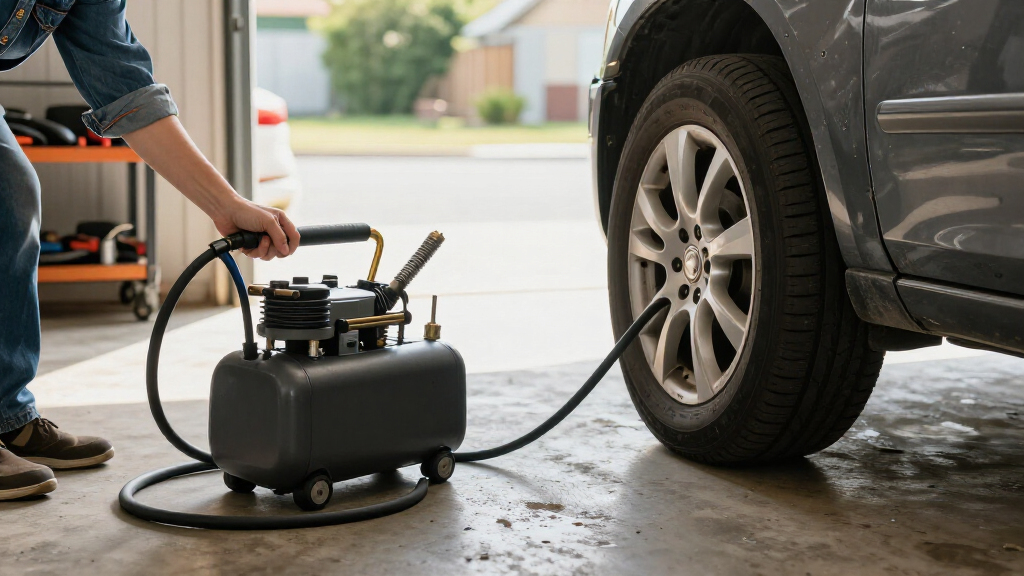
For most home garages, I’d start with the CRAFTSMAN 6-Gallon Pancake Air Compressor: its portable format and 150 PSI rating suit a range of routine inflation and air-tool tasks. The Quiet Oil-Free 5-Gallon model stands out when noise matters, while the Klutch 20-Gallon compressor favors longer runs over easy carrying. The main tradeoff is between tank capacity and portability, with noise, power needs, and maintenance also shaping the choice. Smaller pancake and compact models are easier to store but have less reserve air for demanding tools. Read on for the full comparison and picks by garage use.

Get business pricing on garage and car supplies
- Business-only prices and quantity discounts
- Tax-exempt purchasing
- Multiple users, one account, clear invoices
Complete the kit


Key Takeaways
- The CRAFTSMAN 6-Gallon pancake model is the strongest all-around fit in this group for buyers who want a familiar portable format and 150 PSI capacity.
- The Klutch 20-Gallon model prioritizes air reserve over portability; its larger tank suits longer work sessions, but it is less convenient to move around a garage.
- The Quiet Oil-Free 5-Gallon compressor addresses a real garage constraint: its stated 68 dB noise level may suit shared or attached workspaces better than capacity-first options.
- Accessory kits distinguish several compact CRAFTSMAN and ECOMAX picks, but included accessories matter less if they do not match the fittings and tools already in your garage.
- Oil-free designs appear across much of this lineup, so buyers can focus on footprint, tank size, and noise rather than treating routine oil changes as the deciding factor.


| portable garage air compressor | Tank capacity | Noise level | Maximum pressure | Weight |
|---|---|---|---|---|
| CRAFTSMAN Wall-Mount Air Compr | 0.5 gallons | 65 dB | 125 PSI | — |
| Klutch 20-Gallon Air Compresso | 20 gallons | 80 dB | 175 PSI | 90 pounds |
| Quiet Oil-Free Air Compressor | 5 gallons | 68 dB | — | — |
| CRAFTSMAN 2-Gallon Portable Oi | 2 gallons | 78 dB | 125 PSI | 19 pounds |
| VEVOR 6.3-Gallon 2 HP Oil-Free | 6.3 gallons | 70 dB | 116 PSI | 43 pounds |
| ECOMAX 6-Gallon 150 PSI Oil-Fr | 6 gallons | 75 dB | 150 PSI | 34.17 lbs |
| FORNAX 3-Gallon Oil-Free Panca | 3 gallons | 89 dB(A) | 110 PSI | 18.90 lbs |
| CRAFTSMAN 6-Gallon 150 PSI Oil | 6 gallons | 82 dB | 150 PSI | 30.8 lbs |
More Details on Our Top Picks
CRAFTSMAN Wall-Mount Air Compressor with 8-Piece Accessory Kit
The CRAFTSMAN wall-mount is the easiest pick to fit into a crowded garage: its compact 0.5-gallon tank keeps the unit small, while the 30-foot retractable hose reaches around a vehicle without moving the compressor. At 65 dB, it is also quieter than the 5-gallon Quiet Oil-Free model and the larger Klutch. The tradeoff is the tank: 1.8 CFM and half a gallon of storage suit tire inflation and brief bursts, not sustained sanding or other air-hungry work. Its oil-free pump and included inflation and blow-gun accessories keep routine setup simple. Choose it when saving floor space matters more than running tools for longer stretches; skip it if your garage work depends on steady airflow.
Pros:- Wall-mount design frees up garage floor space.
- Retractable 30-foot hose reaches around a parked vehicle.
- 65 dB noise level is lower than the listed levels for the other compressors here.
- Oil-free pump and included inflation accessories simplify routine use.
Cons:- The 0.5-gallon tank is too small for extended air-tool use.
- The listed 1.8 CFM airflow limits it to lighter-duty tasks.
Best for: Drivers and DIYers with a small garage who mainly inflate tires, blow away debris, and need a long hose without a floor-standing tank.
Not ideal for: People running air tools continuously, since the 0.5-gallon tank and 1.8 CFM airflow limit sustained work.
- Tank capacity:0.5 gallons
- Motor power:1.5 HP
- Maximum pressure:125 PSI
- Airflow:1.8 CFM
- Hose length:30 feet, retractable
- Noise level:65 dB
- Power source:Corded electric
- Pump type:Oil-free
Our verdict“Pick this CRAFTSMAN for tire inflation and short tasks in a tight garage where a wall-mounted footprint matters most.”
Klutch 20-Gallon Air Compressor, 2 HP, 120V, 175 PSI
Among these five, the Klutch 20-gallon is the strongest fit for a garage that regularly runs nailers or other tools needing more air in reserve. Its 4.2 SCFM at 90 PSI and 75% duty cycle give it a more workshop-oriented profile than the compact CRAFTSMAN wall-mount or the 5-gallon Quiet Oil-Free model. Large wheels and an ergonomic handle make it movable, though 90 pounds is a substantial load to roll in and out of storage. That capacity comes with a clear cost in comfort: at 80 dB, it is the loudest listed option here. The 120 V connection may suit a standard garage outlet, but its 14 A draw still merits checking the circuit when other equipment is running.
Pros:- 20-gallon tank stores far more air than the compact models in this group.
- Delivers 4.2 SCFM at 90 PSI for regular tool use.
- 75% duty cycle and quick recovery support longer work sessions.
- Wheels and an ergonomic handle help move its 90-pound frame.
Cons:- At 90 pounds, it is cumbersome to lift or carry.
- Its 80 dB operating noise is high for an attached or shared garage.
- The large tank and 41.5-inch height require dedicated storage space.
Best for: Home mechanics and serious DIYers who use nailers or similar pneumatic tools in a dedicated garage and want a larger air reserve.
Not ideal for: Apartment or shared-garage users who need quiet operation, frequent lifting, or a compressor that stores in a small space.
- Tank capacity:20 gallons
- Motor power:2 HP
- Maximum pressure:175 PSI
- Airflow at 90 PSI:4.2 SCFM
- Duty cycle:75%
- Noise level:80 dB
- Voltage and current:120 V; 14 A maximum
- Weight:90 pounds
Our verdict“Choose the Klutch when longer tool sessions and air capacity matter more than low noise or easy carrying.”
Quiet Oil-Free Air Compressor, 5-Gallon Tank, 68 dB
The Quiet Oil-Free 5-gallon balances usable tank capacity with a lower listed noise level, making it a more comfortable shared-garage choice than the 80 dB Klutch. At 68 dB, it is also quieter than the 2-gallon CRAFTSMAN, and its 2.8 CFM at 90 PSI gives it more breathing room for tools than the wall-mounted CRAFTSMAN. Wheels, a 25-foot hose, and a 13-piece kit make moving between a tire and a workbench straightforward. Its five-gallon tank still sets a limit: it cannot match the Klutch’s 20-gallon reserve for sustained tool use. The listed refill and recovery times are useful for planning short cycles, but this is best treated as a versatile garage compressor rather than a heavy-duty shop source.
Pros:- 68 dB operating level is quieter than the Klutch and 2-gallon CRAFTSMAN.
- 2.8 CFM at 90 PSI supports more than basic tire inflation.
- Wheels make it easier to move between garage work areas.
- Includes a 25-foot hose and 13-piece accessory kit.
Cons:- The 5-gallon tank can run short during sustained air-tool use.
- Its 1.2 HP motor and airflow are less suited to demanding shop tasks than the Klutch.
Best for: DIYers working in an attached garage who want to inflate tires and use smaller pneumatic tools without the noise of a larger compressor.
Not ideal for: Mechanics who run air-hungry tools for long periods and need the larger reserve of a 20-gallon tank.
- Tank capacity:5 gallons
- Power:1.2 HP
- Airflow at 40 PSI:4 CFM
- Airflow at 90 PSI:2.8 CFM
- Noise level:68 dB
- Refill time:80 seconds from empty to full
- Recovery time:25 seconds
- Included hose:25-foot PVC air hose
- Pump type:Oil-free
Our verdict“Choose this model for quieter, mobile garage work with smaller tools, and move up to the Klutch for longer sessions.”
CRAFTSMAN 2-Gallon Portable Oil-Free Air Compressor, 1/3 HP, 125 PSI, with 10-Piece Accessory Kit
At 19 pounds, this 2-gallon CRAFTSMAN is the straightforward choice when the compressor needs to travel from a garage shelf to a vehicle or another work area. Its handle and included 10-piece kit make basic inflation and small workshop jobs easier to start than with the wall-mounted CRAFTSMAN, which trades a carried tank for a long fixed hose. The extra capacity over that half-gallon model gives it a little more reserve, but the 1/3 HP motor and 125 PSI maximum do not make it a long-session tool. The 78 dB noise level is also notably higher than the 5-gallon Quiet Oil-Free model’s 68 dB. It suits portability-first buyers who accept frequent pauses and modest airflow.
Pros:- 19-pound weight and reinforced handle make it easy to carry.
- Two-gallon tank offers more reserve than the wall-mounted CRAFTSMAN.
- Oil-free pump avoids routine pump oil changes.
- Includes a 10-piece accessory kit for common garage tasks.
Cons:- The 1/3 HP motor is a modest match for sustained air-tool use.
- 78 dB is louder than the 5-gallon Quiet Oil-Free model.
- The 2-gallon tank still requires pauses during repeated tool work.
Best for: Homeowners who need to carry a compressor between a garage, driveway, and storage area for tires and occasional small tasks.
Not ideal for: Buyers who need quiet operation or sustained airflow for repeated pneumatic-tool work.
- Tank capacity:2 gallons
- Motor power:1/3 HP
- Maximum pressure:125 PSI
- Weight:19 pounds
- Voltage:120 volts
- Noise level:78 dB
- Pump type:Oil-free
- Style:Hot dog
- Included accessories:10-piece kit
Our verdict“Pick this CRAFTSMAN if carrying the compressor easily matters more than quiet operation or extended tool use.”
VEVOR 6.3-Gallon 2 HP Oil-Free Air Compressor
The VEVOR 6.3-gallon sits between the small portable compressors and the much larger Klutch: it stores more air than the 5-gallon Quiet Oil-Free model while weighing 43 pounds, less than half the Klutch’s listed 90 pounds. Its 3.35 CFM at 90 PSI suits intermittent nailing, spraying, tire inflation, and auto-repair tasks, though the 116 PSI ceiling is lower than the Klutch’s 175 PSI and the CRAFTSMAN models’ 125 PSI. Noise-reduction features bring its stated level to 70 dB, but the Quiet Oil-Free model is still quieter at 68 dB. Cooling fans and automatic overheating protection support regular use; the tradeoff is that 43 pounds remains awkward to carry often, and corded power limits where it can run.
Pros:- 6.3-gallon tank and 3.35 CFM at 90 PSI suit intermittent garage tools.
- At 43 pounds, it is lighter than the 20-gallon Klutch.
- Listed 70 dB noise level is below the levels stated for the Klutch and 2-gallon CRAFTSMAN.
- Cooling fans and automatic overheating protection support regular operation.
Cons:- The 43-pound body is cumbersome to carry frequently.
- 116 PSI maximum is lower than the Klutch’s 175 PSI.
- The Quiet Oil-Free 5-gallon model has a lower listed noise level.
Best for: DIY mechanics who need a moderate air reserve for intermittent tools and can roll or lift a 43-pound compressor around a garage.
Not ideal for: People who prioritize frequent hand-carrying, the quietest operation, or a higher pressure ceiling for their tools.
- Tank capacity:6.3 gallons
- Motor power:2 HP
- Air delivery at 90 PSI:3.35 CFM
- Maximum pressure:116 PSI
- Noise level:70 dB
- Voltage and current:120 V; 14.5 A
- Weight:43 pounds
- Pump type:Oil-free
Our verdict“Choose the VEVOR for a middle ground in tank capacity and weight when your tools fit its 116 PSI ceiling.”
ECOMAX 6-Gallon 150 PSI Oil-Free Pancake Air Compressor with 10-Piece Accessory Kit
The ECOMAX pairs a 6-gallon tank with a 25-foot hose and 10-piece kit, making it a flexible pick for garage owners who want to get started on tire inflation, blow cleaning, or light spraying without gathering accessories separately. Its flip-up handle and 34.17-pound weight make it movable around a home garage, though it is heavier than the 18.9-pound FORNAX 3-Gallon. The oil-free pump reduces routine upkeep, while dual gauges and quick couplers make switching tools more straightforward. One limitation deserves attention: the supplied airflow figure is just 3 cubic inches per minute, an unusually low listing that does not establish strong sustained tool performance. I would treat it as a general-purpose, intermittent-use compressor, not a choice for demanding air tools.
Pros:- Six-gallon tank and 150 PSI maximum pressure suit a range of intermittent garage jobs
- Includes a 25-foot hose and 10-piece accessory kit
- Oil-free pump needs less routine maintenance
- Flip-up handle, dual gauges, and quick couplers support portability and tool changes
Cons:- Listed airflow of 3 cubic inches per minute is too low to establish suitability for air-hungry tools
- At 34.17 pounds, it is heavier than the 3-gallon FORNAX
- The accessory listing repeats an auto plug
Best for: Garage owners who want a portable compressor with a hose and starter accessories for occasional inflation and cleanup tasks
Not ideal for: Buyers who need verified airflow for sustained sanding, spraying, or other high-demand air tools
- Tank capacity:6 gallons
- Maximum pressure:150 PSI
- Motor:1.5 hp
- Power:120 V corded electric
- Listed airflow:3 cubic inches per minute
- Noise level:75 dB
- Weight:34.17 lbs
- Hose length:25 ft
- Pump:Oil-free
Our verdict“Choose the ECOMAX for its included hose and accessories when your garage work is occasional and airflow demands are modest.”
FORNAX 3-Gallon Oil-Free Pancake Air Compressor
At 18.9 pounds with a 3-gallon tank, the FORNAX is the easiest of these three to carry between a garage, driveway, and storage shelf. That small footprint favors tire inflation and quick cleanup jobs where moving the compressor matters more than running a tool for long stretches. Compared with the 6-gallon CRAFTSMAN, it gives up tank capacity and reaches only 110 PSI, so it is a more limited fit for jobs that need longer bursts or higher pressure. Its oil-free pump keeps maintenance simple, but the 89 dB(A) noise level is a real drawback in an enclosed garage or near other people. The listed 0.8 CFM at 90 PSI also points toward light-duty use rather than sustained air-tool work.
Pros:- 18.9-pound weight is notably easier to carry than either 6-gallon model here
- Compact 3-gallon tank is easier to store in a crowded garage
- Oil-free pump reduces routine maintenance
- Provides 0.8 CFM at 90 PSI for light, intermittent tasks
Cons:- 110 PSI maximum and 3-gallon capacity limit longer or more demanding jobs
- 89 dB(A) noise level can be disruptive in an enclosed workspace
- Listed airflow is modest for sustained air-tool use
Best for: Homeowners who need a lightweight compressor for occasional tire inflation and brief cleanup jobs
Not ideal for: Garage users running air tools for extended periods or working where compressor noise is a concern
- Tank capacity:3 gallons
- Maximum pressure:110 PSI
- Air consumption at 90 PSI:0.8 CFM
- Motor speed:4950 RPM
- Noise level:89 dB(A)
- Weight:18.90 lbs
- Pump:Oil-free
Our verdict“Pick the FORNAX when low weight and easy storage matter more than tank capacity, airflow, or quieter operation.”
CRAFTSMAN 6-Gallon 150 PSI Oil-Free Pancake Air Compressor
The CRAFTSMAN’s standout advantage is a clear, usable airflow figure: 2.6 SCFM at 90 PSI. That makes it easier to judge against garage tools than the ECOMAX, whose listed airflow is only 3 cubic inches per minute. Its 6-gallon tank and 150 PSI maximum support common jobs such as nailing and tire inflation, while dual quick couplers let two users or tools connect without swapping a single outlet. At 30.8 pounds, it is also lighter than the ECOMAX, though the compact FORNAX remains far easier to carry. The tradeoffs are corded-only operation and 82 dB noise, so it needs an outlet and may be intrusive in a small attached garage. It is a practical general-purpose choice, not a quiet or cordless one.
Pros:- 2.6 SCFM at 90 PSI gives buyers a useful airflow reference for matching tools
- Six-gallon tank and 150 PSI maximum pressure suit varied home workshop tasks
- Dual quick couplers allow two connections
- At 30.8 pounds, it weighs less than the ECOMAX 6-gallon model
Cons:- Corded electric power limits use to locations with an outlet
- 82 dB noise level may be disruptive in an attached garage
- Heavier to carry than the compact 3-gallon FORNAX
Best for: DIY garage owners who want a 6-gallon compressor with stated airflow for nailing, inflation, and intermittent workshop jobs
Not ideal for: People who need to work far from an outlet, prioritize quiet operation, or need a lightweight compressor to carry frequently
- Model:CMXECXA02106410
- Tank capacity:6 gallons
- Maximum pressure:150 PSI
- Airflow:2.6 SCFM at 90 PSI
- Motor:1 HP
- Power:120 V corded electric
- Noise level:82 dB
- Weight:30.8 lbs
- Warranty:1 year
Our verdict“Choose the CRAFTSMAN if you want a portable 6-gallon garage compressor with a clearly stated airflow rating and can work near power.”

How We Picked
I compared these compressors as garage equipment that may need to move between a vehicle, workbench, and storage spot. The main criteria were tank capacity and pressure, stated motor and power details, portability, noise information, oil-free construction, and the practical usefulness of included accessories. I gave weight to how each specification affects ordinary tasks: tank reserve can reduce interruptions, while a compact form can be easier to store and carry.
The ranking favors versatility for common garage jobs first, then gives distinct advantages room to stand out. That puts a portable 6-gallon model ahead as the broadest fit, while the larger Klutch earns a role for buyers who value reserve capacity and the quiet 5-gallon unit serves noise-sensitive spaces. Smaller compressors rank better for light duty and storage than for sustained air-tool work. Where the supplied product details do not state a performance figure, I do not infer one.
Factors to Consider When Choosing Portable Garage Air Compressors
Choosing a garage compressor starts with the work you expect to do and the space you have to store it. I’d match the compressor to the tool’s air demand and duty cycle, then check whether the electrical setup, noise, and fittings suit the garage.
Match Air Delivery to the Tool, Not Just the PSI
PSI describes pressure, but it does not tell you how much air a compressor can deliver over time. Check the tool’s required CFM at its operating pressure, then compare it with the compressor’s delivered airflow rating at the same pressure. A tank can supply a short burst even when the pump cannot keep pace, so a tool may work briefly and then wait while the tank refills. This matters most for tools that run continuously, such as sanders or some spray equipment. Inflation and intermittent fastening usually place a different demand on the compressor. If an airflow figure is missing, ask the seller or manufacturer before assuming the unit can run a particular tool.
Treat Tank Size as a Buffer, Not a Measure of Power
A larger tank stores more compressed air, which can reduce how often the pump starts during short tasks. It does not by itself mean the compressor can sustain a high-demand tool; pump output still sets the refill pace. Larger tanks also take up more floor space and can be awkward to move through a crowded garage. Consider whether your work comes in brief bursts or requires a steady supply. For occasional inflation, portability and storage may matter more than reserve capacity. For repeated air-tool use, compare both tank size and the pump’s delivery rating.
Plan for Noise and Where the Compressor Will Sit
Noise becomes a practical issue when the garage shares a wall with living space or when you work for long stretches. A stated decibel figure helps with comparison, but the number alone does not describe how loud a compressor will feel in your room; distance, reflections, and run time all matter. A longer air hose may let you place the compressor farther from your work area, though it adds another item to manage. Think about where the unit can sit while remaining ventilated and accessible. Do not enclose a running compressor to muffle sound, since restricted airflow can cause heat buildup. If noise is a priority, compare manufacturer noise specifications and look for a suitable placement before buying.
Check the Garage’s Power Supply Before Choosing
Voltage and motor details affect whether a compressor fits the outlet you have available. A 120V rating is useful information, but it does not guarantee that a circuit can handle the unit alongside other equipment. Check the nameplate requirements and the manual’s guidance for extension cords, startup current, and circuit capacity. A long or undersized extension cord can cause performance and safety problems, so plan to use an appropriate outlet near the work area. If your garage has limited circuits, think about what else may run at the same time. Confirming the electrical setup first can prevent a capable compressor from becoming inconvenient to use.
Compare Portability With the Way You Store It
Portable can mean wheels, a handle, or simply a compact body, and those designs do not all suit the same garage. Measure the space where the compressor will live, including room for hose connections and airflow around the pump. If you need to carry it up steps or lift it onto shelving, check the listed weight rather than relying on the tank size. A wheeled unit may roll well across a clear floor yet be harder to maneuver around parked vehicles. Smaller compressors are easier to put away, but their reduced reserve can make some jobs slower. Choose for the route between storage and work, not for portability as an abstract label.
Look Beyond Oil-Free Claims and Included Accessories
Oil-free construction can simplify routine upkeep, but it does not make a compressor maintenance-free. Draining tank moisture, checking filters, inspecting hoses, and following the manual’s service schedule still matter. In a humid garage, moisture management helps protect both the tank and the air tools connected to it. Accessory kits can save setup time, yet a kit is only useful if its couplers, hose, and attachments suit your existing fittings and intended jobs. Check whether replacement parts and service instructions are available before purchase. A basic kit that fits your workflow may be more useful than a larger assortment of accessories you will not use.
Frequently Asked Questions
Can a 6-gallon portable compressor run an impact wrench for changing tires?
It may handle occasional short bursts, but tank size and PSI alone cannot confirm compatibility. Check the wrench’s required CFM at its operating pressure against the compressor’s delivered CFM at that pressure. Repeated lug removal can outpace a small compressor, leading to pauses while the tank refills. A larger tank can provide more reserve for a brief burst, but it will not fix inadequate pump output. If tire work is a main use, compare the wrench and compressor specifications before buying.
Is a 20-gallon compressor too large for a home garage?
It depends on whether you value air reserve more than easy movement and compact storage. A larger tank can be useful for repeated tasks that draw short bursts of air, but the compressor still needs enough airflow to keep up with demanding tools. Measure the available floor space and the path around parked cars before choosing a larger unit. Also check its weight, mobility features, and electrical requirements. For mostly inflation and occasional light tasks, a smaller compressor may be easier to live with.
Should I choose the quiet model if my garage is attached to my house?
A published noise figure gives you a useful comparison point, especially when compressor noise could reach living areas. It cannot predict exactly how the unit will sound in your garage, since walls, distance, and how often the pump runs all affect the experience. Placement farther from shared walls and an appropriately long hose may help, provided the compressor still has safe ventilation. Consider the tasks you will run and how long the compressor is likely to cycle. If quiet operation is a priority, compare stated noise levels and check how each manufacturer measured them.
Do I need an oil-free compressor if I only use it occasionally?
Oil-free construction can reduce routine upkeep, which is convenient for an occasional-use garage where the compressor may sit unused for stretches. It does not remove the need to drain moisture from the tank or inspect the unit according to its manual. An oil-lubricated design may still suit buyers who prioritize its particular performance or service characteristics, but compare the manufacturer’s maintenance schedule before deciding. For this lineup, several compact options are already described as oil-free, so other factors may make a bigger difference. Consider how much upkeep you are willing to do and where replacement parts can be obtained.
Are accessory kits worth choosing over a compressor without one?
An included kit is useful when its hose, couplers, and attachments fit your intended jobs and the compressor’s connections. It can simplify setup for a new garage, but it should not outweigh a mismatch in airflow, capacity, or power requirements. Buyers with existing tools may already own better hoses or specialized fittings. Check the contents and connector sizes before treating a kit as added value. If the accessories will sit unused, choose the compressor that better fits your workspace and tool demands.
Conclusion
For the broadest range of routine garage jobs, I’d choose the CRAFTSMAN 6-Gallon 150 PSI Pancake Air Compressor as the best overall pick. The ECOMAX 6-Gallon is the value-oriented choice for buyers who want a portable pancake format and an included accessory kit, while the Klutch 20-Gallon is the premium-style fit for those who prioritize a larger air reserve and can spare the space. Beginners may prefer the CRAFTSMAN 2-Gallon for light inflation and easy storage, with the tradeoff of less capacity for sustained work. Choose the Quiet Oil-Free 5-Gallon when noise is a priority, the wall-mount CRAFTSMAN when a fixed garage setup suits your space, the VEVOR 6.3-gallon when its stated 2 HP oil-free design matches your needs, or the FORNAX 3-gallon for compact, lighter-duty tasks. Before settling on any pick, match its airflow and electrical requirements to the tools and outlets you actually have.
Fall Picks
fall essentials
As an affiliate, we earn on qualifying purchases.