
TL;DR

Get business pricing on garage and car supplies
- Business-only prices and quantity discounts
- Tax-exempt purchasing
- Multiple users, one account, clear invoices
Former British para-cycling champion Tom Staniford had both legs amputated below the knee in 2025 because complications from rare MDP syndrome had severely damaged his feet and restricted his mobility. He says the operations went to plan and he has begun walking with prosthetics, but whether he can return to racing remains uncertain.
Former British para-cycling champion Tom Staniford had both legs amputated below the knee after the effects of rare MDP syndrome left his feet badly damaged and his mobility severely limited. In an interview with Cycling Weekly, Staniford said both operations went to plan and described feeling optimistic afterward, while his longer-term recovery and the possibility of returning to racing remain open questions.
Staniford has MDP syndrome—mandibular dysplasia with deafness and progeroid features—a rare genetic condition that prevents the body from storing fat beneath the skin. The report says the condition is thought to affect about 20 people worldwide. In Staniford’s case, it contributed to tight ligaments and tendons, changes to the bones in his legs and feet that had deteriorated without protective fat on their soles, leaving them prone to infection. He had spent much of the preceding three years using a wheelchair.
His first operation, on his right leg, took place on May 21, 2025. He underwent the same procedure on his left leg about five months later. Doctors had warned that his body might not heal properly and told him there would be no way to reverse the decision. Because they had not previously performed amputations on someone with his condition, a plastic surgeon was on standby in case a skin graft was needed. Staniford told Cycling Weekly that the surgeons were able to carry out straightforward below-knee amputations on both occasions.
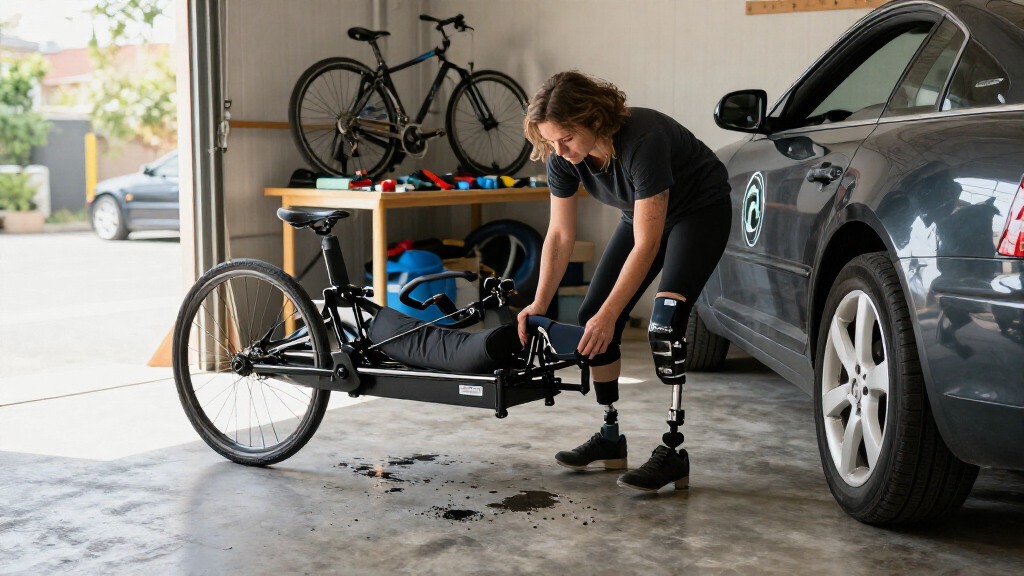
After waiting seven months from the second surgery, Staniford received prosthetics in May 2026 and began learning to walk again. He started with small steps while holding support bars, then set himself the goal of completing a local Parkrun as part of a nine-week project he called “Ouch to 5k.” Cycling Weekly’s account describes the challenge and his recovery, but does not establish whether he has returned to competitive cycling.
From Surgery to Prosthetic Walking
The operations addressed a set of physical problems that had made walking difficult and left Staniford’s feet vulnerable to infection. His account shows a major change in his daily mobility: after spending much of three years in a wheelchair, he is now learning to walk with prosthetics. That progress is personal to Staniford and does not, by itself, establish what outcomes other people with MDP syndrome might have after amputation.
For readers following para-cycling, the central question is what the surgery means for his ability to ride. Staniford is a former British para-cycling champion and said cycling had shaped his life, but the report does not confirm a return to racing. His recovery involves both healing from surgery and learning how to use prosthetics, so his sporting future cannot yet be read from his early steps alone.
Products Worth Considering

Chemical Guys TORQX Random Orbital Polisher Kit, 9-Piece

DEWALT 20V MAX XR 3-Speed Cordless Impact Driver Kit with Battery and Charger (DCF845P1)

NOCO Boost GB150 3000A 12V Lithium Jump Starter
As an affiliate, we earn on qualifying purchases.
MDP Syndrome and the Decision
MDP syndrome is named for mandibular dysplasia, deafness and progeroid features. The source describes it as an exceptionally rare genetic condition caused by a single gene mutation that prevents fatty tissue from being stored under the skin. It says the condition was first described in a 2010 study and that research remains limited. The report states that MDP syndrome is not known to affect life expectancy; it does not provide a detailed medical review of the condition.
Before surgery, Staniford took part in a symbolic “Goodbye Legs Ride,” attended by about 50 people, shortly before his first operation. The ride raised £16,000 for four charities, according to Cycling Weekly. Staniford said he had made peace with the possibility that he might not be able to cycle much after surgery. His decision came after years of worsening problems with his legs and feet, alongside warnings from doctors about the possibility that the wounds would not heal properly.
His response to the first operation mixed grief with relief and hope. He told Cycling Weekly that seeing the result brought a sense of shock, but also the prospect of a better quality of life. He gave his residual limbs the names Trevor and Roger, describing the naming as a way to make them easier to relate to. He said the second surgery felt less overwhelming because he had already been through the experience once.
“I have no regrets whatsoever.”
— Tom Staniford, speaking to Cycling Weekly
Healing and Racing Remain Open
The report does not give a detailed medical assessment of Staniford’s current healing or say whether he has completed the Parkrun challenge. It also does not confirm whether he has returned to cycling, resumed training or plans to race again. Staniford had previously said he had made peace with the possibility of cycling less, but his longer-term sporting plans are not established in the account.
His doctors had warned that his body might not heal properly, and a plastic surgeon was prepared to perform a skin graft if required. Staniford reported that both operations went to plan, but the report does not provide further clinical details about healing risks, long-term complications or his prognosis. The account is a profile based on his experience, not a treatment guide or evidence that amputation is appropriate for others with the condition.
Building Mobility After Surgery
Staniford’s immediate focus, as described in the report, is learning to walk with his prosthetics and working toward the Parkrun goal he set for himself. The account does not give a date for a possible return to competition or describe a formal cycling rehabilitation timetable. Any further update on racing would depend on his recovery and his own plans.
For now, the reported milestones are the two operations, the start of prosthetic walking and Staniford’s attempt to increase his activity. The outcome of his Parkrun project and his future on the bike remain unconfirmed in the source material.
Key Questions
Who is Tom Staniford?
Tom Staniford is a former British para-cycling champion who has MDP syndrome, a rare genetic condition. He spoke to Cycling Weekly about having both legs amputated below the knee and beginning rehabilitation with prosthetics.
Why did Staniford have both legs amputated?
According to the report, MDP syndrome contributed to tight ligaments and tendons, changes to the bones in his legs and severely damaged feet that were prone to infection. Staniford had also spent much of the previous three years in a wheelchair.
When did the operations take place?
The first operation, on Staniford’s right leg, took place on May 21, 2025. He had the left leg operated on about five months later, according to Cycling Weekly.
Has Staniford returned to racing?
The report does not confirm a return to competitive cycling. It says he received prosthetics in May 2026, began learning to walk and set himself a local Parkrun goal.
What is MDP syndrome?
MDP stands for mandibular dysplasia with deafness and progeroid features. The source describes it as a rare genetic condition that prevents the body from storing fatty tissue beneath the skin; research on it remains limited.
Source: cyclingweekly.com