

Choosing between a 2-into-1 and a 4-into-4 exhaust depends on your performance goals. A 2-into-1 boosts throttle response, increases horsepower, and is lighter, making it great for quick, sporty success. Meanwhile, a 4-into-4 offers better high-RPM power, smoother operation, and refined sound, ideal for high-end performance. Both can be tuned effectively, but understanding their unique advantages helps you select the best fit. Keep exploring to uncover which setup truly enhances your ride.
Key Takeaways
- 2-into-1 systems enhance throttle response and horsepower with simpler, lighter design for quick performance gains.
- 4-into-4 setups provide balanced exhaust flow, better high-RPM performance, and smoother engine operation.
- 2-into-1 often produces a more aggressive sound, while 4-into-4 offers deeper, refined exhaust tones.
- Tuning plays a crucial role; properly tuned 2-into-1 can outperform in low- and mid-range, but 4-into-4 excels at high-end power.
- Overall performance depends on vehicle goals; 2-into-1 favors sporty, quick response, whereas 4-into-4 prioritizes refined high-performance.
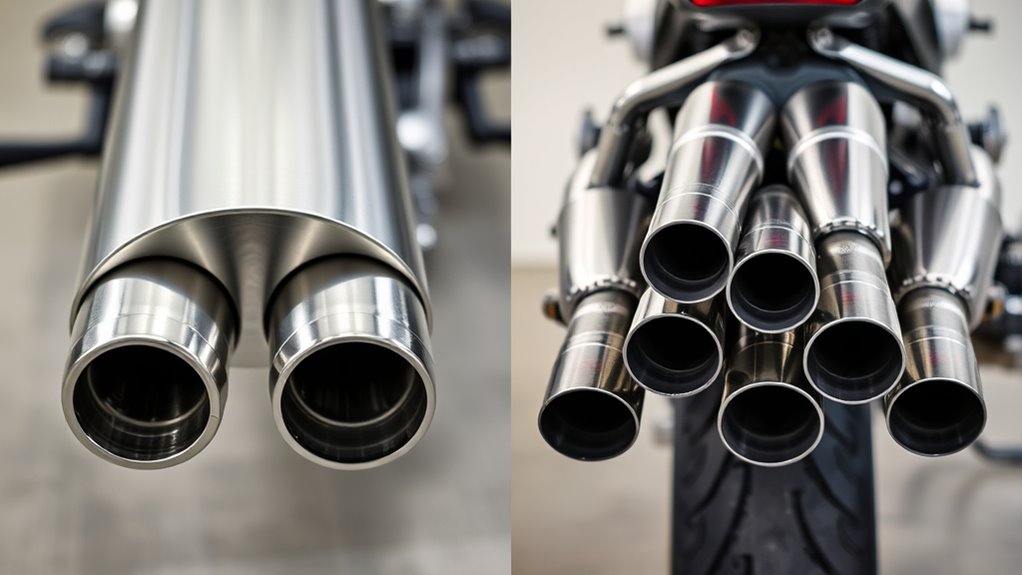
Have you ever wondered how exhaust systems influence vehicle performance and environmental impact? Your choice between different exhaust configurations, like 2-into-1 and 4-into-4 systems, can considerably affect how your vehicle runs and how much pollution it produces. Both setups have their advantages, but understanding how they work and how tuning techniques and noise reduction come into play can help you decide which is better suited for your needs.
Exhaust system choices greatly impact vehicle performance, sound, and environmental effects—understanding their differences helps you make the best decision.
A 2-into-1 exhaust system merges two exhaust pipes into one before reaching the muffler. This design is often favored for its simplicity and efficiency in improving exhaust scavenging. When done correctly, tuning techniques can optimize the flow of gases, resulting in better throttle response and increased horsepower. Because less piping is involved, a 2-into-1 setup tends to be lighter, which can also contribute to improved handling and acceleration. However, noise reduction might be a concern, as this configuration can produce a more aggressive sound if not properly tuned. You can address this by selecting appropriate mufflers or resonators, ensuring you balance performance gains with acceptable noise levels.
On the other hand, a 4-into-4 exhaust system features four separate pipes that run from the engine to the muffler or tailpipe. This setup is often associated with high-performance and luxury vehicles, offering a more balanced exhaust flow and a distinctive sound. While it might seem that more pipes mean more complexity, this configuration allows for precise tuning techniques to optimize exhaust flow across all cylinders. This can lead to improved power delivery at higher RPMs and a smoother overall operation. Noise reduction is also more manageable here, as the multiple pipes and muffler design can help control and soften exhaust noise, giving you a deeper, more refined sound.
Furthermore, advancements in European cloud innovation and sustainable solutions can inspire modern approaches to exhaust design, emphasizing efficiency and environmental considerations. Ultimately, your choice hinges on what you value most—whether it’s maximum performance, sound quality, or environmental consideration. Both systems can be fine-tuned to meet specific goals, but they do require different approaches to tuning techniques and noise reduction. A 2-into-1 system might suit someone seeking quick gains and a sportier tone, while a 4-into-4 setup appeals to those aiming for a more refined sound with higher-end performance characteristics. By understanding these factors, you can better match your exhaust system to your driving style and environmental priorities, ensuring you get the best performance without unnecessary noise or pollution.
Frequently Asked Questions
How Does Exhaust Design Impact Fuel Efficiency?
Your exhaust design markedly impacts fuel efficiency by optimizing engine efficiency and reducing emissions. A well-designed exhaust system improves airflow, allowing your engine to breathe better and work more efficiently. This leads to better fuel economy and lower emissions. Whether you choose a 2-into-1 or 4-into-4 setup, the key is ensuring your exhaust system minimizes backpressure and enhances emission control, helping your vehicle run smoothly and efficiently.
Which System Is Easier to Maintain—2-Into-1 or 4-Into-4?
Think of maintenance as tending a garden—you want simplicity and durability. The 2-into-1 system is like pruning a single, sturdy tree; it’s easier to maintain with fewer parts that stand the test of time. The 4-into-4 is a dense forest, requiring more effort to keep everything in check. So, for maintenance simplicity and system durability, the 2-into-1 system wins, making your life a lot easier.
Are There Specific Vehicle Types Better Suited for Each Exhaust System?
If you’re choosing an exhaust system, sports cars often benefit from a 2-into-1 setup, boosting power and torque at higher RPMs. Off-road vehicles usually perform better with 4-into-4 systems, providing enhanced airflow and durability for rugged terrains. So, pick a 2-into-1 for sporty, high-performance driving and a 4-into-4 for off-road adventures, ensuring your vehicle gets the right exhaust setup for its purpose.
How Do Exhaust Systems Influence Vehicle Sound and Noise Levels?
Your exhaust system directly influences your vehicle’s sound and noise levels. A well-designed system enhances the engine rumble you enjoy, while noise suppression features reduce unwanted drone and loud exhaust noise. Upgrading to a sportier exhaust can give you a deeper, more aggressive sound, but it’s essential to balance sound quality with noise levels to avoid loud, disruptive noise. Ultimately, your choice affects both your driving experience and how nearby people perceive your vehicle.
What Are the Cost Differences Between Installing 2-Into-1 and 4-Into-4 Systems?
Imagine stepping into a workshop where options whisper promises of power and style. The cost comparison shows that 2-into-1 systems usually come with lower installation expenses, making them more budget-friendly and simpler to set up. In contrast, 4-into-4 setups tend to be pricier, with more complex installation processes. So, you’ll find that choosing between them depends on your budget and the performance goals you’re aiming for.
Conclusion
When choosing between 2-into-1 and 4-into-4 exhaust systems, it’s all about your performance goals. The 2-into-1 setup often boosts low-end torque, perfect for street riding, while 4-into-4 can enhance high-end power, ideal for racing. Did you know that 4-into-4 systems can increase horsepower by up to 15%? Ultimately, select the setup that aligns with your riding style to get the best performance and enjoy the ride to its fullest.