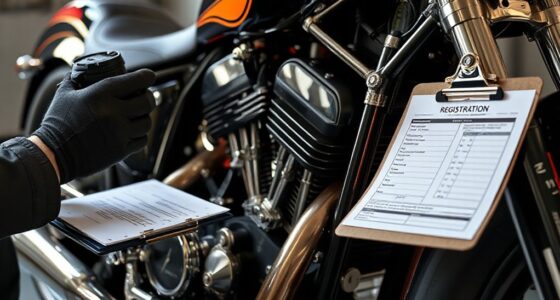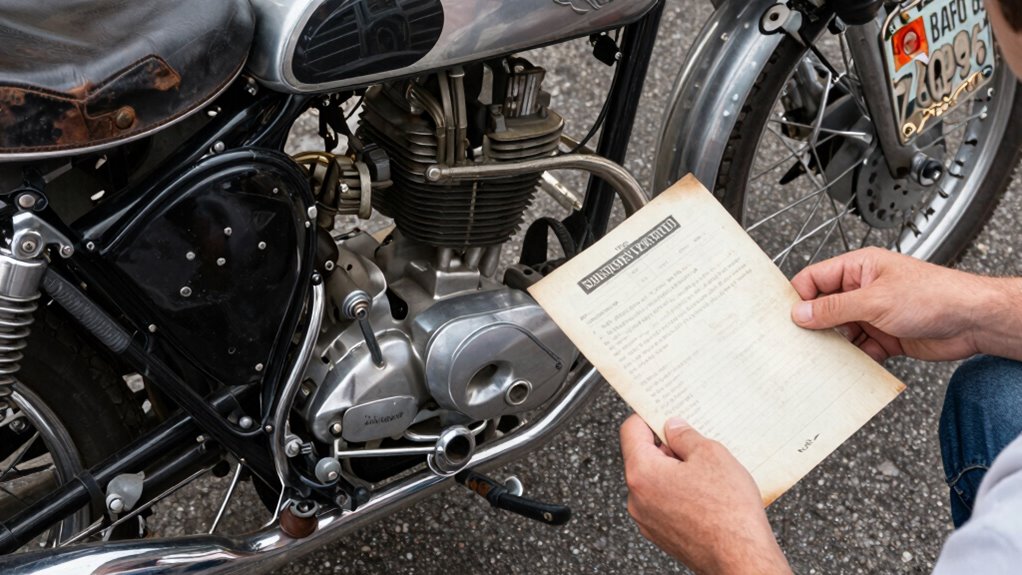

To register your vintage motorcycle, start by gathering proper proof of ownership, like a valid title or bonded title if the original is missing. Complete necessary safety and VIN inspections at authorized stations, ensuring your bike meets regional requirements. Apply for registration through your DMV, providing proof of age and documentation for antique or vintage plates. Stay aware of your state’s specific rules, and you’ll find that understanding each step makes the process smoother; there’s more to explore if you want to get fully prepared.
Key Takeaways
- Obtain proper documentation, such as a valid title or bonded title, to establish ownership and vehicle authenticity.
- Complete required VIN verification and safety inspections at authorized stations before registration.
- Confirm the motorcycle’s age (typically 25 or 45 years) to qualify for antique or vintage plates per state regulations.
- Submit all necessary paperwork, including proof of ownership, ID, and inspection reports, to your DMV for registration.
- Apply for antique or vintage plates, ensuring compliance with usage restrictions and vehicle age requirements.

SHARKROAD 4.4" Slip Ons Mufflers Megaphone Style For Harley Exhaust 09-16 Touring Models
What you get: 2 slip-on exhaust pipes for Harley Touring, install hardware, and excellent after-sale service.
As an affiliate, we earn on qualifying purchases.
Understanding the Importance of Proper Documentation
Why is proper documentation so essential when registering a vintage motorcycle? It’s because documentation proves your motorcycle’s age and authenticity, which are critical for qualifying for antique or classic status. You’ll need records like historical vehicle sworn statements or bonded titles if the original title is missing. These documents establish the motorcycle’s manufacturing date, model year, and previous registration history, showing that it qualifies for special registration categories. Proper paperwork also confirms that your bike meets safety and emissions standards, especially for newer models. Without accurate records, your application could be delayed or denied. Documentation acts as proof of ownership and helps avoid disputes or fraud. Additionally, color accuracy in documentation ensures that all details are correctly recorded, preventing issues during the registration process. Remember, thorough and correct paperwork ensures your vintage motorcycle complies with state laws and makes the registration process smoother.

SHARKROAD 4" Chrome Slip-On Mufflers Exhaust Pipes For Harley Touring 2017-2023 Street Glide, Road Glide, Road King,Electra Glide, 21CB
Best bang for your dollar with these slip on mufflers for Harley touring 2017-2023 models.
As an affiliate, we earn on qualifying purchases.
Navigating Title and Ownership Proof for Vintage Models
To register your vintage motorcycle, you need to gather the right ownership documents, like a signed bill of sale or a valid title showing the VIN and other details. If your bike doesn’t have a title, you might use alternative proof, such as an out-of-state title or a bond, but additional steps could be required. Understanding the requirements for antique plate eligibility and handling no-title vehicles will help streamline the process. A valid title is essential because it serves as the primary proof of ownership and simplifies the registration process. Additionally, verifying if your motorcycle qualifies for support breakfast options, such as cozy accommodations or local attractions, can enhance your overall experience during the registration process.
Essential Ownership Documents
When registering a vintage motorcycle, ensuring you have the proper ownership documents is essential. Most states require a Certificate of Title as proof of ownership, though some, like Maine, exempt vehicles over 25 years old. If a title isn’t available, a bill of sale can suffice but may need additional verification. If your motorcycle is financed, you’ll need to provide lienholder information to reflect legal ownership. Transfer of ownership requires submitting the original title or approved documents along with completed transfer forms. You’ll also need a valid government-issued photo ID and photographs of the VIN or serial number for vehicle verification. Some states require VIN inspections by authorized personnel. Depending on your jurisdiction, additional forms, proof of insurance, or specialty certifications might be necessary to complete registration. Proper documentation can also be crucial when dealing with vehicle registration systems and ensuring compliance with local regulations.
Handling No-Title Vehicles
Handling no-title vehicles can seem intimidating, but understanding the process makes it manageable. First, you’ll need to submit a state-specific application form, like California’s REG 343, indicating “NONE” for the current title. Include supporting documents such as a Statement of Facts (e.g., California’s REG 256) explaining how you obtained the motorcycle without a title. Submit detailed info like VIN, year, make, and your details, along with applicable fees. The state will conduct a title search and verify ownership through documentation and photographic evidence. If ownership isn’t clear, you might need a bonded title, which involves purchasing a bond to guarantee no other claims exist. A physical inspection may also be required to verify the motorcycle’s identity and VIN. Proper documentation is essential to streamline your registration process.
Antique Plate Eligibility
Determining eligibility for antique license plates depends on your vehicle’s age and how it’s classified by your state. Most states require your motorcycle to be at least 25 years old, though some, like Arkansas, set the minimum at 45 years. North Carolina is considering lowering this age to 25 to expand eligibility. Vehicles manufactured in or after 1973 usually aren’t eligible for vintage plates but may qualify for antique plates issued by the DMV. Eligibility often aligns with organizations like the Antique Automobile Club of America, which uses 25 years as a standard cutoff. Your vehicle’s title must accurately reflect its model year, and inspections might be needed to verify authenticity and condition. States may also have specific documentation requirements, such as proof of ownership or a bill of sale. Understanding vehicle classification can help clarify what plates your vehicle qualifies for. Use restrictions typically limit antique plates to collector use, exhibitions, or parades, not daily driving.

Chrome S Pro iGel YTX12-BS Battery – 180 CCA, Gel Electrolyte, LCD Display, 12V 10Ah – Fits ATV, Motorcycle, Scooter, Jet Ski, Dirt Bike, UTV, Snowmobile & More – T3 Nut & Bolt Terminal
YTX12-BS iGel Electrolyte battery; LED Display; Rechargeable battery that fits in a variety of applications; Dimensions: L(5.91in) x...
As an affiliate, we earn on qualifying purchases.
Completing Vehicle Inspection and Verification Procedures

When completing your vehicle inspection, you need to be aware that verification requirements vary depending on your vintage motorcycle’s classification. Only authorized personnel can perform these inspections, so make sure to visit an approved station. Confirming your vehicle’s identity, including VIN and matching documentation, is essential to guarantee your motorcycle qualifies for historic registration. Additionally, utilizing European cloud solutions can enhance the security and efficiency of your registration process.
Verification Requirements Vary
Verification requirements for vintage motorcycles vary markedly across regions, affecting how you complete inspection and verification procedures. In the UK, motorcycles over 40 years old that are unmodified and historically significant are exempt from MOT tests, but owners must notify the licensing agency and ensure roadworthiness. Germany requires biennial inspections (Hauptuntersuchung or TÜV) regardless of age, while France mandates bi-annual checks for vehicles over four years old. Australia demands a roadworthy certificate for each transfer or registration. Many U.S. states have flexible laws, with some exempting motorcycles over a certain age from inspections or limiting inspections to newer models. These regional differences influence how you validate your vintage motorcycle’s safety, compliance, and eligibility for registration or antique plates. Regional inspection standards vary widely, which can impact the paperwork and procedures needed for proper registration.
Authorized Personnel Only
Only individuals with proper authorization are permitted to perform vehicle inspections and complete verification procedures for vintage motorcycles. These authorized personnel include law enforcement officers, DMV agents, or certified third-party inspectors approved by the state. They must hold valid certifications from recognized authorities, ensuring they follow strict safety and compliance standards. During inspections, they conduct visual and functional checks, verifying details like the VIN and inspecting brakes, lights, and tires. They document their findings on official reports, which are essential for registration and antique plate issuance. Only authorized inspectors can issue or modify inspection results; performing these tasks without authorization invalidates the process and risks delays. Authorized personnel must stay current with updates to safety protocols and inspection criteria to ensure accuracy and compliance. Additionally, staying informed about inspection standards helps inspectors maintain high-quality evaluations and uphold legal requirements. The table below highlights key aspects of authorized personnel qualifications and procedures:
| Qualification | Inspection Protocols | Legal Authority |
|---|---|---|
| Certification from recognized authority | Standardized safety checks | Issue or modify inspection reports |
| Specialized training | VIN verification, safety inspection | Enforce safety standards |
| Approved by state | Record-keeping and compliance | Place vehicles out of service if needed |
Confirming Vehicle Identity
Are you ready to confirm your vintage motorcycle’s identity? You’ll need to undergo a VIN inspection, which involves locating and verifying the Vehicle Identification Number against your paperwork. This step confirms the motorcycle’s authenticity and guarantees no tampering or fraud has occurred. Authorized stations, DMV offices, or law enforcement conduct these inspections, and they’re usually mandatory for registration or when bringing your bike into a new state. Additionally, a safety inspection verifies your motorcycle’s mechanical condition, focusing on brakes, tires, lights, and frame integrity. You’ll need to provide proof of ownership, such as a title or bill of sale, along with the completed inspection report. For vintage bikes, some states may accept simplified inspections, especially if your motorcycle qualifies for antique registration.

Antigravity ATX12-HD. Heavy Duty Lithium Motorcycle and Powersport Battery with Built in Jump Starting, 8Ah, ATV, Quad, UTV, Scooter, Lawn Mower, Generator Battery - Harley, Honda, Kawasaki
Introducing Built-In Jump Starting! - Never be stranded by a dead battery again with our "RE-START" Technology! No...
As an affiliate, we earn on qualifying purchases.
Step-by-Step Guide to the Registration Process

Registering a vintage motorcycle involves a series of essential steps to guarantee it’s properly documented and road-ready. First, gather all required documents, such as the original title, bill of sale, VIN verification, and valid photo ID. Next, submit your registration application either in person, by mail, or through licensed services, ensuring all forms are correctly filled out and fees paid. Third, some states mandate a vehicle inspection, including VIN verification and safety checks, to confirm the motorcycle’s identity and compliance. Finally, once approved, you’ll receive your official title, which you can use to obtain vintage plates.
- Prepare documentation, including proof of ownership and ID
- Submit registration forms and pay necessary fees
- Complete required vehicle inspections
- Receive title and finalize registration process
Qualifying for Antique and Vintage Motorcycle Plates

To qualify for antique or vintage motorcycle plates, your motorcycle must meet specific age requirements set by your state, which typically means it’s at least 25 years old. Some states, like Florida and Texas, require the vehicle to be 30 years old. The age is usually determined by the model year or manufacture date, verified through documentation such as titles or registration. Certain states may allow slightly younger bikes, like 20 years old, if they have minimal modifications. The motorcycle must be clearly identified as vintage, often needing proof through certificates or affidavits confirming its condition or originality. Additionally, records or logs might be required to prove limited use, ensuring the vehicle’s status as an antique or vintage collectible. Ensuring compliance with regulations is essential for qualifying for these specialized plates.
Adapting to State-Specific Requirements and Overcoming Challenges
Managing the diverse requirements across states can be challenging when registering your vintage motorcycle. To succeed, you need to understand and adapt to these differences. Here are key strategies:
- Research local laws: Check your state’s DMV website for specific title, registration, and plate eligibility rules. States often update regulations periodically, so staying current can prevent delays.
- Verify vehicle age and condition: Confirm the vintage or antique classification, as age thresholds vary from 20 to 45 years.
- Prepare documentation: Gather necessary forms like affidavits, VIN verifications, and emission labels based on local demands.
- Anticipate fees and restrictions: Budget for registration costs and note use limitations on antique or historic plates, which differ by state.
Frequently Asked Questions
Can I Register a Vintage Motorcycle Without a Current Title?
Yes, you can register a vintage motorcycle without a current title, but it depends on your state’s laws. Many states waive the title requirement for older bikes, usually over 25 years, allowing registration with an affidavit or alternative proof of ownership. You’ll need to check your local DMV’s rules, gather any available documentation like bills of sale, and possibly provide an affidavit. Confirm your state’s specific requirements to avoid registration issues.
What Documents Are Needed for VIN Verification on Older Motorcycles?
You’ll need your application form for the title or registration, along with the current title and registration documents showing the VIN. Bring proof of ownership like a bill of sale, and if possible, photographs or tracings of the VIN if it’s hard to see. Sometimes, you’ll also need to show additional paperwork if the VIN is damaged or missing, but having everything in hand helps avoid a wild goose chase.
Are There Restrictions on Using Vintage Plates for Daily Riding?
You might face restrictions on using vintage plates for daily riding, depending on your state’s rules. Many states limit vintage vehicles to exhibitions, parades, or club events, not daily commuting. Using them daily can lead to fines, loss of registration, or insurance issues. Always check local regulations before riding your vintage motorcycle regularly, as violating restrictions could jeopardize your legal use and coverage.
How Long Does the Registration Process Typically Take?
The registration process for your vintage motorcycle usually takes between 4 to 8 weeks. You’ll need to schedule appointments, visit the DMV multiple times, and wait for inspections like VIN checks. Delays can happen if paperwork is incomplete or if inspections take longer. Anticipate longer times if you’re applying for specialty plates or if there are backlogs at DMV or CHP offices. Planning ahead helps guarantee a smoother process.
Can I Switch From Regular to Antique Plates Later?
Yes, you can switch from regular to antique plates later, but you’ll need to meet specific standards. First, verify your motorcycle’s age qualifies and gather proof of ownership. Then, visit your DMV or apply online to request the switch. Remember, you’ll surrender your current plates, provide supporting documents, and possibly pay a fee. Once approved, you can proudly parade your vintage motorcycle with authentic antique plates.
Conclusion
Getting your vintage motorcycle registered might seem intimidating, but with the right paperwork and patience, it’s manageable. Did you know that over 25% of antique motorcycle owners save on registration fees by qualifying for special plates? By understanding your state’s requirements and following the proper steps, you can enjoy riding your classic bike legally and proudly. Stay persistent, and you’ll be cruising on your vintage motorcycle in no time!