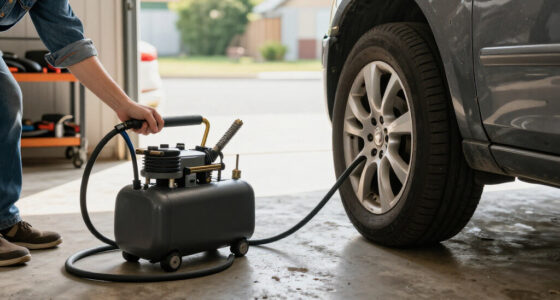
For most garages, I’d start with the VEVOR 13-gallon oil-free compressor: its listed 4.6 CFM at 90 PSI and 66 dB noise rating balance useful airflow with a quieter operating profile. The California Air Tools 8010A is a standout for buyers who put low noise first, while the Campbell Hausfeld 60-gallon two-stage model better suits a fixed workshop with heavier air demands and 230V power. The main tradeoffs are tank capacity and airflow versus noise, portability, and installation requirements. A larger tank can support longer bursts, but it does not replace adequate delivered CFM for sustained tool use. Read on for the full comparison and guidance on matching a compressor to your garage tasks.

Get business pricing on garage and car supplies
- Business-only prices and quantity discounts
- Tax-exempt purchasing
- Multiple users, one account, clear invoices
Complete the kit


Key Takeaways
- The VEVOR 13-gallon model leads on stated balance: 4.6 CFM at 90 PSI, 66 dB, and a 125 PSI maximum make it the strongest general-purpose combination in this lineup, though it is not the biggest-tank option.
- The Campbell Hausfeld 60-gallon unit serves a different class of garage: its two-stage design and 175 PSI rating suit a fixed shop with demanding work, but 230V power and installation needs rule it out for many casual users.
- Quiet options are not interchangeable: the California Air Tools 8010A is explicitly ultra-quiet and has an aluminum tank, while the VEVOR and RyanTek 15-gallon models list 66 dB; compare airflow and capacity alongside noise.
- Oil-free choices dominate the portable end of the list: they simplify routine ownership, but buyers should still check the manual for condensate draining, duty-cycle limits, and other upkeep.
- Tank size alone does not predict tool compatibility: the 2-gallon CRAFTSMAN and 6-gallon pancake models favor brief tasks, while sustained air-tool work calls for checking delivered CFM at the tool’s required pressure.


| garage air compressor | Tank capacity | Maximum pressure | Noise level | Weight |
|---|---|---|---|---|
| CRAFTSMAN 1.5 HP Wall-Mount Ai | 0.5 gallons | 125 PSI | 65 dB | — |
| VEVOR 13-Gallon Oil-Free Air C | 13 gallons | 125 PSI | 66 dB | 71 pounds |
| CRAFTSMAN 33-Gallon Vertical P | 33 gallons | 175 PSI | 80 dB | 154 pounds |
| CRAFTSMAN 2-Gallon Portable Ai | 2 gallons | 125 PSI | 78 dB | 19 pounds in description; 11.11 kg in specifications |
| CRAFTSMAN 8-Gallon Oil-Free Ai | 8 gallons | 150 PSI | — | 24 pounds |
| FORNAX 13-Gallon Portable Vert | 13 gallons | 120 PSI in specifications; 125 PSI in description | 70 dB | — |
| Klutch 20-Gallon Portable Air | 20 gallons | 175 PSI | 80 dB | 90 pounds |
| Klutch 29-Gallon Oil-Free Air | 29 gallons | 175 PSI | 81 dB | 127 pounds |
| Craftsman 20-Gallon Oil-Free A | 20 gallons | 175 PSI | 80 dB | — |
| Campbell Hausfeld 60-Gallon Tw | 60 gallons | 175 PSI | 65 dB | 255 pounds |
| RyanTek 15-Gallon Air Compress | 15 gallons | 125 PSI | 66 dB | 68.3 lb |
| California Air Tools 8010A 1.0 | 8 gallons | 120 PSI | 60 dBA | 37.3 lb |
| ECOMAX 6-Gallon 150 PSI Oil-Fr | 6 gallons | 150 PSI | 75 dB | 34.17 lb |
| VEVOR 6.3-Gallon 2 HP Oil-Free | 6.3 gallons | 116 PSI | 70 dB | 43 lb |
More Details on Our Top Picks
CRAFTSMAN 1.5 HP Wall-Mount Air Compressor with 30-Foot Retractable Hose and 8-Piece Accessory Kit
The CRAFTSMAN wall-mount compressor is the space-saving pick for garages where quick access to a hose matters more than running air-hungry tools. Its 30-foot retractable hose reaches around a parking bay without requiring a portable tank to be rolled into place, and the oil-free motor keeps routine care simple. At 1.8 CFM and just 0.5 gallons of storage, it is better suited to topping up tires and short bursts of light-duty air than sustained pneumatic work. The VEVOR 13-Gallon holds much more air for longer jobs, while this CRAFTSMAN takes up less floor space and is easier to keep ready for everyday inflation. The tradeoff is limited reserve capacity, and the listed 11.14 kg weight conflicts with another stated weight in the product information.
Pros:- Wall-mountable layout frees up floor space.
- 30-foot retractable hose reaches across a typical garage work area.
- Oil-free motor avoids routine lubrication.
- Includes an 8-piece accessory kit for common inflation tasks.
Cons:- The 0.5-gallon tank provides little reserve for air-hungry tools.
- Listed weight is inconsistent with another weight claim in the product information.
Best for: Garage owners who want a permanently mounted hose for tire inflation and occasional light-duty tasks without sacrificing floor space.
Not ideal for: Buyers planning extended spray painting, sanding, or other sustained pneumatic-tool work; the 0.5-gallon tank and 1.8 CFM output limit its air supply.
- Motor power:1.5 HP
- Tank capacity:0.5 gallons
- Maximum pressure:125 PSI
- Airflow:1.8 CFM
- Hose length:30 feet
- Noise level:65 dB
- Pump type:Oil-free
- Power source:Corded electric
Our verdict“Choose this CRAFTSMAN for an always-accessible garage hose and light inflation jobs, not sustained tool use.”
VEVOR 13-Gallon Oil-Free Air Compressor, 2 HP, 4.6 CFM at 90 PSI, 66 dB, 125 PSI Maximum
The VEVOR 13-Gallon is the balanced choice for a home garage that needs more working air than compact inflation models can offer, without moving up to a large vertical tank. Its 4.6 CFM at 90 PSI and 13-gallon capacity suit a mix of auto repair, woodworking, and intermittent spray work; wheels also help when the compressor has to move between tasks. Compared with the 0.5-gallon CRAFTSMAN wall-mount model, it can support longer work periods before pressure drops, though it gives up that model’s compact, fixed installation. The 66 dB operating figure is relatively quiet for a compressor in this size class, but the unit still weighs 71 pounds, so moving it is easier than lifting it. Its capacity remains modest beside the CRAFTSMAN 33-Gallon for longer, higher-demand sessions.
Pros:- 4.6 CFM at 90 PSI supports a broader range of workshop tasks than compact inflation models.
- 13-gallon tank offers useful reserve for intermittent work.
- Oil-free pump reduces routine maintenance.
- Wheels help move the 71-pound unit around the garage.
Cons:- Heavy enough to make lifting into a vehicle or onto a shelf difficult.
- Tank capacity is less suited to sustained air demand than the CRAFTSMAN 33-Gallon.
Best for: Home mechanics and hobby woodworkers who need a wheeled compressor for varied intermittent jobs and want more tank reserve than a compact unit provides.
Not ideal for: Buyers who need a light, easy-to-lift compressor or who run high-demand tools continuously; its 71-pound weight and 13-gallon tank may be limiting.
- Tank capacity:13 gallons
- Motor power:2 HP
- Airflow:4.6 CFM at 90 PSI
- Maximum pressure:125 PSI
- Noise level:66 dB
- Weight:71 pounds
- Voltage:120 volts
- Pump type:Oil-free
Our verdict“Pick the VEVOR for a quieter, wheeled mid-size compressor for mixed garage jobs, but not for extended high-demand tool use.”
CRAFTSMAN 33-Gallon Vertical Portable Air Compressor
For buyers who regularly run air tools, the CRAFTSMAN 33-Gallon offers the largest tank in this group and the strongest stated pressure ceiling. Its 5.1 CFM at 90 PSI and 175 PSI maximum make it better suited to longer work sessions than the 13-gallon VEVOR, while two high-flow quick couplers allow two users or tools to connect. The vertical tank uses less floor width than a horizontal tank with similar storage, but the compressor still stands 51 inches tall and weighs 154 pounds; its wheels and handle help with repositioning, not frequent carrying. At 80 dB, it is also notably louder than the VEVOR’s 66 dB. This is the most capable pick here for a fixed workshop area, though buyers needing a compact or quiet garage setup should choose smaller alternatives.
Pros:- 33-gallon tank provides the largest air reserve among these five options.
- 5.1 CFM at 90 PSI suits more demanding work than the smaller-tank models.
- Two high-flow quick couplers support two connected tools or users.
- Vertical design uses less floor width than a horizontal tank of similar capacity.
Cons:- At 154 pounds, it is difficult to lift or move often.
- 80 dB operation is louder than the VEVOR 13-Gallon.
- Its 46 × 23 × 51-inch footprint and height require a dedicated storage spot.
Best for: Home workshop owners who use pneumatic tools regularly, need higher air capacity, and can dedicate a tall storage area to a heavy compressor.
Not ideal for: Buyers in small or noise-sensitive garages, or anyone who needs to carry a compressor between locations; it is 154 pounds and operates at 80 dB.
- Tank capacity:33 gallons
- Maximum pressure:175 PSI
- Airflow:5.1 CFM at 90 PSI
- Pump type:Oil-free
- Quick couplers:2
- Noise level:80 dB
- Weight:154 pounds
- Dimensions:46 × 23 × 51 inches
Our verdict“Choose this CRAFTSMAN when air capacity and dual connections matter more than quiet operation or easy portability.”
CRAFTSMAN 2-Gallon Portable Air Compressor, 1/3 HP, 125 PSI, Oil-Free, with 10-Piece Accessory Kit
The CRAFTSMAN 2-Gallon is a straightforward starter compressor for tire care and short bursts of garage work. Its 19-pound listed weight, reinforced handle, and 10-piece accessory kit make it easier to take out for a quick task than the wheeled VEVOR 13-Gallon, while its 2-gallon tank offers more reserve than the wall-mounted CRAFTSMAN’s 0.5-gallon tank. That added capacity still does not make it a sustained-tool machine: the 1/3 HP motor and small tank favor brief jobs over long runs of sanding or spraying. The oil-free pump cuts routine maintenance, but 78 dB is not especially quiet. Product information gives two different weights—19 pounds and 11.11 kg—so I would treat portability claims with that discrepancy in mind.
Pros:- Compact format and reinforced handle suit occasional portable use.
- Two-gallon tank offers more reserve than the 0.5-gallon wall-mount CRAFTSMAN.
- Oil-free pump avoids routine lubrication.
- 10-piece accessory kit covers several basic inflation and cleanup tasks.
Cons:- Small tank and 1/3 HP motor limit sustained air-tool work.
- Noise level is listed at 78 dB.
- Weight information conflicts between 19 pounds and 11.11 kg.
Best for: DIY garage owners who mainly inflate tires, use a blow gun, or need a compact compressor for occasional short tasks.
Not ideal for: Frequent users of air-hungry tools or buyers who need a quiet unit; the small tank and 78 dB noise level are poor fits for prolonged sessions.
- Tank capacity:2 gallons
- Motor power:1/3 HP
- Maximum pressure:125 PSI
- Voltage:120 volts
- Pump type:Oil-free
- Weight:19 pounds in description; 11.11 kg in specifications
- Noise level:78 dB
- Included accessories:10-piece kit
Our verdict“Choose this model for occasional inflation and basic DIY tasks, rather than continuous pneumatic-tool use.”
CRAFTSMAN 8-Gallon Oil-Free Air Compressor, 1.8 HP, 150 PSI, with 10-Piece Accessory Kit
The CRAFTSMAN 8-Gallon sits between compact inflation units and the larger workshop compressors, making it a practical step-up for garage owners who want a portable tank with more usable reserve. Its 4 CFM airflow and 150 PSI maximum give it more headroom than the 2-gallon CRAFTSMAN for varied intermittent tasks, while the handle and rubber wheels help with repositioning. The listed 45-second recovery time is useful when a job involves repeated air use, though it does not replace the larger reserve of the CRAFTSMAN 33-Gallon for sustained work. At 24 pounds, it is lighter than the 71-pound VEVOR 13-Gallon, but it may still be awkward to lift for some users. The oil-free design and included kit suit low-maintenance garage use, with tank size remaining the limit for extended high-demand applications.
Pros:- 4 CFM airflow and an 8-gallon tank offer a useful step up from compact models.
- 150 PSI maximum provides more pressure headroom than the 125 PSI options.
- Handle and rubber wheels support repositioning around the garage.
- Oil-free pump and 10-piece accessory kit simplify setup and routine care.
Cons:- Eight gallons may not sustain high-demand tools for extended work.
- At 24 pounds, it may be difficult for some users to lift.
- The stated capacity is well below the CRAFTSMAN 33-Gallon for longer sessions.
Best for: Garage DIYers who want a wheeled, mid-capacity compressor for inflation and occasional pneumatic-tool tasks without storing a large vertical tank.
Not ideal for: Users who run demanding air tools for long stretches or need the largest air reserve; an 8-gallon tank will run short sooner than the CRAFTSMAN 33-Gallon.
- Tank capacity:8 gallons
- Motor power:1.8 HP
- Maximum pressure:150 PSI
- Airflow:4 CFM
- Recovery time:45 seconds
- Weight:24 pounds
- Tank orientation:Horizontal
- Pump type:Oil-free
Our verdict“Choose this CRAFTSMAN for a portable middle ground between small inflation compressors and large workshop tanks.”
FORNAX 13-Gallon Portable Vertical Air Compressor, 2 HP, 125 PSI
The FORNAX pairs a space-saving 13-gallon vertical tank with a stated 10.8 CFM at 90 PSI, giving it a different emphasis from the larger-tank Klutch 29-Gallon model, which lists 5.1 CFM at 90 PSI. That airflow figure may suit buyers whose tools need a strong supply without dedicating as much floor space to the tank. Wheels and an integrated handle help with repositioning, while the oil-free twin-cylinder pump avoids routine oil changes. I would check tool requirements against the compressor’s actual delivery before buying: the listed maximum pressure also conflicts, with 125 PSI in the description and 120 PSI in the specifications. It is a compelling capacity-to-footprint option, but that spec discrepancy deserves clarification.
Pros:- 13-gallon vertical tank uses less floor width than many horizontal designs.
- Stated 10.8 CFM at 90 PSI is higher than the listed airflow for the Klutch 29-Gallon model.
- Wheels and an integrated handle support movement around a garage.
- Oil-free twin-cylinder pump reduces routine maintenance.
Cons:- Maximum pressure is listed as both 125 PSI and 120 PSI.
- Tool compatibility depends on matching actual air delivery and pressure requirements.
- A 13-gallon tank provides less stored air than the 20- and 29-gallon portable options here.
Best for: Garage owners who need a vertical, movable compressor and whose air tools can use its stated 10.8 CFM at 90 PSI.
Not ideal for: Buyers who need verified maximum-pressure specifications or a quiet compressor; the pressure listings conflict, and the unit is rated at 70 dB.
- Tank capacity:13 gallons
- Motor:2 HP; 1500 W
- Airflow:10.8 CFM at 90 PSI
- Maximum pressure:120 PSI in specifications; 125 PSI in description
- Pump:Oil-free, twin-cylinder
- Electrical:120 V, 60 Hz, 15 A maximum
- Noise level:70 dB
- Design:Portable vertical tank with wheels
Our verdict“Choose the FORNAX if you want a compact vertical footprint with a high stated airflow, but verify the pressure specification and your tools’ air demands first.”
Klutch 20-Gallon Portable Air Compressor, 2 HP, 120V
The Klutch 20-Gallon balances a larger air reserve with a wheeled portable format, making it a practical middle ground between the smaller FORNAX 13-Gallon and the heavier Klutch 29-Gallon. Its 4.2 SCFM at 90 PSI suits many nailing and spraying jobs, though buyers should compare that delivery figure with the requirements of any tool they plan to run. The 175 PSI maximum gives it a broad pressure range, and the oil-free pump cuts routine upkeep. At 90 pounds, it is movable across a garage floor but not an easy lift into a vehicle or over rough ground. Its 80 dB rating also makes it a less suitable choice for noise-sensitive indoor work.
Pros:- 20-gallon tank offers more stored air than the FORNAX 13-Gallon.
- Delivers 4.2 SCFM at 90 PSI for compatible nailing and spraying tasks.
- Oil-free pump reduces maintenance needs.
- Rubber wheels, an ergonomic handle, and thermal overload protection support practical garage use.
Cons:- At 90 pounds, it is difficult to lift or carry up steps.
- The 80 dB noise rating may be disruptive in attached or shared spaces.
- Its air delivery may not meet the needs of tools requiring higher continuous airflow.
Best for: Home mechanics and DIYers who want a wheeled 20-gallon tank for intermittent nailing, spraying, and general garage tasks.
Not ideal for: Buyers who need a lightweight compressor for frequent lifting, quiet indoor operation, or sustained use of high-demand tools.
- Tank capacity:20 gallons
- Motor:2 HP
- Air delivery:4.2 SCFM at 90 PSI
- Maximum pressure:175 PSI
- Pump:Oil-free
- Electrical:120 V, 14 A maximum
- Noise level:80 dB
- Weight:90 pounds
- Dimensions:19.1 x 17.5 x 41.5 inches
Our verdict“Pick this Klutch for a movable 20-gallon tank and routine garage tools, not for quiet work or high-air-demand applications.”
Klutch 29-Gallon Oil-Free Air Compressor, 2.5 HP, 120V, 175 PSI
With a 29-gallon vertical tank and 5.1 CFM at 90 PSI, this Klutch favors longer stretches of work over easy lifting. It provides more stored air and slightly higher listed airflow than the Klutch 20-Gallon, which can mean fewer interruptions during compatible nailing, stapling, or painting jobs. The oil-free pump and flat-free wheels make routine ownership simpler, while the quick-connect coupler speeds tool changes. The tradeoff is substantial: at 127 pounds, this is portable mainly in the sense that it can be rolled across suitable surfaces, not carried around a jobsite. Its 81 dB rating is also a poor match for buyers prioritizing a quieter garage. I’d match its delivery to the tool rather than assume the larger tank supports every air-hungry application.
Pros:- 29-gallon tank stores more air than either 20-gallon portable option in this batch.
- Listed 5.1 CFM at 90 PSI exceeds the Klutch 20-Gallon’s stated 4.2 SCFM at 90 PSI.
- Oil-free pump avoids routine oil changes.
- Flat-free wheels and a quick-connect coupler simplify repositioning and tool changes.
Cons:- At 127 pounds, it is difficult to lift and awkward over uneven surfaces.
- The 81 dB noise rating may be unwelcome in an attached garage.
- Its 5.1 CFM rating may still fall short of sustained high-demand air tools.
Best for: Garage users who want a larger portable tank for longer nailing, stapling, or painting sessions and can leave it on one garage level.
Not ideal for: Buyers who need to lift a compressor into a vehicle, move it over uneven ground often, or keep noise low.
- Tank capacity:29 gallons
- Motor:2.5 HP
- Airflow:5.1 CFM at 90 PSI
- Maximum pressure:175 PSI
- Pump:Oil-free
- Electrical:120 V, 14.5 A maximum
- Noise level:81 dB
- Weight:127 pounds
- Dimensions:23.2 x 21.1 x 45.3 inches
Our verdict“Choose this model over the Klutch 20-Gallon when longer sessions and a bigger tank matter more than easy transport.”
Craftsman 20-Gallon Oil-Free Air Compressor with 1.8 HP, 175 PSI, Dual Quick Couplers – Red (CMXECXA0232043)
The Craftsman stands apart from the Klutch 20-Gallon through its dual quick couplers, a useful detail for a garage where two hoses or tools need ready connections. Its 20-gallon tank, 175 PSI maximum, and stated 5 CFM airflow cover a broad range of compatible tasks, including inflation, spraying, and nailing. Compared with the Klutch 20-Gallon, it lists more airflow, while keeping the same tank size and a similar 80 dB noise rating. The oil-free pump limits routine maintenance, and rubber feet help steady the unit. This is still a corded, 20-gallon compressor rather than a quiet or highly portable solution; the six-foot hose length also calls for a separate longer hose if the work area is spread out.
Pros:- Dual quick couplers make it easier to keep two hose connections available.
- Stated 5 CFM airflow is higher than the Klutch 20-Gallon’s listed 4.2 SCFM at 90 PSI.
- 20-gallon tank and 175 PSI maximum suit a range of compatible garage tools.
- Oil-free pump reduces routine maintenance.
Cons:- The 80 dB noise rating may be loud for enclosed or shared work areas.
- The listed hose is only 6 feet long, limiting reach without an additional hose.
- A 1-year limited warranty is shorter than the Klutch 20-Gallon’s listed 2-year warranty.
Best for: DIY garage users who want a 20-gallon compressor with two ready hose connections for switching between tools or work areas.
Not ideal for: Buyers who need quiet operation, an extended included hose, or a compressor for continuous high-air-demand tools.
- Tank capacity:20 gallons
- Motor:1.8 HP
- Airflow:5 CFM
- Maximum pressure:175 PSI
- Pump:Oil-free
- Electrical:120 V, corded electric
- Noise level:80 dB
- Hose length:6 feet
- Warranty:1-year limited
Our verdict“Choose the Craftsman if dual hose connections and its stated 5 CFM matter more to your setup than quieter operation or a longer included hose.”
Campbell Hausfeld 60-Gallon Two-Stage Air Compressor, 175 PSI, 230V
Unlike the portable, 120-volt models above, the Campbell Hausfeld is a stationary 60-gallon compressor built around a two-stage, oil-lubricated cast-iron pump and a 230-volt motor. Its 7.6 CFM at 90 PSI and 6.9 CFM at 175 PSI support a broader range of demanding shop tasks than the listed delivery figures for the Klutch 29-Gallon or Craftsman 20-Gallon. The large tank can reduce cycling during extended work, and the listed 65 dB noise level is lower than those portable units’ 80- and 81-dB ratings. In exchange, this 255-pound compressor needs a suitable permanent location and a dedicated 230/240-volt supply. It also requires oil maintenance, unlike the oil-free portable picks.
Pros:- 60-gallon tank supports longer work between compressor cycles.
- Two-stage cast-iron pump is designed for durable workshop service.
- Delivers 7.6 CFM at 90 PSI and 6.9 CFM at 175 PSI.
- Listed 65 dB noise level is lower than the portable Klutch models in this batch.
Cons:- Requires a 230/240-volt electrical supply rather than standard 120-volt power.
- At 255 pounds, it is a stationary installation rather than a portable garage compressor.
- Oil-lubricated pump requires maintenance that the oil-free alternatives avoid.
Best for: Garage owners setting up a permanent workshop with 230/240-volt service who run air tools for extended periods.
Not ideal for: Renters, casual DIYers without a dedicated 230/240-volt circuit, or anyone needing a compressor that can be moved between work areas.
- Tank capacity:60 gallons
- Tank type:Vertical ASME
- Pump:Oil-lubricated, two-stage cast iron
- Motor:3.7 HP induction motor
- Airflow:7.6 CFM at 90 PSI; 6.9 CFM at 175 PSI
- Maximum pressure:175 PSI
- Electrical:230 V AC
- Noise level:65 dB
- Weight:255 pounds
Our verdict“Choose the Campbell Hausfeld for a permanent, higher-demand workshop if you have the electrical supply and space for a heavy stationary unit.”
RyanTek 15-Gallon Air Compressor, 2HP, Oil-Free Twin Cylinder, 66dB Quiet, 4.5CFM @ 90PSI
The RyanTek 15-gallon pairs a larger tank with 4.5 CFM at 90 PSI, giving it more capacity for sustained garage work than the smaller California Air Tools 8010A. That makes it a stronger fit for jobs that involve repeated tool use, while its 66 dB operation is quieter than many conventional compressors. The oil-free twin-cylinder setup also avoids routine oil changes, and the vertical tank with wheels takes up less floor width than a horizontal tank of similar capacity. The tradeoff is portability: at 68.3 pounds, it rolls more readily than it lifts, and the included plastic-shell air filters may be less durable than metal alternatives. Choose it for a quieter, higher-capacity workspace, not for frequent carrying or heavy-duty tools that demand more airflow.
Pros:- 15-gallon vertical tank offers more stored air than the California Air Tools 8010A’s 8-gallon tank.
- 66 dB noise rating is suited to indoor garage use.
- Oil-free twin-cylinder design reduces routine maintenance.
- Wheels and handle make it easier to roll around a workspace than a carry-only compressor.
Cons:- At 68.3 pounds, it is cumbersome to lift despite its wheels.
- Plastic-shell air filters may be less durable than metal alternatives.
- Its 4.5 CFM at 90 PSI does not make it a match for sustained use of demanding air tools.
Best for: Garage owners who want a relatively quiet compressor with a 15-gallon reserve for repeated nailing, inflation, and light spray work.
Not ideal for: People who need to carry a compressor up stairs or run high-demand pneumatic tools for long stretches; its 68.3-pound weight and 4.5 CFM output may not suit those jobs.
- Tank capacity:15 gallons
- Motor:2 HP twin cylinder
- Air delivery:4.5 CFM at 90 PSI
- Maximum pressure:125 PSI
- Noise level:66 dB
- Power:110 V corded electric
- Weight:68.3 lb
- Design:Oil-free; vertical tank with wheels and handle
Our verdict“Choose the RyanTek if a quieter, larger tank matters more than easy lifting or high-demand tool capacity.”
California Air Tools 8010A 1.0 HP Ultra-Quiet Oil-Free Air Compressor, 8-Gallon Aluminum Tank
The California Air Tools 8010A is the quietest option in this group at 60 dBA, and its 37.3-pound weight with wheels makes it much easier to reposition than the 68.3-pound RyanTek. Its aluminum 8-gallon tank keeps the package portable, while the oil-free dual-piston pump reduces maintenance. The compromise is airflow: at 2.20 CFM at 90 PSI, it is better suited to intermittent tasks such as nailing, inflation, and blow cleaning than extended tool use. The VEVOR 6.3-gallon compressor delivers 3.35 CFM at 90 PSI, so it has more listed airflow, but it is heavier and louder. I’d favor the 8010A when a calmer indoor workspace and manageable movement matter more than faster recovery or prolonged spraying.
Pros:- 60 dBA operation is the quietest listed among these four compressors.
- 37.3-pound weight and wheels simplify moving it around a garage.
- Aluminum tank and oil-free dual-piston pump avoid routine pump oil changes.
- Two pressure gauges and quick-connect fittings support straightforward setup.
Cons:- 2.20 CFM at 90 PSI is modest for sustained air-tool use.
- The 8-gallon tank may need frequent recovery during longer jobs.
- Corded operation requires a suitable power outlet nearby.
Best for: Home garage users who move their compressor between work areas and mainly run nailers, inflate tires, or handle short bursts of air.
Not ideal for: Buyers who need sustained airflow for sanding or extended spray work; its 2.20 CFM at 90 PSI and 8-gallon tank may require frequent recovery.
- Tank capacity:8 gallons
- Tank material:Aluminum
- Motor:1.0 HP
- Air delivery:3.10 CFM at 40 PSI; 2.20 CFM at 90 PSI
- Maximum pressure:120 PSI
- Noise level:60 dBA
- Weight:37.3 lb
- Power:110 V AC, corded electric
Our verdict“Pick the 8010A for quiet, movable garage use with intermittent tools, but choose a higher-output model for longer air-tool sessions.”
ECOMAX 6-Gallon 150 PSI Oil-Free Pancake Air Compressor with 10-Piece Accessory Kit
The ECOMAX 6-gallon pancake compressor is the most ready-to-start option here: its package includes a 25-foot hose, tire gauge, blow gun, air chuck, and other fittings, so a new garage setup needs fewer separate accessories. Its dual gauges and quick couplers also make it straightforward to connect tools, while the 150 PSI maximum exceeds the VEVOR’s 116 PSI ceiling. That pressure figure does not tell the whole story, though: the listed airflow is given as 3 cubic inches per minute at 90 PSI, an unusual unit that makes output hard to compare with the RyanTek’s stated 4.5 CFM. At 75 dB, it is also louder than the other three options. I’d choose it for basic inflation and occasional tool use with included gear, not for buyers who need clear airflow figures or a quieter garage.
Pros:- Includes a 25-foot hose and a range of inflation and air-tool accessories.
- Dual gauges and dual quick couplers make connections and pressure checks convenient.
- Oil-free pump reduces routine maintenance needs.
- 150 PSI maximum pressure is higher than the VEVOR 6.3-gallon model’s 116 PSI.
Cons:- Airflow is listed as 3 cubic inches per minute at 90 PSI, an unusual unit that limits useful comparison.
- 75 dB noise rating is louder than the RyanTek, California Air Tools, and VEVOR options.
- The 6-gallon tank and unclear airflow rating make it a less certain choice for sustained tool use.
Best for: First-time garage compressor buyers who need a hose and basic inflation and blow-cleaning accessories included for occasional use.
Not ideal for: Buyers planning sustained air-tool work or choosing by airflow output; the listed airflow unit is difficult to compare, and its 75 dB rating is the loudest in this group.
- Tank capacity:6 gallons
- Pump:1.5 HP oil-free
- Maximum pressure:150 PSI
- Listed air flow:3 cubic inches per minute at 90 PSI (as stated)
- Noise level:75 dB
- Power:120 V corded electric
- Weight:34.17 lb
- Included accessories:25-foot hose, tire pressure gauge, air chuck, blow gun, and assorted fittings
Our verdict“Choose the ECOMAX for an included accessory bundle and basic garage jobs, but skip it if dependable airflow comparisons or lower noise are priorities.”
VEVOR 6.3-Gallon 2 HP Oil-Free Air Compressor, 116 PSI
For a compact tank, the VEVOR 6.3-gallon has the strongest clearly stated airflow in this smaller-tank group: 3.35 CFM at 90 PSI, ahead of the California Air Tools 8010A’s 2.20 CFM at the same pressure. That makes it the more suitable of those two for short bursts of nailing, spraying, or auto-repair work, though its tank still limits longer sessions. Noise-reduction silencers and automatic overheating protection add practical garage features, and the oil-free design cuts pump maintenance. Its tradeoffs are a 43-pound weight and a 14.5-amp maximum current draw, which makes it less convenient to move than the California Air Tools model and worth checking against the available circuit. Its 116 PSI maximum is also lower than the ECOMAX’s 150 PSI.
Pros:- 3.35 CFM at 90 PSI exceeds the California Air Tools 8010A’s listed 2.20 CFM at 90 PSI.
- Noise-reduction silencers support a less intrusive garage setup.
- Automatic overheating protection and pressure relief add operating safeguards.
- Oil-free design reduces routine pump maintenance.
Cons:- At 43 pounds, it is heavier to move than the California Air Tools 8010A.
- 14.5 A maximum current draw may be a concern for some garage circuits.
- 116 PSI maximum pressure is below the ECOMAX’s stated 150 PSI.
Best for: Garage users who want a compact compressor with stated airflow above 3 CFM at 90 PSI for intermittent nailing, inflation, and light repair tasks.
Not ideal for: People who need a lightweight carry-around unit, have limited circuit capacity, or need higher maximum pressure than 116 PSI.
- Tank capacity:6.3 gallons
- Motor:2 HP (1450 W)
- Air delivery:3.35 CFM at 90 PSI
- Maximum pressure:116 PSI
- Noise level:70 dB
- Power:120 V corded electric; maximum current 14.5 A
- Weight:43 lb
- Safety features:Automatic overheating protection and pressure relief
Our verdict“Choose the VEVOR for compact size and stronger stated airflow than the quieter California Air Tools, provided its weight and current draw suit your garage.”
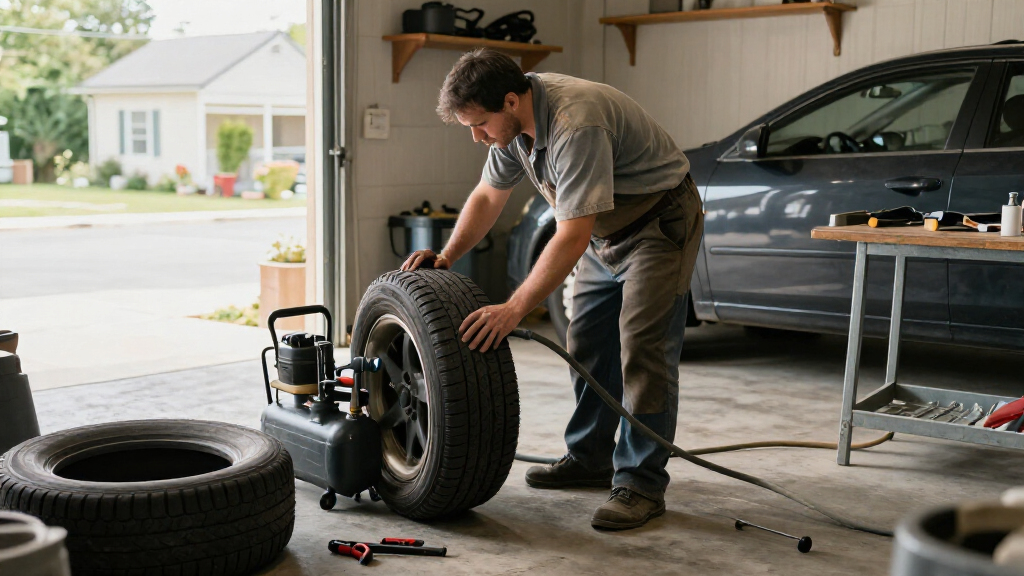
How We Picked
I ranked these garage air compressors by how well their stated specifications match common garage jobs, from tire inflation and brad nailing to impact tools and longer workshop sessions. Air delivery at a stated pressure mattered more than horsepower or tank size on its own, because a large tank cannot make up for insufficient sustained airflow. I also weighed noise, portability, power requirements, oil-free operation, and practical details such as included hoses or accessories.
The order favors useful capability with manageable ownership demands, not the largest number on a spec sheet. The VEVOR 13-gallon model ranks first for its listed airflow and noise combination; the quiet-focused California Air Tools and high-capacity Campbell Hausfeld earn distinct roles for buyers with different priorities. Compact units rank lower for general-purpose use because their smaller tanks limit longer jobs, while the 60-gallon compressor ranks lower for typical home garages because its 230V requirement and stationary format narrow its audience. Where the supplied specifications do not state a feature, I avoid treating it as a proven advantage.
Factors to Consider When Choosing Garage Air Compressors
Before choosing a compressor, I’d work backward from the tools and the space rather than starting with tank size. These checks help separate a convenient home-garage unit from a compressor that will struggle during longer sessions or demand more installation work than expected.
Match Delivered Airflow to Your Tools
Check each tool’s air consumption in CFM at its required PSI, then compare it with the compressor’s delivered airflow at the same pressure. A compressor’s peak PSI does not tell you how long it can keep a tool running, and horsepower figures are not a substitute for an airflow rating. For occasional tire inflation or short bursts with a nailer, modest output may be enough. Sanding, spraying, and sustained impact-wrench use can place a much heavier continuous demand on the pump. If several tools will run at once, add their airflow needs and leave a margin rather than choosing a unit that only matches the total on paper.
Treat Tank Capacity as a Buffer, Not a Performance Rating
A larger tank stores more compressed air, which can support short bursts and reduce how often the motor starts. It does not make a low-output compressor suitable for continuous air use; once the stored air is depleted, pump recovery becomes the limiting factor. Small tanks are easier to store and move, but frequent cycling can interrupt longer jobs. Decide whether your work consists mainly of quick tasks or repeated, extended tool use before paying for more capacity. For a garage with mixed jobs, consider both tank volume and the compressor’s CFM at working pressure.
Check Electrical Supply Before Choosing a Large Unit
Confirm the voltage and circuit requirements against the outlet and wiring available in your garage. A 230V stationary compressor can make sense in a dedicated workshop, but it may require electrical work that a standard 120V portable model does not. Also check the manufacturer’s requirements for circuit capacity, extension cords, and startup load; a compressor that trips a breaker is not a useful upgrade. If you rent, share a garage, or expect to move the unit, power and installation constraints may matter more than extra capacity. Plan where the compressor will sit and how air lines will reach the work area before selecting a fixed model.
Balance Noise Against Location and Work Hours
Noise ratings can help compare models, but the measurement conditions may differ, so treat close numbers as a rough guide rather than a direct promise of equal sound in your garage. A quieter compressor is especially useful in an attached garage, a shared building, or a space where others are nearby. Placement also changes what you hear: hard walls can reflect sound, while a longer air hose may let you keep the compressor farther from the workbench. Check the manual for required clearances and ventilation before placing a unit in an enclosure. If low noise is a priority, compare sound claims alongside airflow and tank capacity so quiet operation does not come at the cost of the performance your tools need.
Choose Portability and Layout for Your Actual Garage
Think about where the compressor will live, how often it needs to move, and whether you can spare floor or wall space. Pancake and small portable models suit tight garages and occasional jobs, while vertical tanks can use floor area more efficiently than wide horizontal designs. A wall-mounted compressor keeps the tank off the floor, but its location is less flexible and installation must suit the wall and hose reach. Check the unit’s dimensions, weight, handle and wheel arrangement, and the location of its outlets. A useful accessory kit can help with basic inflation tasks, but it should not outweigh a mismatch between the compressor’s output and your main air tools.
Account for Maintenance and Duty Cycle
Oil-free pumps can reduce routine lubrication work, but they still need care; tank condensate must be drained and intake filters or fittings may need attention. Oil-lubricated models add oil checks and changes, which may be worthwhile for buyers who prioritize a particular pump design or workshop use. Look up the recommended duty cycle and rest periods before planning long sessions, since continuous operation can shorten equipment life or trigger overheating. Consider whether drain valves are accessible and whether the unit’s manual gives clear maintenance instructions. The best fit is not simply the compressor with the least upkeep, but the one whose maintenance and operating limits match how often you use it.
Frequently Asked Questions
Can a 6-gallon or 8-gallon compressor run an impact wrench?
It depends on the wrench’s air consumption, the compressor’s delivered CFM at the required PSI, and how long you need to use it. A smaller tank may provide enough stored air for short bursts, but it can run low quickly during repeated lug-nut work. Compare the tool’s specifications with the compressor’s output rather than relying on the tank size or maximum PSI alone. If you use an impact wrench frequently, a larger-output compressor is more likely to keep interruptions manageable. For occasional use, a compact unit may still be adequate when you allow recovery time between bursts.
Is a 66 dB compressor quiet enough for an attached garage?
A listed 66 dB rating is a useful point of comparison, but it does not guarantee that a compressor will sound quiet in every garage. Distance, wall surfaces, vibration, and the measurement method all affect perceived noise. In an attached garage, look for a low-noise design and plan to place the compressor away from living areas where its installation and hose layout allow. Hearing protection may still be appropriate during nearby work, especially for long sessions. If noise is a firm constraint, compare the manufacturer’s rating and operating guidance rather than assuming that two models with similar numbers sound identical.
Should I choose the 60-gallon 230V compressor for a home garage?
Choose a large stationary compressor only if your work calls for sustained airflow and your garage can support its electrical and installation requirements. The Campbell Hausfeld two-stage model is a more natural match for a dedicated workshop than for occasional inflation or light fastening. Check whether 230V service is already available and whether the floor space, ventilation, and mounting location suit the unit. If you mainly use portable tools for short jobs, a smaller 120V compressor will often be easier to place and use. The larger model earns its place when your workload—not the tank size alone—justifies the commitment.
Does an oil-free compressor still need regular maintenance?
Yes. Oil-free describes the pump’s lubrication arrangement, not a maintenance-free compressor. You generally still need to drain moisture from the tank, keep the intake clean, inspect hoses and fittings, and follow the manufacturer’s service schedule. Leaving condensate in a steel tank can contribute to corrosion, so check how often the manual calls for draining it and whether the valve is easy to reach. Duty-cycle limits also matter; running a compressor beyond its intended workload can cause excess heat and wear. Read the care instructions before buying if you want low-fuss ownership.
What matters more for a spray gun: tank capacity or CFM?
For sustained spray-gun use, delivered CFM at the gun’s required pressure is usually the first specification to match, because the compressor must keep supplying air as you work. Tank capacity provides a reserve and can help the pump cycle less often, but it cannot compensate for insufficient output over a long spray session. Check the spray gun’s airflow requirements and compare them with the compressor’s stated CFM at the relevant PSI. Also account for the hose, regulator, and any other air tools sharing the line. If the compressor cannot meet demand, you may see pressure fall or need to pause for recovery.
Conclusion
For a flexible home-garage setup, my best overall pick is the VEVOR 13-gallon model, based on its listed 4.6 CFM at 90 PSI and 66 dB rating. The best value direction is a compact oil-free CRAFTSMAN or ECOMAX option when your work is limited to inflation and short bursts; choose between them by matching output, footprint, and included accessories to your needs. For a best premium, fixed-shop choice, the Campbell Hausfeld 60-gallon two-stage compressor is the fit for buyers with demanding workloads and compatible 230V power. Beginners with limited space should start with a small, straightforward portable model such as the CRAFTSMAN 2-gallon unit, while accepting its limits on sustained work. For a quieter garage, compare the California Air Tools 8010A with the 66 dB VEVOR and RyanTek models; for higher-capacity work without a stationary 60-gallon setup, consider the larger portable tanks and verify their airflow against your tools.