TL;DR

Get business pricing on garage and car supplies
- Business-only prices and quantity discounts
- Tax-exempt purchasing
- Multiple users, one account, clear invoices
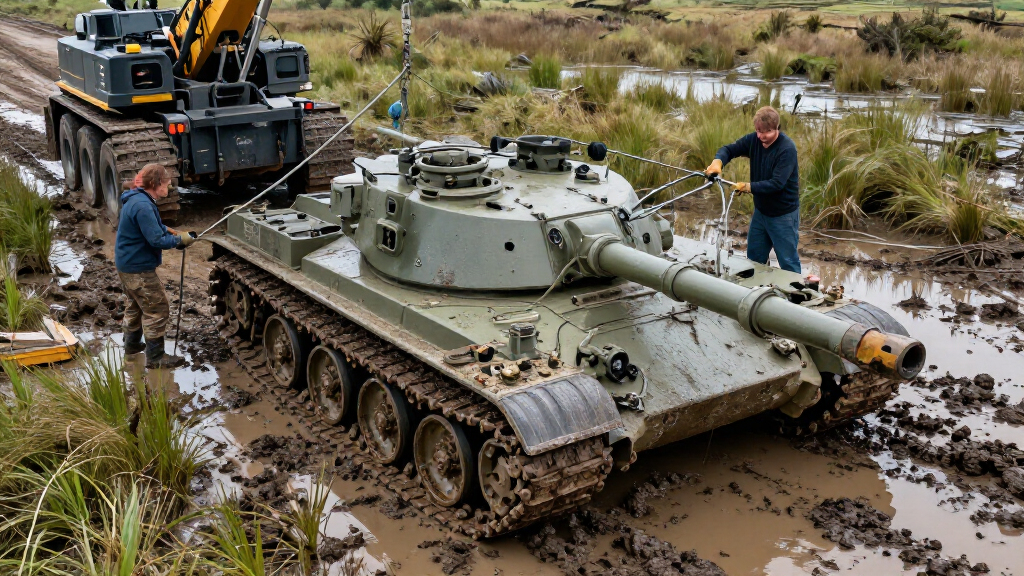
The Tank Museum and YouTube creator Joe Hewes recovered a derelict British Conqueror tank from a swampy former gunnery range. Because the roughly 65-ton vehicle had no tracks and its road wheels were sunk into the ground, the Ministry of Defence required tracks to be fitted before it could be moved. Two Foden recovery trucks lifted it, and an Oshkosh M1070 winched it onto a trailer.
The Tank Museum and YouTube creator Joe Hewes recovered a derelict British Conqueror tank from a swampy former Ministry of Defence gunnery range, a job complicated by the vehicle’s missing tracks and the possibility of unexploded ammunition nearby. The recovery team had to refit tracks before moving the tank, which weighed about 65 tons when new, according to The Drive’s report.
The Conqueror was being used as a source of parts for a Tank Museum restoration. The museum’s vehicle was missing its turret and main gun, and replacements were available on the abandoned range vehicle, which had been used for target practice. The donor tank had also lost its engine and transmission, but it remained extremely heavy and had been left in place for decades.
Its missing tracks made a direct tow risky. The tank was resting on its road wheels, which were partly sunk into the earth. Tracks spread a tank’s weight across a larger area; without them, the vehicle could have dug further into the soft ground during a pull. The Drive reported that the Ministry of Defence would permit the recovery only after tracks were reinstalled, given the site’s potential unexploded mines and artillery shells.
Hewes brought in two former British Army Foden heavy recovery trucks to lift the Conqueror clear of the ground so the tracks could be fitted. Afterward, a U.S. military Oshkosh M1070 transporter winched the tank onto its tracks and hauled it away on a trailer. The account and video were published by The Drive, which credited footage to Hewes’s YouTube channel.
A Rare Tank Returns to Restoration
The recovery matters because the Conqueror is a rare part of British postwar tank history, and the parts on this range vehicle are intended for a museum restoration. The Drive describes the design as a link between the Centurion and Chieftain, helping explain the development of British tanks during the early Cold War.
The operation also shows that moving heavy military machinery from a former range is not simply a matter of bringing in a powerful tow vehicle. The team had to address the tank’s weight, its buried road wheels, and the hazards associated with a live-fire training area. Reinstalling tracks was a safety and ground-pressure requirement, not just a convenience.
Products Worth Considering

Chemical Guys 14-Piece Arsenal Builder Car Wash Kit with Foam Blaster

DEWALT 20V MAX XR Cordless 1/2-Inch Impact Wrench Kit (DCF900P1)

Meguiar's G55048 Ultimate Car Care Kit
As an affiliate, we earn on qualifying purchases.
Why the Conqueror Was Built
After World War II, NATO countries considered heavier tanks in response to Soviet vehicles such as the IS-3. The United States developed the M103, while Britain designed the Conqueror as a larger companion to the Centurion. The Drive reports that the Conqueror’s size and other drawbacks limited its success, as later technology supported more versatile tank designs such as the Chieftain.
The museum project uses the abandoned Conqueror as a donor for a vehicle missing its turret and gun. The report does not identify the exact number of surviving Conquerors or provide a date for the recovery. It says only that relatively few were built and fewer remain.
“The only way the Ministry of Defence would allow the recovery to proceed was by reinstalling the tracks.”
— The Drive, reporting on the Ministry of Defence’s recovery condition
Recovery Details Still Unreported
The source account does not state when the recovery took place, how long the operation lasted, or the tank’s condition after it reached the museum or another destination. It also does not specify whether the recovered turret and gun have already been fitted to the museum’s Conqueror.
The report describes unexploded ordnance as a potential hazard at the range, but does not say that any explosives were found during this operation or detail the site’s clearance procedures. The exact weight of the donor vehicle at the time of recovery is also not given; about 65 tons refers to the tank’s weight when new.
Museum Restoration Remains the Goal
The stated purpose of the recovery was to obtain the turret and main gun for the Tank Museum’s Conqueror restoration. The next practical milestone is whether those parts can be installed and how the museum will present the completed vehicle. The source does not give a restoration schedule or announce a display date.
Further information may come from the museum or Hewes’s video documentation. Until then, the confirmed outcome is that the donor tank was lifted, fitted with tracks, and moved from the range on a trailer; the museum’s restoration timeline remains unreported.
Key Questions
Why did the tank need tracks before it could be moved?
The Conqueror’s road wheels were sunk into soft ground. Tracks spread the vehicle’s weight over a wider area, reducing the chance that a tow would pull it deeper into the earth. The Drive reported that the Ministry of Defence required tracks to be reinstalled before the recovery.
How was the Conqueror lifted and transported?
Two former British Army Foden recovery trucks lifted it so the tracks could be fitted. An Oshkosh M1070 then winched it onto the tracks and hauled it away on a trailer.
Why was the tank being recovered?
The derelict Conqueror had a turret and main gun that could serve as replacements for a Tank Museum vehicle being restored. The museum’s tank was missing those components.
Was unexploded ammunition found during the operation?
The report says the former gunnery range could contain unexploded mines and artillery shells, but it does not report that any were found during the recovery.
When will the restored tank be completed?
No completion date is provided in the report. It does not confirm when the donor parts will be fitted or when the museum’s restored Conqueror will go on display.
Source: thedrive.com